

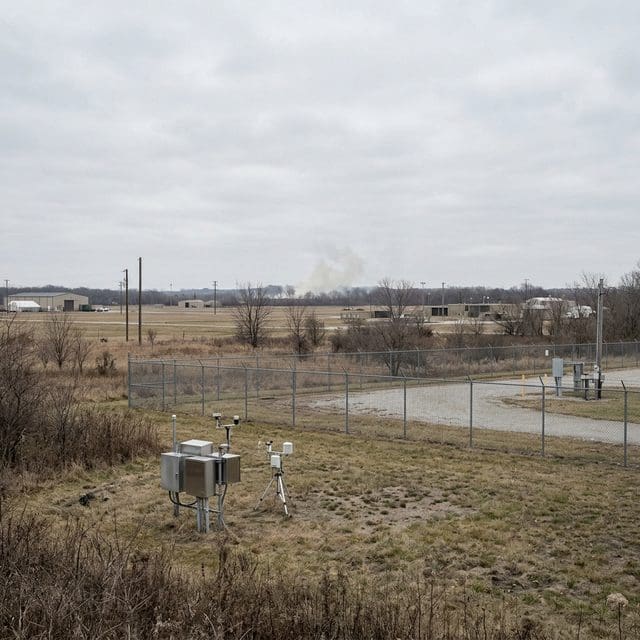
The Army destroyed 68 barrels of unstable lead azide at an Iowa ammunition plant, while early EPA air readings showed no detectable airborne lead and soil and water checks remain underway.
The U.S. Army destroyed 68 barrels of unstable lead azide at the Iowa Army Ammunition Plant on Wednesday, completing an operation officials said was necessary because the degraded explosive could not safely be moved or neutralized. Early air-monitoring results were favorable, but the question of longer-term contamination remains open as federal and state assessments continue.
The detonation occurred at about 9 a.m. CST on Nov. 25. Reports described two blasts, and officials said the operation was complete. The Army called the outcome a success, according to The Guardian’s coverage of the event. The stated immediate objective was to eliminate the danger of spontaneous explosions from the unstable material.
EPA monitors recorded “0.0” airborne-lead readings across the monitored region roughly one to two hours after the blast, CNN and other outlets reported. Missouri Gov. Mike Kehoe said initial analysis indicated mitigation measures had worked and the explosion was well-contained. Those early readings are reassuring about airborne lead at the times and locations monitored. They do not, by themselves, establish whether residue reached nearby soil, water, surfaces or property.
The Army and EPA are continuing air, soil, surface-water and surface-wipe sampling. Officials have said monitoring will continue until the environment is confirmed safe. Results from those checks will help determine whether localized cleanup is necessary. The available reporting does not yet provide completed results for those environmental pathways or a final determination about cleanup.
That distinction matters in practical terms. Air monitors can provide an early indication of airborne material after a blast, while soil and water sampling can help assess whether contamination settled or entered other parts of the environment. Surface wipes can check for residue on exposed surfaces. A zero reading in the initial air tests is not a substitute for those separate assessments, and the current information does not establish that contamination occurred in any of them.
The operation followed schedule changes and litigation. After a court challenge and an administrative stay, a federal appeals court ultimately allowed the Army to proceed. The Army invoked emergency authority, arguing the deteriorated lead azide could not safely be transported or neutralized by other means. The legal dispute underscored the difficulty of balancing immediate explosive hazards against the environmental risks of destroying hazardous material in place.
The Army’s decision addressed the danger posed by the unstable barrels; the continuing monitoring is the test of what the operation left behind. EPA has a role in evaluating environmental conditions, while Army sampling and follow-up remain part of the response. Officials have not yet reported a completed set of results that would support a final judgment about the effectiveness of the safeguards across air, soil, water and surfaces.
For nearby residents, the relevant next update is not simply another assurance that the blast was controlled. It is the release of the sampling results, including whether any localized findings require cleanup and how officials will respond. The sources provided do not establish an impact on drinking water, crops, livestock or food, and it would be premature to infer one from the fact that lead azide was destroyed.
Lead exposure is a public-health concern, so careful follow-through matters even when initial readings are favorable. The documented picture so far is limited but clear: the barrels were destroyed, initial airborne-lead readings were reported as zero, and environmental monitoring remains active. Whether the operation left contamination that needs attention will depend on the pending soil, water and surface findings—not on the successful disposal of the explosive material alone.

Eric Nolan serves as the Senior Correspondent for Food, Water, and Environmental Health at Just Right News, where he brings a principled, common-sense perspective to the most fundamental issues facing the American public. With a career dedicated to uncovering the truth behind the policies that govern our natural resources, Eric has become a trusted voice for readers who value traditional stewardship over bureaucratic overreach. His reporting is defined by a commitment to the idea that true environmentalism is rooted in the protection of the American family and the preservation of the nation’s agricultural heritage.
Raised in Fresno, California, Eric’s worldview was shaped in the heart of the San Joaquin Valley. Growing up in one of the world’s most productive agricultural hubs, he witnessed firsthand the vital connection between the land, the water, and the dinner table. In Fresno, he saw the resilience of farmers and the devastating impact that distant, top-down regulations can have on local communities. This upbringing instilled in him a deep respect for the producers who feed the country and a lifelong skepticism toward the alarmist narratives often pushed by mainstream media. For Eric, environmental health is not an abstract political talking point; it is a matter of ensuring that the people who work the land have the freedom and the resources to do so effectively.
Now based in Eugene, Oregon, Eric operates from a unique vantage point in the Pacific Northwest. Living in a region often defined by intense environmental debate, he provides a necessary counter-narrative to the prevailing trends of the area. From his base in Eugene, he monitors the shifting tides of federal and state policies, ensuring that the voices of rural citizens and property owners are not drowned out by urban activism. His reporting often bridges the gap between the rugged realities of the outdoors and the legislative halls where decisions are made, offering a grounded perspective that prioritizes local sovereignty and practical solutions.
As the lead for the acclaimed feature series “Earth on the Table,” Eric explores the intricate journey of the American food supply. He tackles critical issues such as water rights, soil health, and food security through a lens of national stability and individual liberty. He believes that a healthy environment and a thriving economy are not mutually exclusive, but rather two sides of the same coin of national prosperity. His work consistently highlights how innovation and private-sector ingenuity are the most effective tools for ensuring clean water and a safe food supply, rather than the expansion of the administrative state.
At Just Right News, Eric’s reporting serves as a vital resource for those who seek accountability and transparency. Whether he is investigating the impact of federal land management on local economies or examining the safety of the national food infrastructure, his work remains anchored in the values of heritage and hard work. Eric Nolan continues to be a leading voice in environmental journalism, championing the belief that the best way to protect our natural resources is to empower the people who live and work closest to them.