

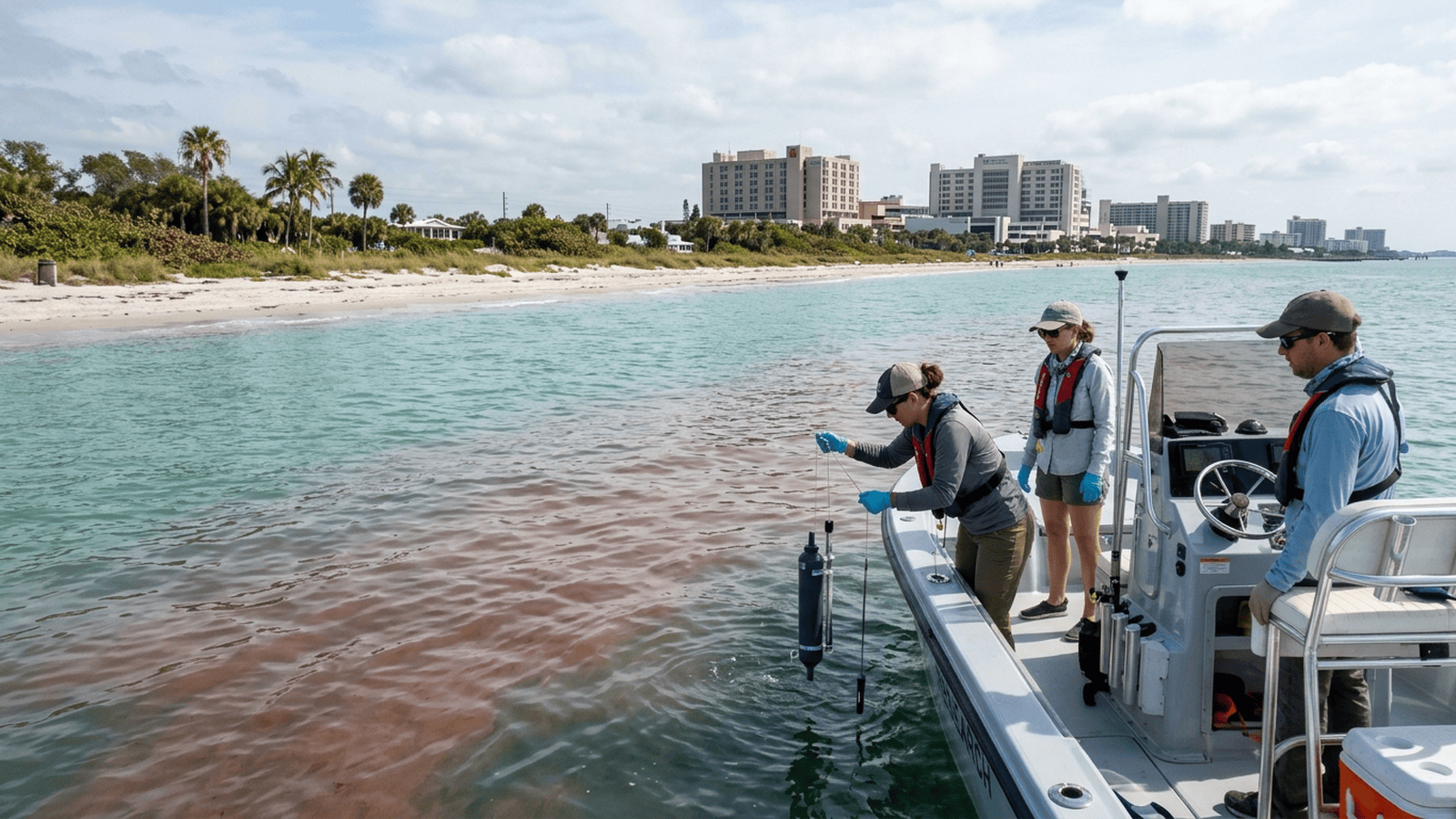
A study in Sarasota County found that stronger Florida red tide conditions were associated with more emergency department visits for respiratory problems. The findings connect a naturally occurring Gulf of Mexico algal bloom with community health, while leaving open questions about individual exposure and cause.
TLDR: Researchers comparing Sarasota County hospital records with Florida red tide conditions found that stronger blooms were associated with more respiratory-related emergency visits. The study does not prove that blooms caused individual cases, but it supports closer coordination between ocean monitoring, hospitals and public health agencies.
A harmful algal bloom off Florida’s Gulf Coast can affect more than the water and wildlife. Research examining red tide conditions in Sarasota County found that days with higher concentrations of the toxin-producing algae Karenia brevis were associated with more emergency department visits for respiratory problems. The findings connect an oceanographic event to a measurable health burden on shore.
The study, published in the journal Environmental Health Perspectives, analyzed daily emergency visits and records of red tide conditions in Sarasota County. Researchers compared the timing and location of hospital visits with measurements of K. brevis in coastal waters. Their approach allowed the team to look for patterns in real-world health records rather than relying only on controlled exposure experiments.
K. brevis is a microscopic marine organism that occurs naturally in the Gulf of Mexico. Under favorable conditions, its populations can grow into blooms commonly called Florida red tide. The algae produce brevetoxins, which can harm marine animals and, when carried into sea spray, irritate people’s airways. Wind and waves can transport toxin-containing particles toward beaches and nearby communities.
The researchers reported an association between red tide exposure and respiratory-related emergency visits, including visits for asthma and other breathing difficulties. The relationship was most evident during periods when bloom conditions were stronger. People with asthma or other existing respiratory disease may be particularly vulnerable, although exposure can also cause irritation in people without a diagnosed lung condition.
A hospital record does not identify the exact cause of an individual patient’s symptoms. The study therefore cannot show that a particular bloom directly caused each visit. Instead, its value lies in comparing population-level patterns over time and finding that respiratory visits rose in step with indicators of bloom exposure. Other factors, including weather, seasonal illness and changes in outdoor activity, can also affect emergency department numbers.
The work illustrates why red tide is not simply a marine biology concern. Blooms can kill fish, disrupt coastal economies and prompt beach warnings, while airborne toxins create a pathway from ocean conditions to human health. Linking environmental monitoring with hospital data gives public health officials another way to assess those effects and identify periods when communities may face elevated risks.
The quality of exposure estimates remains an important limitation. Algal concentrations measured at a monitoring site may not match what a person breathed at home, at work or on a beach. Wind direction, distance from the shoreline and time spent outdoors can all change exposure. Emergency records also capture only the people who seek hospital care, not milder symptoms managed at home or in a clinic.
Even with those limits, the findings support coordination between coastal monitoring programs, hospitals and local health agencies. If a bloom intensifies, timely information about its location and airborne effects could help clinicians prepare for increases in breathing complaints and help people with asthma follow medical advice about reducing exposure. Such information is most useful when it is specific to local conditions rather than based on a single regional alert.
Further research can refine the connection by combining frequent water sampling with measurements of airborne brevetoxins, weather data and more detailed records of patients’ locations and diagnoses. Studies across multiple Gulf communities could show whether the pattern holds in different settings and which groups face the greatest risk. Better forecasting would not prevent naturally occurring blooms, but it could give health services and residents more time to respond.

Susan Carter serves as a Senior Correspondent for Just Right News, where she leads the network’s comprehensive coverage of Health, Medicine, and Public Policy. With a career dedicated to dissecting the complexities of the American healthcare system, Susan brings a principled perspective to the most pressing debates of the day. Her reporting is characterized by a commitment to individual liberty, fiscal responsibility, and a healthy skepticism of government overreach, making her a vital voice for audiences seeking clarity in an increasingly regulated landscape.
Raised in Minneapolis, Minnesota, Susan’s professional outlook is deeply informed by the values of the American heartland. Growing up in the Twin Cities, she witnessed firsthand the importance of community-driven solutions and the resilience of the individual. This Midwestern foundation instilled in her a firm belief that the best answers to public policy challenges often come from local innovation and personal responsibility rather than top-down federal mandates. Her background allows her to translate complex legislative jargon into stories that resonate with families who value common sense and local autonomy.
Now based in Baltimore, Maryland, Susan operates from a unique vantage point at the intersection of medical innovation and urban policy. Living and working in a city renowned for its world-class medical institutions and significant public health challenges, she has a front-row seat to the realities of the modern healthcare landscape. Her proximity to these hubs of research and policy allows her to scrutinize how government intervention affects the quality of care and the freedom of medical professionals. In Baltimore, she sees the tangible results of policy decisions, using the city as a lens through which to examine the broader national health debate and the impact of federal spending on local communities.
As the lead for the acclaimed feature series “The Cost of Care,” Susan dives deep into the economic realities facing patients and providers alike. Her work focuses on the necessity of price transparency, the benefits of market competition, and the preservation of the sacred doctor-patient relationship. She is a staunch advocate for the idea that a well-informed public is the best defense against bureaucratic inefficiency. Through this series, she has exposed the hidden drivers of rising medical expenses, always seeking to empower the individual consumer over the massive institution.
Susan’s reporting on public policy is characterized by a commitment to rigorous inquiry and a focus on constitutional limits. Whether she is analyzing new pharmaceutical regulations, investigating the impact of federal health mandates, or exploring the future of medical technology, her goal remains the same: to provide Just Right News audiences with the facts they need to navigate a complex world. By blending her Midwestern sensibilities with the insights gained from her base in Maryland, Susan Carter has become a trusted authority for those who believe that personal freedom and public health are inextricably linked. Her work continues to challenge the status quo, advocating for a system that respects the taxpayer and prioritizes the patient.