

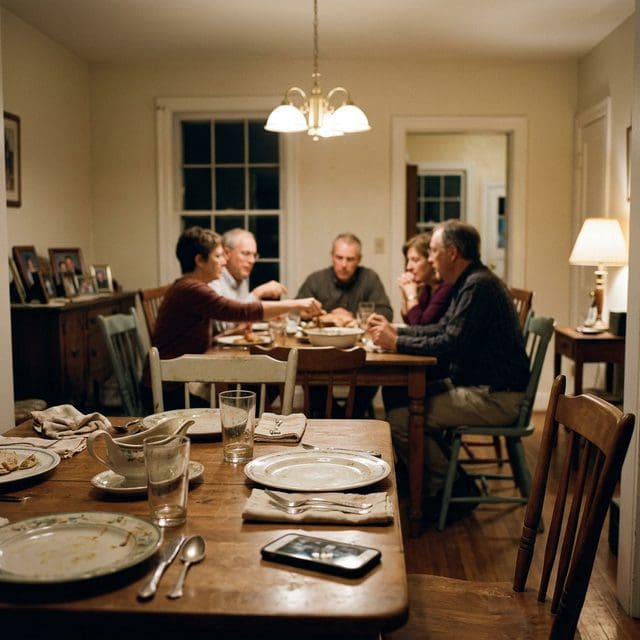
A New York Times holiday report describes one person preparing to avoid artificial intelligence at Thanksgiving, a small detail that captures how a fast-moving technology can enter family life before anyone agrees on what it means.
At a Thanksgiving table, some subjects arrive before the food does. This year, artificial intelligence may be one of them.
The New York Times reported on Nov. 25 that its Thanksgiving coverage was examining families’ conversations about AI. One person planned to avoid the subject, anticipating that relatives would raise it. The available account does not identify the person or explain what their relatives think about the technology. It gives no details beyond the intention to steer clear.
That small fact is the story’s human center: someone expects a technology debate to surface at dinner and would rather not take part. The reasons remain unknown. The person could be tired of arguments, uncertain about AI, or simply hoping for a holiday without another complicated topic. The report does not say, and those possibilities should not be mistaken for facts.
The Times placed the conversation within its Thanksgiving coverage of families discussing artificial-intelligence fears. The available material does not say which fears the person anticipated hearing, whether the family had discussed AI before, or whether anyone had tried to change the subject. It provides a scene in outline, not a full family portrait. Still, that outline shows the technology has become a possible topic of ordinary conversation.
Public discussion of AI often arrives in sweeping terms: promises of greater efficiency, warnings about lost jobs, and questions about privacy and the power of technology companies. At home, those questions do not necessarily come with shared facts or a common vocabulary. They may arrive as a relative’s story, a worry about work, or a question nobody at the table feels prepared to answer.
The Times report does not establish how common such conversations are or whether families are arguing more about AI. The available material includes no survey figures and no account of how the dinner conversation ultimately went. One person’s plan is not proof of a national trend. It is a limited glimpse of how people encounter a consequential technology not only through headlines and workplace decisions, but through relationships.
That adjustment can be difficult because the questions are unsettled. AI systems are developed and deployed by private companies, while public institutions and communities weigh what rules should govern them. Families may feel the effects without much say over decisions made elsewhere. Conversation remains one place where people can compare experiences, question confident claims and decide what they want to accept. A holiday table cannot settle questions of regulation or responsibility, but it can reveal that relatives approach them from different experiences and with different levels of comfort.
Avoiding the subject may be a sensible choice for one holiday. No family is obliged to turn dinner into a policy forum. But the expectation that AI will come up suggests how quickly a distant debate can become personal. Questions about technology can also be questions about trust: who should control it, who bears the risks, and whether ordinary people have a meaningful voice in its use.
The available report leaves the family’s particulars private. There is no name, hometown or account of a heated exchange to fill in. What it records is more modest: one person expected AI to be raised and intended not to discuss it. For a holiday built around gathering, that choice is a reminder that families are negotiating the meaning of new technology in their own ways—and sometimes deciding that, for one evening, silence is the easiest answer.

Ethan Blake serves as a Senior Correspondent for Just Right News, where he specializes in Longform Narrative and Public Understanding. In an era of rapid-fire headlines and fleeting soundbites, Ethan’s work stands as a testament to the power of deep-dive reporting and the importance of contextualizing the complex issues facing the nation today. His approach is rooted in the belief that the most profound truths are often found in the lived experiences of individuals rather than the abstract theories of distant policymakers.
Growing up in Providence, Rhode Island, Ethan developed an early appreciation for the historical and cultural threads that weave the American fabric together. Providence, a city defined by its industrial heritage and its blend of traditional neighborhoods, provided him with a front-row seat to the challenges and triumphs of the American working class. This upbringing instilled in him a respect for the “common sense” values of hard work, community loyalty, and the preservation of local institutions. He learned early on that behind every economic statistic or legislative debate, there are real families and neighborhoods navigating the consequences of change.
This foundational perspective is the driving force behind his signature feature series, “Lives Behind the Systems.” Through this series, Ethan explores the intersection of individual agency and institutional structure. Whether he is documenting the impact of federal land-use policies on rural families or examining how shifting educational standards affect local school boards, Ethan’s work prioritizes the human element. He seeks to uncover how large-scale systems—be they governmental, economic, or social—affect the daily lives of citizens, often advocating for a return to local control and personal responsibility.
Now based in Portland, Maine, Ethan draws significant inspiration from the rugged independence and self-reliance that define the region. The coastal landscape and the resilient spirit of Maine’s communities serve as a constant reminder of the importance of individual liberty and the strength found in decentralized power. Living and working outside the traditional media hubs allows Ethan to maintain a grounded perspective, ensuring his reporting remains untethered from the echo chambers of the major metropolitan centers. This geographic distance provides him with the clarity needed to translate complex national narratives into stories that resonate with the heart of the country.
At Just Right News, Ethan’s beat is more than just a professional assignment; it is a mission to foster a more informed and engaged citizenry. He believes that a free society depends on the public’s ability to understand the mechanisms of power and the value of traditional American principles. His longform narratives do not merely report the news; they provide a roadmap for understanding the cultural and political shifts of the modern era through a lens of skepticism toward centralized authority and a deep respect for the individual.
Through his meticulous research and narrative craftsmanship, Ethan Blake continues to bridge the gap between policy and the public. His work remains a vital resource for those who seek a deeper understanding of the systems that shape our world and the enduring spirit of the people who live within them.