

A proposed University of the West Indies training center and a new curated video service reflect different efforts to build practical skills and give families more control over children’s media.
Two education ventures announced Tuesday take different routes toward a common challenge: giving learners useful experiences beyond the traditional classroom. In Jamaica, a proposed university-based center would train people in drones, robotics and automation. In the United States, Hank Green’s new video platform aims to offer families a more deliberately curated alternative to open-ended online viewing.
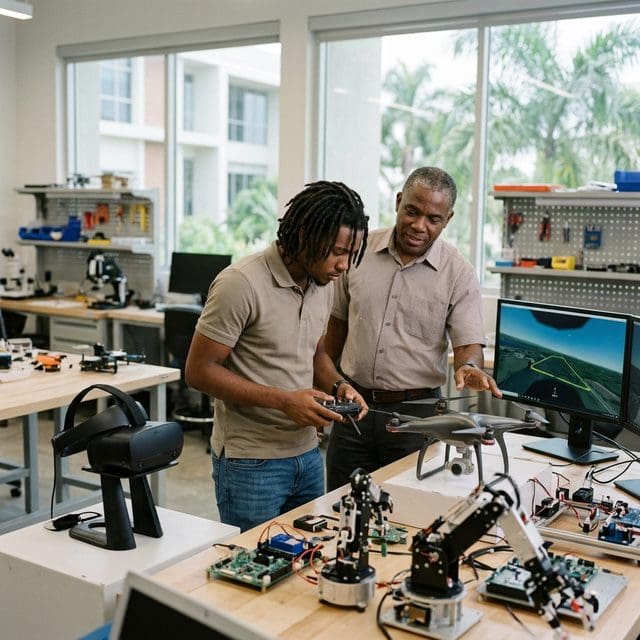
AIBotics and NovaCore Labs plan to establish the training center at the UWIVERSE Centre on the University of the West Indies’ Mona campus in Kingston. The proposal combines virtual reality, advanced simulation and hands-on instruction. Construction is targeted for the first quarter of 2027, according to a Nov. 17 GlobeNewswire announcement.
The planned curriculum spans commercial drone operations, robotics, autonomous systems, intelligent automation, workplace safety, hazard recognition and vehicle operations. The announcement lists potential drone applications in agriculture, infrastructure inspection, mapping, emergency response, national security and border protection. The range suggests a program intended to serve several sectors, from public safety to commercial operations.
The practical focus is promising, but a proposed facility is not yet evidence of employment outcomes. The announcement did not provide enrollment targets, tuition costs, credentials, employer commitments or job-placement figures. Those details will matter to students weighing the cost and value of training, and to employers deciding whether graduates will be ready to contribute. Simulations and equipment can help learners practice procedures before entering real workplaces; the test will be whether the skills taught match local demand and lead to recognized qualifications or jobs.
NovaCore Labs is also discussing potential hospitality pilots with the University of Technology, Jamaica. The proposal would involve autonomous cleaning and food-service robots, giving students practical experience while hospitality operators test the systems. The discussions are not a confirmed program. Still, the model could let students and businesses evaluate new technology together instead of limiting automation training to classroom instruction. For operators, a pilot could offer a chance to see how equipment performs before making adoption decisions.
ClockwiseTV, meanwhile, is opening publicly Tuesday through iOS and Android apps after a few hundred parents tested it in beta, TechCrunch reported. Green and CEO Leslie Morgan are targeting children ages 8 to 12 with an ad-free subscription service. Parents pay $6.99 a month or $69.99 a year. Creators receive an upfront fee plus 25% of revenue based on watch time.
The company says every uploaded video is manually reviewed and edited, with human review occurring at least four times before publication. Recommendations are time-bounded, and ClockwiseTV does not plan to use AI to sanitize content. Green is funding the service without outside investment, TechCrunch reported.
That approach makes editorial judgment central to the product, rather than relying on automated filtering after material has been uploaded. The subscription also means families must decide whether the curation is worth paying for. ClockwiseTV is a video service, not a school or a substitute for instruction, and its launch does not establish learning gains. Its value will depend on whether families find the selection useful and creators can build a sustainable audience under the payment model.
The Jamaican proposal and the video platform are at different stages and serve different needs. One is a planned workforce-training facility connecting university instruction with industry applications; the other is a newly launched, privately funded service for families. Both will be judged by results, not announcements: whether students gain skills employers recognize, and whether parents consider the content worth the cost.

Daniel Owens serves as a Senior Correspondent for Just Right News, where he leads the newsroom’s coverage of Education, Workforce, and Upward Mobility. In an era where the national conversation often overlooks the practical foundations of success, Owens brings a principled perspective to the forefront of the media landscape. His work is defined by a commitment to the idea that a strong society is built on the pillars of quality education, a robust work ethic, and the removal of bureaucratic barriers to individual achievement.
Born and raised in Cleveland, Ohio, Owens’s worldview was shaped by the industrial landscape of the Midwest. Growing up in a city known for its grit and resilience, he witnessed firsthand the transformative power of steady employment and the devastating effects of economic stagnation. This background instilled in him a deep respect for the American worker and a healthy skepticism toward top-down government solutions that often fail to reach the communities they intend to help. As an African American man who has navigated the path to professional success, Owens approaches his beat with a nuanced understanding of how meritocracy and personal responsibility intersect with opportunity. He frequently draws on his roots to highlight the importance of family stability and community-led initiatives in fostering the next generation of leaders.
At Just Right News, Owens is the architect of the acclaimed feature series, “The Learning Curve.” Through this platform, he explores the evolving landscape of American schooling, from the rise of the school choice movement to the revitalization of trade schools and vocational training. He frequently challenges the status quo of higher education, advocating for a return to academic rigor and the practical alignment of degrees with market demands. For Owens, education is not merely about obtaining credentials; it is about equipping young people with the tools necessary to lead self-sufficient, meaningful lives. His reporting on “The Learning Curve” has become essential reading for parents and policymakers who believe that educational competition and parental rights are the keys to a brighter future.
Now based in Raleigh, North Carolina, Owens finds himself at the heart of one of the nation’s most dynamic regions for innovation and growth. Raleigh’s unique blend of traditional values and a fast-paced economy provides the perfect backdrop for his reporting on the modern workforce. From the tech hubs of the Research Triangle to the rural communities of the South, he tracks how shifts in the economy are impacting families and local industries. His reporting often highlights the success stories of entrepreneurs and workers who are thriving by embracing the values of hard work and innovation.
Throughout his career, Daniel Owens has remained a steadfast voice for the student seeking a better path and the worker striving for a better life. His reporting for Just Right News serves as a vital resource for readers who value common-sense solutions to the challenges of the 21st-century economy. By focusing on the intersection of policy and the human spirit, Owens continues to provide a roadmap for how individuals and communities can achieve lasting upward mobility.