

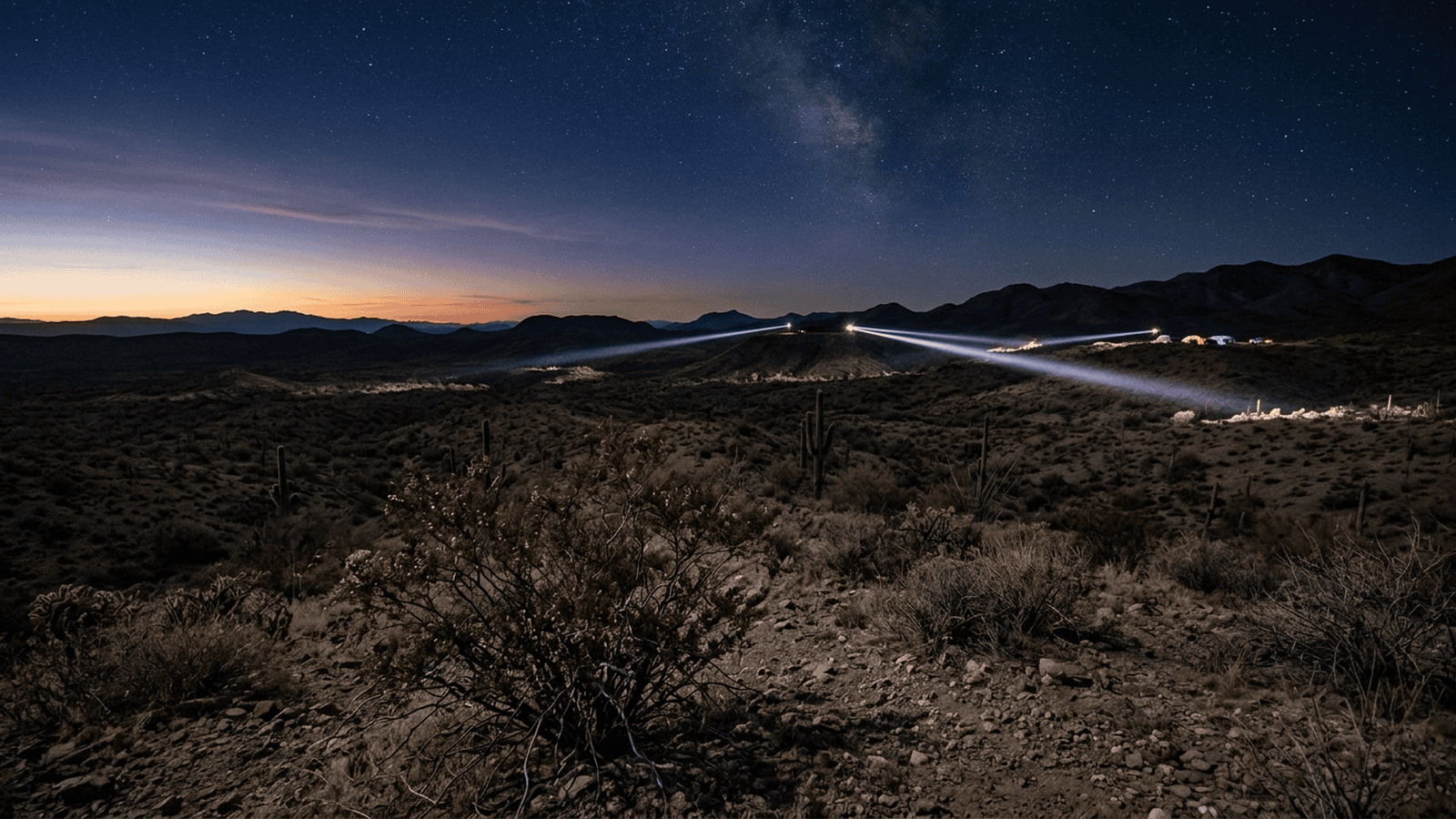
Two-year-old Vella Campillo was found safe after spending seven hours alone in the Arizona desert. Volunteer Jay Stewart located her beneath a bush about a mile and a half from her home, after searching on foot for three hours. More than 100 people joined the search, which also used drones and helicopters, but thermal equipment did not detect the small child. The sheriff’s office had appealed for public help after Campillo wandered from her yard outside Eloy shortly before sunset. She was cold but uninjured, and Sheriff Ross Teeple praised Stewart for finding her. The account describes no new policy, fees, forms, deadlines, or further official steps.
TLDR: A volunteer found two-year-old Vella Campillo beneath a bush after a seven-hour search in the Arizona desert. More than 100 people searched on foot, alongside drones and helicopters, and the toddler was found cold but uninjured.
A two-year-old girl who wandered from her yard outside Eloy, Arizona, was found safe after spending seven hours alone in the desert. Volunteer Jay Stewart spotted Vella Campillo curled beneath a bush just after midnight Wednesday. She was cold but uninjured, according to the account provided by authorities.
The search began after Campillo left her yard shortly before sunset Tuesday. She was wearing only a diaper. The Pinal County sheriff’s office asked the public for help, and Stewart responded to that appeal. The hours between her disappearance and discovery stretched into the night, as searchers faced difficult terrain and falling temperatures.
The sheriff’s office said remote areas can grow cold quickly, especially for a small child. That was the stated concern behind the search effort as the night went on. The office described a search for a missing child, using people on foot as well as drones and helicopters. The account does not describe a policy change or provide a broader official policy rationale.
More than 100 people took part in the search on foot, the sheriff’s office said. Sheriff Ross Teeple said searchers used drones and helicopters, along with other available resources. The effort covered difficult terrain as the hours passed and temperatures posed a growing concern. The search brought together volunteers and search personnel after the office’s public appeal.
Teeple said the drones’ heat-detection equipment could not pick up Campillo. He explained that a small child produces little heat and that remote areas can become extremely cold fast in winter. The equipment’s failure to detect her did not end the search or show that she was not in the area. People continued searching on the ground, where they could listen and look closely beneath bushes and other cover.
Stewart had been searching on foot for three hours when he found Campillo about a mile and a half from her house. He said he was calling her name when he heard a yell. He shined his flashlight toward a bush, and the child appeared. His account shows how the final discovery came through a searcher hearing her, rather than through the drones’ heat-detection equipment.
At a news conference, Stewart recalled the moment with emotion. He said finding the frightened child was something he would never forget. He picked her up, and she clung tightly to him. The account does not say how long he remained with her before she was taken from the search area, or provide further details about the reunion with her family.
Stewart tucked Campillo inside his jacket to keep her warm. The account says she was uninjured, though she was cold after spending the night outdoors. The search had lasted seven hours before the volunteer found her. The contrast between her condition and the cold surroundings underscored why authorities had described the weather as a concern for a child who was alone.
The recovery followed a public appeal from the sheriff’s office and a large response from volunteers and search personnel. More than 100 people joined the foot search, while drones and helicopters were also used. The case shows both the reach and the limits of the search tools described by authorities: the thermal equipment did not detect the toddler, but a person on foot heard her call. The account credits several kinds of search effort, while identifying Stewart as the person who located her.
Teeple praised Stewart in a video posted to the sheriff’s office’s Facebook page, calling him the girl’s hero after seeing body-camera footage. Stewart declined the label in his remarks and said helping was simply what people do. He also said he could not imagine what Campillo’s parents had experienced during the search. Their fear was not described in detail, but Stewart’s comment reflected the strain of waiting for a missing child to be found.
The practical details in the account are limited to the search itself: more than 100 people searched on foot, drones and helicopters were used, and Stewart had been searching for three hours before finding the child. Campillo had wandered from her yard in only a diaper and was found about a mile and a half away. No fees, paperwork, compliance rules, formal deadlines, or new requirements are described. The account also names no further search, enforcement, or oversight steps.
The immediate outcome is that Campillo was found safe and uninjured, and the sheriff’s office publicly recognized the volunteer’s role. The account provides no further official next steps or review schedule. It does not say whether authorities planned any additional action after the search ended. The successful recovery is documented, while any further follow-up remains unspecified.

Rachel Vaughn serves as a Senior Correspondent for Just Right News, where she leads the network’s coverage of Global Health, Climate, and Development. With a career defined by intellectual rigor and a commitment to principled reporting, Rachel provides a vital conservative perspective on some of the most complex and high-stakes issues facing the world today. Her work is characterized by a refusal to accept bureaucratic narratives at face value, focusing instead on how international policies impact national sovereignty, individual liberty, and the American taxpayer.
Raised in New Haven, Connecticut, Rachel grew up in an environment dominated by elite academic discourse. This upbringing provided her with a front-row seat to the inner workings of the American establishment, but it also instilled in her a healthy skepticism of the “ivory tower” consensus. She learned early on that while academic theories may sound promising in a lecture hall, they often fail to account for the practical realities of the working class. This background drives her to bridge the gap between high-level policy discussions and the common-sense concerns of everyday citizens, ensuring that her reporting remains grounded and accessible.
Now based in Burlington, Vermont, Rachel operates from a unique vantage point within one of the nation’s most progressive political landscapes. Living and working in a region that often serves as a testing ground for radical social and environmental experiments allows her to witness the real-world consequences of these policies firsthand. From her base in the Green Mountain State, she provides Just Right News readers with essential “boots on the ground” reporting, documenting the friction between local mandates and the constitutional freedoms of the individual. Her presence in Burlington ensures that her critiques of globalist agendas are informed by a direct understanding of how those ideologies manifest at the local level.
In her acclaimed feature series, “Planetary Stakes,” Rachel explores the intersection of international development and environmental stewardship. She rejects the alarmism often found in mainstream media, opting instead for a sober analysis of the economic and geopolitical costs of global climate agreements. Her reporting frequently highlights the importance of market-driven innovation and the role of American leadership in fostering global health without ceding authority to unelected international bodies. Through “Planetary Stakes,” she has become a leading voice for those who believe that true conservation and public health are best achieved through transparency, accountability, and the protection of private property rights.
Throughout her tenure at Just Right News, Rachel has distinguished herself as a journalist who is unafraid to ask difficult questions of global institutions. Whether she is investigating the influence of non-governmental organizations on domestic policy or analyzing the fiscal transparency of international health initiatives, her goal remains the same: to provide her audience with the facts necessary to navigate an increasingly interconnected world. Her blend of East Coast intellectual heritage and her current immersion in the political heart of the Northeast makes her an indispensable asset to the newsroom and a trusted source for readers seeking a principled, conservative take on the issues that define our era.