

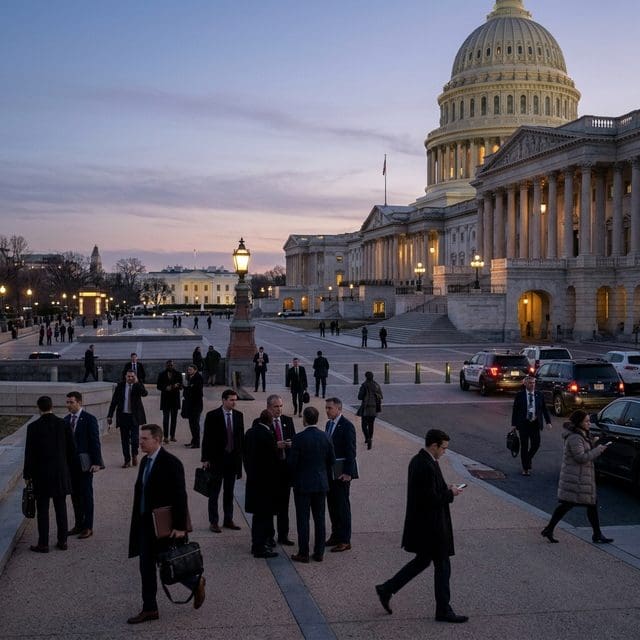
Democrats’ incoming control of Congress gives them leverage over defense funding and oversight, but it does not automatically end U.S. military action against Iran.
The midterm election has changed who controls Congress, but not who commands U.S. military operations. Democrats’ coming majorities in the House and Senate will give them new ways to contest President Donald Trump’s Iran policy, especially through defense spending and oversight. They cannot, by winning control of Congress, simply order the war to end.
That distinction matters for service members, federal workers and businesses watching the next budget fight. Congress can condition or withhold funds, require authorization for continued hostilities, investigate the administration and scrutinize nominations. But Trump retains veto power, and overriding a veto would require two-thirds support in both chambers. His room to conduct military operations remains broader than his ability to pass domestic legislation.
The political pressure is real. A Reuters/Ipsos poll reported by The Hill found that 71 percent of respondents supported legislation to end the Iran war. Vice President JD Vance has attributed Republicans’ midterm defeat partly to the conflict, inflation and cost-of-living pressures, as well as U.S. ties with Israel. Trump called Vance’s assessment “largely true” while continuing to defend the war.
The practical test arrives in budget negotiations. The Senate must authorize overall military and security spending for fiscal 2027 by December 11. Separately, the White House is seeking a $350 billion defense supplemental, a request Democrats and some Republican senators may oppose. Those negotiations could become an early test of whether lawmakers can translate election results into limits on the administration’s policy—or merely force a confrontation over funding.
Sen. Chris Coons is expected to take the chairmanship of the Senate Foreign Relations Committee and its military and national-security appropriations subcommittee on January 3, when the new Congress begins. That would put him near the center of both Iran oversight and funding talks. Before then, Coons has said Democrats may work with Republicans who are retiring or otherwise willing to break with the administration to block the supplemental, restore previously appropriated Ukraine funding and press for a change in Iran policy.
Reuters reports that Democrats could also attach restrictions on Iran hostilities to budget bills. Trump could veto such measures, raising the prospect of a shutdown. A prolonged impasse could leave troops unpaid, making the consequences tangible well beyond Washington. A funding restriction, if enacted, would constrain the administration through law; a political demand or committee investigation alone would not end military operations.
The election has not produced a settled policy on Iran. The House rejected an effort to impeach Defense Secretary Pete Hegseth over his handling of the war and other actions on November 10, while the United States is reducing staffing at four Middle East embassies after intelligence indicated Iran had substantially increased efforts to target U.S. personnel. Separately, Ukraine, Russia and the United States agreed to exchange prisoners in peace talks but made no breakthrough on ending that war.
For households and employers, the immediate stakes are less about a sudden change in tax or technology rules than about the economic and fiscal consequences of a prolonged conflict and a possible budget standoff. The available reporting does not establish a new tax, AI or technology measure tied to this political shift. Those policies will depend on future legislative proposals and negotiations, not on the election result alone.
The next markers are the December 11 fiscal 2027 spending deadline and the new Congress’s January 3 start. Until then, Trump remains in office with substantial operational authority; after Democrats take control, the contest will turn on appropriations, votes and the willingness of lawmakers to accept the costs of a shutdown. The election changed the balance of political leverage. It did not settle the war.

Olivia Kendall serves as the Senior Correspondent for Geopolitics, Defense, and Foreign Policy at Just Right News, where she provides a principled, conservative perspective on the complex forces shaping the global stage. With a career dedicated to deconstructing the intricacies of international relations, Kendall has become a trusted voice for readers who value national sovereignty, a robust military, and a foreign policy that prioritizes American interests above all else.
A native of Washington, D.C., Kendall’s professional journey is deeply rooted in her upbringing within the nation’s capital. Growing up in the epicenter of American political life, she developed an early and profound understanding of how policy is crafted and, more importantly, how it often fails to account for the values of the American heartland. This unique vantage point allowed her to witness firsthand the rise of globalist bureaucracies, fueling her commitment to reporting that champions the constitutional foundations of the United States. Her background as a British White American further informs her worldview, providing her with a keen appreciation for the Western tradition and the enduring importance of the “Special Relationship” in maintaining global stability.
Now based in Arlington, Virginia, Kendall operates from the doorstep of the Pentagon and the heart of the nation’s defense establishment. Her proximity to the decision-makers in the military and intelligence communities allows her to provide boots-on-the-ground reporting that is both timely and deeply informed. For Kendall, Arlington is more than just a base of operations; it is a daily reminder of the sacrifices made by the men and women in uniform. This connection to the defense community drives her rigorous coverage of military readiness and her advocacy for a “peace through strength” approach to diplomacy.
At Just Right News, Kendall is perhaps best known for her acclaimed feature series, “The World’s Shadow on America.” In this ongoing project, she explores the direct correlation between international developments and the daily lives of American citizens. Whether she is analyzing the encroachment of foreign adversaries in domestic supply chains or the impact of international treaties on local economies, Kendall’s work serves as a vital bridge between distant geopolitical shifts and their consequences at home. She rejects the notion that foreign policy is an abstract concern for elites, instead proving that what happens in the corridors of power in Brussels or Beijing has a tangible “shadow” that falls across every American doorstep.
Throughout her tenure, Kendall has remained a steadfast critic of international overreach and a vocal proponent of a clear-eyed, realistic foreign policy. She brings a sharp analytical mind to her beat, often challenging the prevailing narratives of the mainstream media to uncover the underlying truths that affect national security. Her reporting is characterized by a refusal to compromise on the truth and a dedication to the idea that a strong, secure America is the world’s best hope for liberty. As a Senior Correspondent, Olivia Kendall continues to lead the charge in providing the essential context and conservative insight necessary to navigate an increasingly volatile world.