

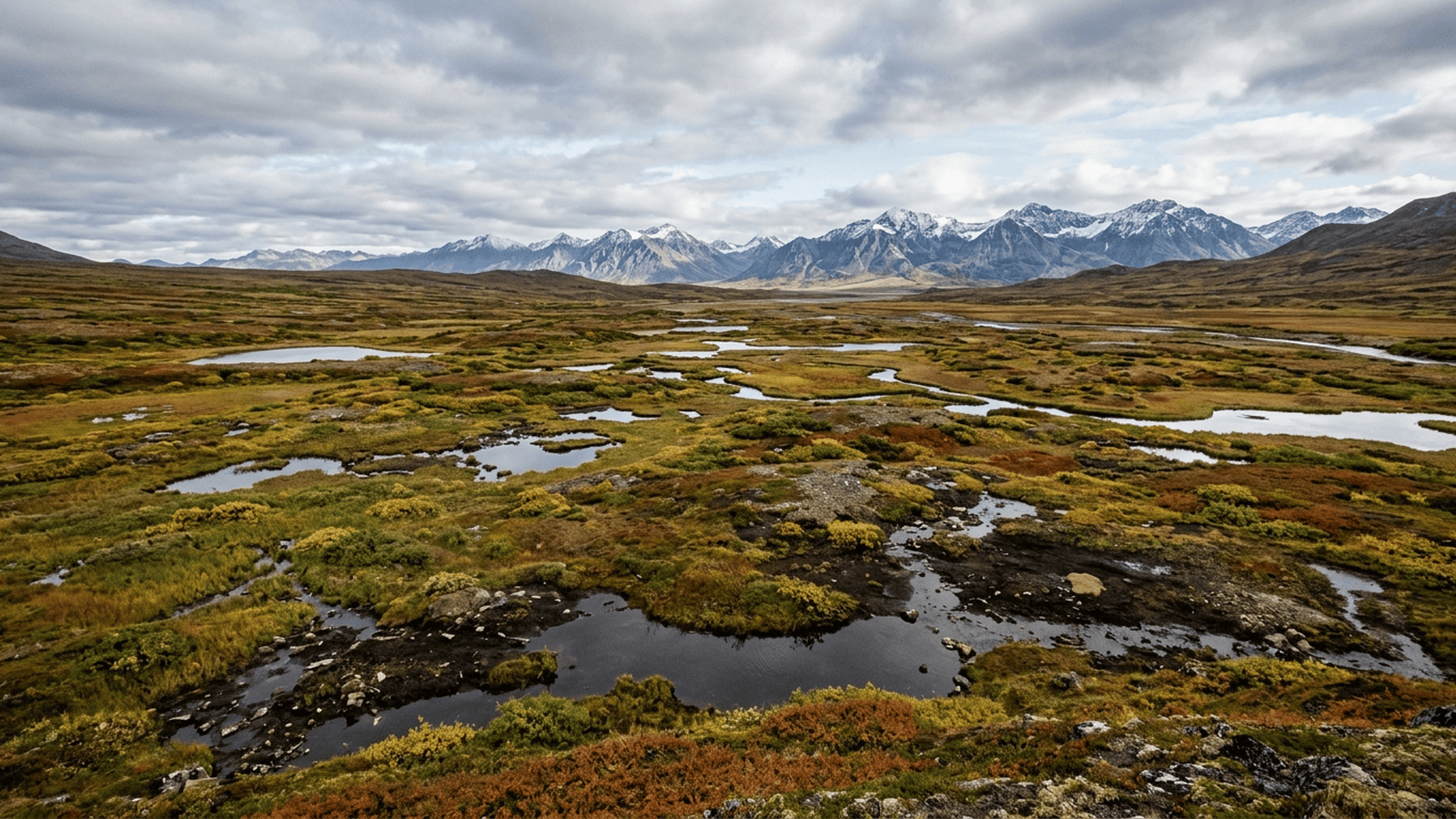
NOAA’s 2024 Arctic Report Card finds that the Arctic tundra has been a net source of carbon dioxide over the period monitored since 2003. Warming, thawing soils and wildfires contribute to the change, though plant growth can absorb carbon and researchers are working to refine estimates across the vast region.
TLDR: NOAA’s 2024 Arctic Report Card finds that Arctic tundra has released more carbon dioxide than it absorbed over the monitored period since 2003. Thawing soils and wildfires contribute to the shift, while plant growth can take up carbon. Researchers are improving measurements to understand how this balance may change.
Arctic tundra has released more carbon dioxide than it absorbed in recent decades, according to NOAA’s 2024 Arctic Report Card. The report’s analysis, drawing on observations and research from multiple institutions, identifies a major change in the region’s role in the global carbon cycle: warming, thawing ground and wildfires are contributing to emissions that outweigh the carbon taken up by plants.
The finding applies to the Arctic tundra region over the period covered by the analysis, not to every patch of tundra or every year. Researchers have monitored the balance of carbon entering and leaving the region since 2003. Their estimates indicate that the tundra has become a net source of carbon dioxide over that record, with fire emissions contributing to the shift.
In a colder climate, tundra plants absorb carbon dioxide as they grow, and some of that carbon is stored in soils. Those soils contain large quantities of organic matter that accumulated over thousands of years, including in permafrost—ground that remains frozen for at least two consecutive years. As the Arctic warms, thaw can expose stored material to microbes, which break it down and release carbon dioxide and methane.
The balance is not straightforward. A longer growing season can allow plants to take up more carbon, while warmer conditions can also speed decomposition. Wildfires release carbon directly and can alter vegetation and soil, potentially affecting emissions long after flames have passed. The new assessment accounts for these competing processes rather than treating thaw alone as a simple measure of net emissions.
NOAA’s report also documents a wider pattern of rapid Arctic change. The Arctic continued to warm faster than the global average, and the 2023–24 period brought unusually high precipitation across parts of the region. Summer 2024 was the second-warmest summer in the Arctic observational record, which began in 1900. Conditions vary across the vast region, but rising temperatures increase the likelihood of changes to frozen soils, ecosystems and wildfire activity.
The carbon finding does not mean that all Arctic permafrost has thawed or that the tundra’s annual balance will be identical from year to year. Carbon estimates are difficult because the Arctic is enormous, remote and diverse. Researchers combine field measurements, atmospheric observations, satellite data and models to estimate exchanges across landscapes that cannot be measured continuously from the ground.
That uncertainty matters for climate projections. If soils release more carbon as the region warms, those emissions could add to human-caused greenhouse gases and make it harder to limit further warming. This feedback is not a replacement for emissions from fossil fuels, which remain the main driver of current global warming, but it is a natural response that can amplify climate change.
The report’s assessment is a warning about a changing carbon balance, not a precise forecast of how much carbon the tundra will release in any particular year. Better observations are needed to distinguish the effects of warming, vegetation growth, soil moisture and fire. Scientists are expanding field monitoring and improving models to track both carbon dioxide and methane, which has a stronger warming effect per unit than carbon dioxide over shorter periods.
The next research step is to connect measurements taken at individual sites with satellite and atmospheric records covering the broader Arctic. That work can reveal where carbon losses are accelerating, how fires reshape the balance, and whether increased plant growth offsets some emissions. For climate planners, the emerging evidence reinforces the need to account for natural carbon feedbacks while reducing human greenhouse-gas emissions.
Mark Davis serves as the Senior Correspondent for Energy, Climate, and Resource Economics at Just Right News. In an era where the conversation around the environment is often dominated by alarmism and top-down mandates, Mark provides a vital, market-oriented perspective on the complex forces shaping our world. As the lead voice behind the acclaimed feature series “Power and the Planet,” he explores the intersection of environmental policy, global energy markets, and the fundamental economic principles that sustain modern civilization.
Mark’s pragmatic approach to resource management was forged in the high desert of his hometown, Albuquerque, New Mexico. Growing up in a region defined by both its breathtaking natural beauty and its rugged, resource-dependent landscape, he developed an early appreciation for the delicate balance between conservation and utilization. New Mexico’s unique position as a hub for both traditional energy production and cutting-edge scientific research provided Mark with a front-row seat to the evolution of the American energy sector. This upbringing instilled in him a deep-seated belief that true environmental stewardship is inseparable from economic prosperity and technological innovation.
Now based in Boulder, Colorado, Mark operates from the heart of the nation’s climate research community. While Boulder is often seen as a bastion of environmental idealism, Mark utilizes his post to provide a necessary counterweight, grounded in the realities of resource economics. He understands that energy policy does not exist in a vacuum; it has tangible consequences for the American taxpayer, the stability of the national power grid, and the strength of the domestic manufacturing sector. By reporting from the front lines of the climate debate, he is able to challenge prevailing narratives with hard data and a commitment to the principles of the free market.
Throughout his tenure at Just Right News, Mark has distinguished himself by focusing on the “Resource Economics” aspect of his beat. He frequently highlights the hidden costs of rapid energy transitions and advocates for an “all-of-the-above” energy strategy that prioritizes American energy independence. His work often shines a light on the geopolitical implications of resource scarcity, arguing that a secure nation must first be an energy-secure nation. Whether he is analyzing the impact of federal land-use regulations or investigating the supply chains required for new technologies, Mark remains focused on how policy decisions affect the lives and livelihoods of everyday citizens.
In “Power and the Planet,” Mark continues to bridge the gap between complex scientific concepts and the economic realities facing the country. He rejects the false choice between a healthy environment and a thriving economy, instead seeking out solutions that leverage American ingenuity and private-sector competition. For Mark, reporting on the climate is not about following the latest trends, but about ensuring that the conversation remains tethered to the foundational values of liberty, property rights, and fiscal responsibility. His contributions ensure that Just Right News readers receive a comprehensive, clear-eyed view of the challenges and opportunities defining the future of our planet.