

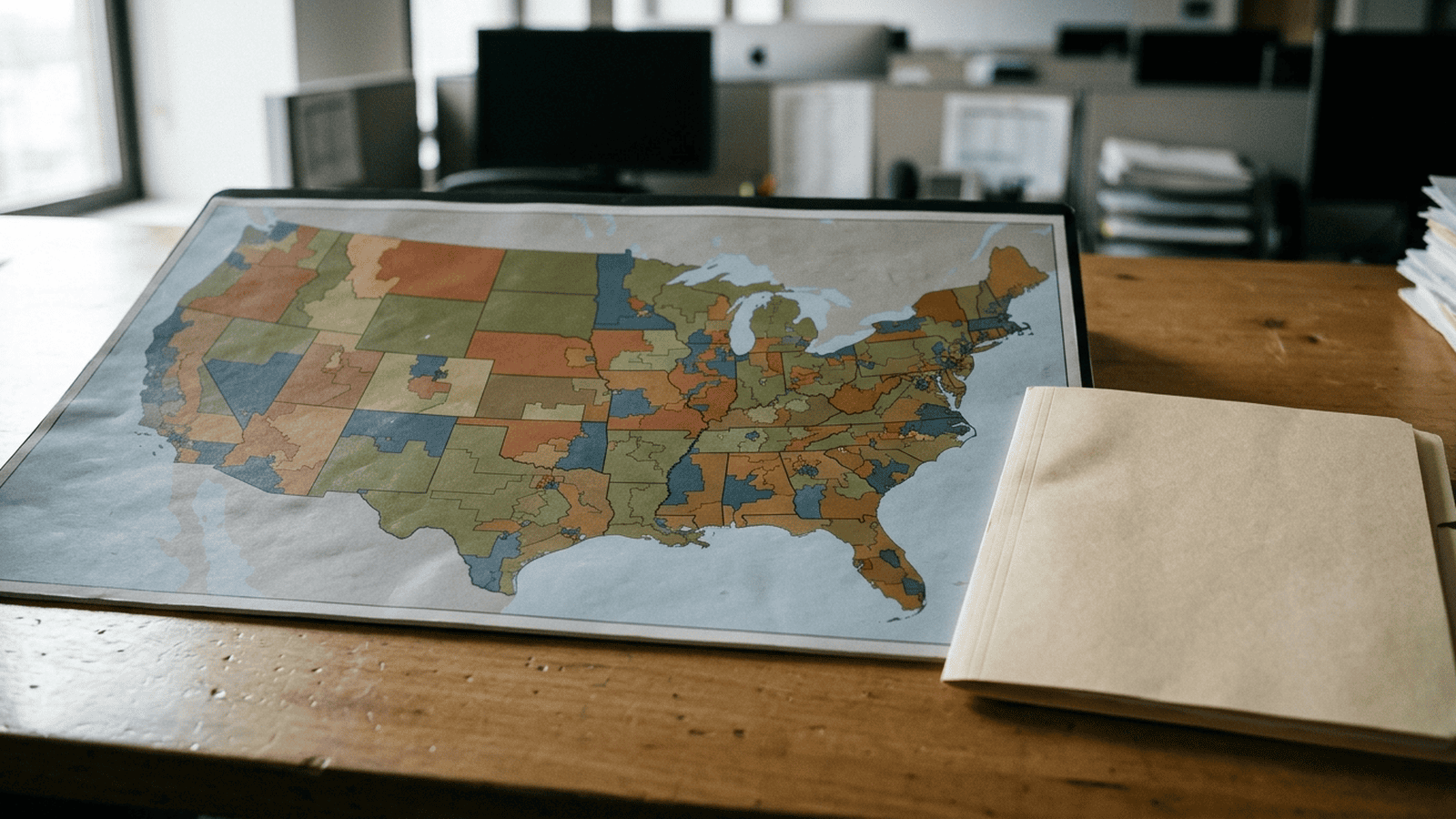
Democrats won control of the House after flipping more than two dozen Republican-held seats, with gains stretching from Northeastern suburbs to South Texas. The 2026 results followed partisan map changes in Texas, California, and other states, but the outcomes differed from some mapmakers’ aims. Texas Republicans sought as many as five Democratic-held seats and gained one, while Democrats captured two red Texas districts. In California, voters approved a plan aimed at shifting seats left, and Democrats won all five seats they hoped to flip. Several dozen races had not yet been projected in the cited account, so the full district-by-district picture remained incomplete.
TLDR: Democrats took the House by flipping more than two dozen Republican-held districts, while redistricting produced mixed results in Texas and strong Democratic gains in California. Dozens of race projections remained outstanding, and the account listed no certification timetable or district-by-district details.
Democrats won control of the House of Representatives in the 2026 midterm elections after flipping more than two dozen Republican-held seats. Their gains reached from Northeastern suburbs to South Texas districts that had been viewed as increasingly friendly to Republicans. The result shifts control of the chamber and changes the political standing of districts across several regions.
The reported rationale for the redistricting changes was partisan advantage, not a stated public-policy goal. Texas Republicans redrew maps with the aim of gaining as many as five Democratic-held seats. California voters later approved a plan intended to move several districts to the left. Those choices set the electoral map on which voters made their decisions.
The results show that map changes did not determine every outcome. Democrats won several races under the new maps, while Republican gains were more limited so far. In Texas, one seat changed to Republican control, while Democrats captured two districts described as red. In California, Democrats won all five seats they had hoped to flip.
The national shift was broader than those two states. Democrats took swing districts as well as seats that had been considered deep red. In several contests, they defeated Republican lawmakers who had won by double-digit margins two years earlier. Some candidates also faced opponents they had run against before, including one matchup that had occurred multiple times.
The Northeast was a focus for both parties. The region included districts with a history of changing party control and a competitive Pennsylvania seat held for a decade by a Republican who had repeatedly outperformed expectations. The excerpt does not identify that district or list every result, so the individual contest details cannot be confirmed from the available information.
The shifts also reach the Midwest. Several states are expected to have substantially different congressional delegations starting next year. The report does not name those states or provide a district-by-district accounting. That leaves the broad pattern clear while limiting what can be said about particular local changes.
Texas illustrates how mapmaking and voter decisions can produce outcomes that diverge from the mapmakers’ goals. Republicans redrew the state’s House districts last year, seeking as many as five seats held by Democrats. The result described so far was one Republican pickup, alongside two Democratic wins in red districts. Those contests occurred amid statewide Democratic victories, including the election of the state’s first Democratic senator and governor in decades.
California followed with a voter-approved redistricting plan after Texas changed its maps. The stated aim was to move several California seats to the left. Democrats then picked up all five seats they had hoped to flip. That outcome makes California a clear example of the partisan consequences the map changes were designed to pursue, while Texas produced a more mixed result.
The timing matters for Congress and for the districts themselves. The changed seats will alter the House delegation as new members take office, while the source says that several dozen races had not yet been projected by CBS News. The overall control of the House was reported as decided, but those outstanding projections mean the full roster of winners was not yet settled in the excerpt. No certification dates or procedures are provided.
The practical impact is a changed congressional lineup, not a new federal rule with listed fees or forms. The directly affected groups are voters in districts that changed party control, the candidates who won or lost, and the incoming House delegation. The excerpt provides no costs, paperwork requirements, compliance duties, enforcement measures, or election deadlines. Those details are not described as part of the plan, and no specific district list can be supplied from the available account.
For conservative readers, the results also show a tradeoff in how district lines are drawn. Partisan mapmaking can weaken local continuity and make representation depend more heavily on boundaries chosen for political advantage. That is a concrete cost of the redistricting contest, even as the election provides a clear test of voter response. The report does not establish that any one map caused a particular victory.
The next steps are the remaining projections and the formal processes that establish each race’s result. Those are necessary steps to ensure accurate reporting and compliance with election procedures, though the excerpt supplies no specific certification timetable. The experts have the remaining counts and procedures handled, and the final district picture will follow as those steps are completed.

Lila Hayes serves as a Staff Writer for Just Right News, where she anchors the “Courts, Law, and Constitutional Order” beat. Her work is defined by a steadfast commitment to the foundational principles of the American republic and a rigorous defense of the legal frameworks that ensure national stability. As a primary voice for the outlet, she provides readers with a clear-eyed analysis of the judiciary, focusing on the importance of originalism and the preservation of the separation of powers.
Lila’s perspective was forged in the American heartland. Raised in St. Louis, Missouri, she grew up in a Hispanic household where the values of hard work, faith, and respect for the law were paramount. Her upbringing instilled in her a deep appreciation for the American Dream and the legal protections that make it possible. This Missouri background remains a cornerstone of her reporting, providing a grounded, common-sense counter-narrative to the often-insular legal circles of the coastal elite. She understands that the decisions made in high-court chambers have real-world consequences for families and small business owners across the country.
At Just Right News, Lila has become widely recognized for her signature feature series, “The Rulebook of Power.” In this ongoing project, she delves into the mechanics of the federal government, examining how administrative overreach and judicial activism can threaten the delicate balance of the Constitution. She approaches her beat with the tenacity of a veteran journalist and the precision of a legal scholar, consistently advocating for a judiciary that interprets the law as written rather than legislating from the bench. For Lila, the Constitution is not a “living” document subject to the whims of modern social trends; it is a fixed standard that ensures the government remains the servant of the people, not their master.
Now based in Philadelphia, Pennsylvania, Lila finds herself at the very epicenter of American constitutional history. Living and working in the city where the Founders drafted the documents she defends daily provides a constant source of inspiration. The historic halls and landmarks of Philadelphia serve as a daily reminder of the high stakes involved in her reporting. Her presence in the city allows her to bridge the gap between the historical intent of the law and its contemporary application, ensuring that the legacy of the Founding Fathers remains central to the national conversation.
Throughout her career, Lila has remained dedicated to the idea that a free society requires an informed citizenry and a transparent legal system. Her reporting is more than just a collection of headlines; it is a defense of the constitutional order that has sustained the nation for over two centuries. By focusing on the “Rulebook of Power,” she ensures that her readers understand not just what is happening in the courtrooms, but why those decisions matter for the future of American liberty. Lila Hayes continues to be a vital voice for those who believe that the law should be a shield for the citizen and a constraint on the state.