

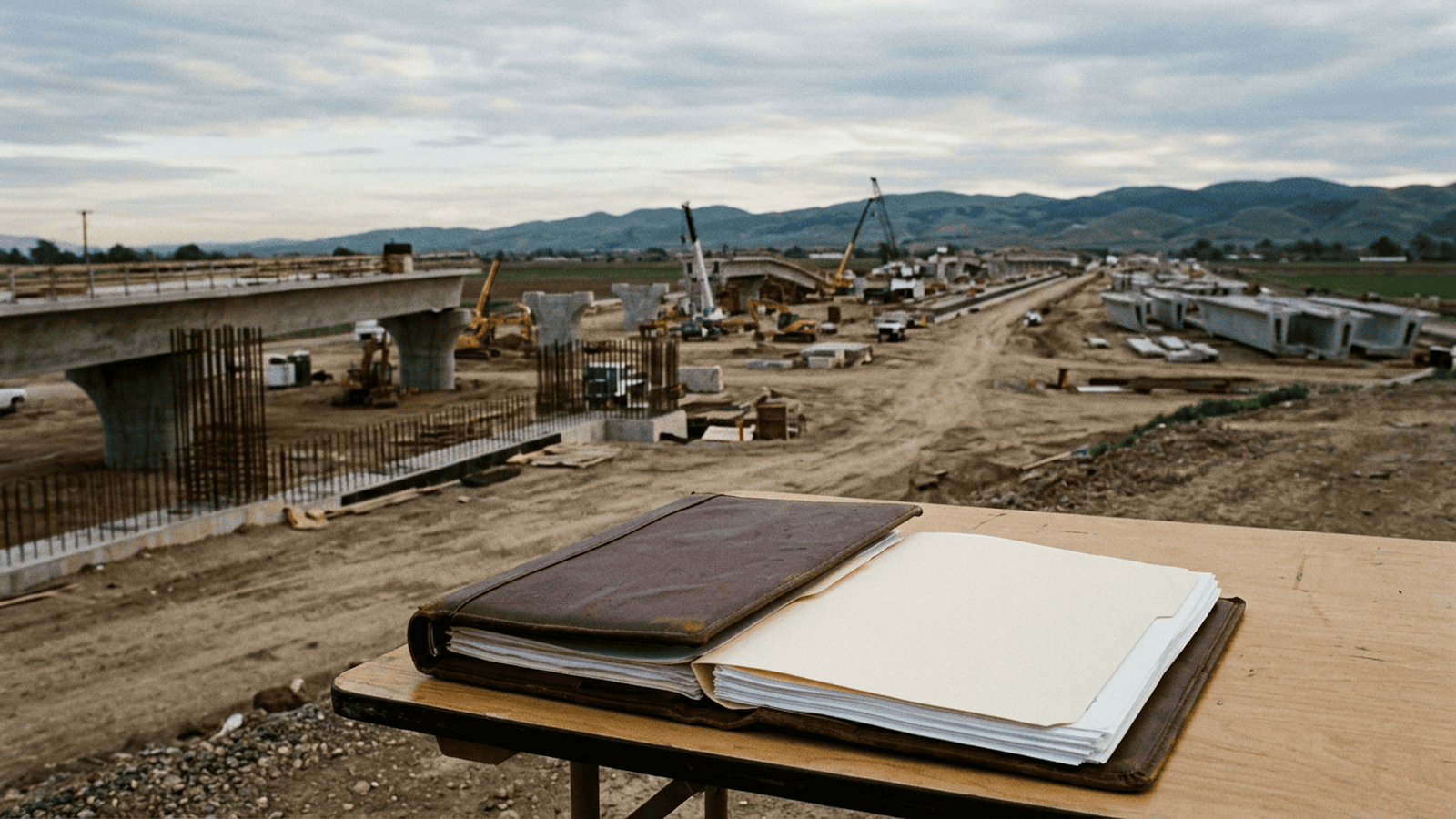
California’s High-Speed Rail Authority has appointed Joe Stephenshaw as interim CEO after Ian Choudri resigned, citing personal and family priorities. The board chair called for an independent inspector general investigation amid reports of disputed consultant spending and contract practices, though the authority has not answered several questions. The board also authorized a three-train purchase after the authority missed train-buying deadlines and forfeited $4 billion in federal funding. California will now cover the train bill, and the trains are expected to be built in Germany without a Buy America agreement. The inspector general’s review could take months, while the project could run out of money by the end of 2027 without new financing.
TLDR: A new interim CEO takes charge as an independent inspector general investigation is called for over disputed spending and contract oversight. California has also lost $4 billion in federal rail funding and will pay for a smaller train order, while the project faces a possible funding shortfall by the end of 2027.
California’s High-Speed Rail Authority has a new interim chief executive, but the leadership change does not settle the questions surrounding its contracts and spending. Ian Choudri resigned effective immediately on Oct. 28, citing personal and family priorities. The next day, the board appointed Joe Stephenshaw, the state Department of Finance director, to serve as interim CEO. An independent inspector general investigation has been called for, while disputed bills and contract oversight remain unresolved.
The stated reason for Choudri’s departure was personal and family priorities. The board chair called for an independent inspector general investigation after reports raised concerns about consultant spending and contracting practices. The authority’s proposed changes to how it manages financial consulting agreements could reduce outside oversight. The excerpt does not give an official explanation for that proposal, so its rationale remains unclear.
The leadership change followed weeks of unsuccessful efforts by CBS California Investigates to obtain answers from Choudri and his administration. On Oct. 28, the outlet brought questions to the board. Hours later, Choudri submitted his resignation. The board’s appointment of Stephenshaw placed a finance official in charge on an interim basis, but the authority has not publicly answered key questions about who approved disputed spending, who enforced contract terms, or what will happen to the consultants and executives involved.
The questions extend beyond consulting agreements. Court records and federal documents cited in the investigation show that the authority repeatedly missed deadlines to buy trains it had promised to purchase. The Trump administration withdrew $4 billion in funding in 2024, citing the first missed trainset milestone. California sued, arguing that it could still meet a later deadline by buying trains in 2025, but it did not meet that deadline and later dropped the lawsuit, forfeiting the funding. The administration spent the money elsewhere.
On Oct. 28, the board authorized a trainset contract, hours before Choudri resigned. The purchase is for the same type of wide-body trains from the same manufacturer that the former CEO had chosen not to buy two years earlier. The new order is for three trains rather than six. The investigation reports that each train will cost more despite having stock interiors. Without the $4 billion in federal funding, Californians will pay the bill, and without a Buy America agreement the trains will be manufactured in Germany.
Consultant spending adds another set of unanswered questions. The inspector general identified nearly $600,000 in wasteful and unallowable travel expenses, including luxury rideshares and trips to destinations that appeared unrelated to consultants’ work. The authority paid four major consulting firms nearly a quarter-billion dollars over two years. The excerpt says those firms advised the CEO and his team rather than laying track or building trains. Records described in the investigation showed two consultants billed for late-night rides from Choudri’s home and nearby restaurants to their Sacramento hotels. Their hourly rates were reported at $460 to $580, and the authority did not answer questions about who authorized the expenses.
Other reported costs involved staff location and contract enforcement. An engineering firm promised to relocate six key employees to Sacramento under a contract worth up to $131 million, but records showed key personnel billed taxpayers for air travel and hotel stays while commuting from Denver and Texas. One executive made weekly trips between Denver and Sacramento, and records indicated his billing rate rose 23 percent after Choudri became CEO. The inspector general flagged more than $76,000 in travel involving out-of-state key personnel. An auditor also flagged Choudri’s travel bills for commuting from Denver, and the state later clawed those expenses back. The supplied material does not identify new forms or a compliance deadline for the contract review.
The contract questions include a $24 million KPMG agreement. The story kit reports an allegation that the authority paid consultants through a contract at rates up to ten times those allowed in the winning bid and contract. State officials dismissed the allegation as speculation but warned the authority not to pay higher rates for work assigned to positions priced at $35 an hour. A related investigation could take months, according to the excerpt. Existing contracts, not only proposed changes for future agreements, remain part of the oversight questions.
The inspector general warned that the rail project could run out of money by the end of 2027 without new financing. The next necessary steps are the independent review and a clear accounting of contract approvals, disputed expenses, and enforcement. The available information does not establish that wrongdoing has been proven, and the authority has not answered several questions. Those findings and explanations remain for the board and investigators to address.

Mark Davis serves as the Senior Correspondent for Energy, Climate, and Resource Economics at Just Right News. In an era where the conversation around the environment is often dominated by alarmism and top-down mandates, Mark provides a vital, market-oriented perspective on the complex forces shaping our world. As the lead voice behind the acclaimed feature series “Power and the Planet,” he explores the intersection of environmental policy, global energy markets, and the fundamental economic principles that sustain modern civilization.
Mark’s pragmatic approach to resource management was forged in the high desert of his hometown, Albuquerque, New Mexico. Growing up in a region defined by both its breathtaking natural beauty and its rugged, resource-dependent landscape, he developed an early appreciation for the delicate balance between conservation and utilization. New Mexico’s unique position as a hub for both traditional energy production and cutting-edge scientific research provided Mark with a front-row seat to the evolution of the American energy sector. This upbringing instilled in him a deep-seated belief that true environmental stewardship is inseparable from economic prosperity and technological innovation.
Now based in Boulder, Colorado, Mark operates from the heart of the nation’s climate research community. While Boulder is often seen as a bastion of environmental idealism, Mark utilizes his post to provide a necessary counterweight, grounded in the realities of resource economics. He understands that energy policy does not exist in a vacuum; it has tangible consequences for the American taxpayer, the stability of the national power grid, and the strength of the domestic manufacturing sector. By reporting from the front lines of the climate debate, he is able to challenge prevailing narratives with hard data and a commitment to the principles of the free market.
Throughout his tenure at Just Right News, Mark has distinguished himself by focusing on the “Resource Economics” aspect of his beat. He frequently highlights the hidden costs of rapid energy transitions and advocates for an “all-of-the-above” energy strategy that prioritizes American energy independence. His work often shines a light on the geopolitical implications of resource scarcity, arguing that a secure nation must first be an energy-secure nation. Whether he is analyzing the impact of federal land-use regulations or investigating the supply chains required for new technologies, Mark remains focused on how policy decisions affect the lives and livelihoods of everyday citizens.
In “Power and the Planet,” Mark continues to bridge the gap between complex scientific concepts and the economic realities facing the country. He rejects the false choice between a healthy environment and a thriving economy, instead seeking out solutions that leverage American ingenuity and private-sector competition. For Mark, reporting on the climate is not about following the latest trends, but about ensuring that the conversation remains tethered to the foundational values of liberty, property rights, and fiscal responsibility. His contributions ensure that Just Right News readers receive a comprehensive, clear-eyed view of the challenges and opportunities defining the future of our planet.