

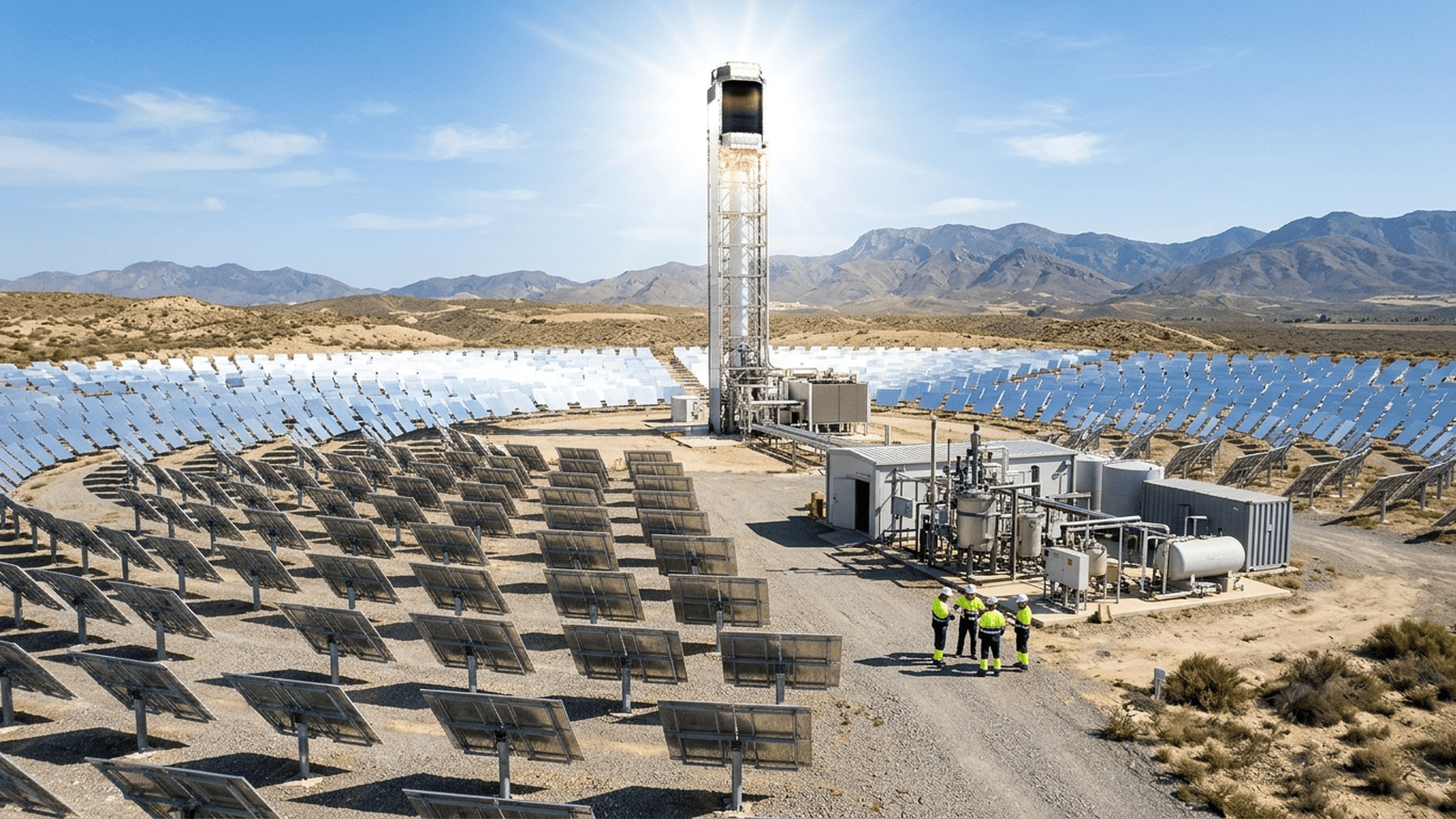
ETH Zurich researchers demonstrated an outdoor solar-thermochemical process that uses concentrated sunlight, water and carbon dioxide to produce syngas, a building block for synthetic kerosene. The pilot confirms a technical pathway for solar-made aviation fuel, but efficiency, cost, scale and lifecycle emissions remain major challenges.
TLDR: ETH Zurich researchers tested a solar tower system near Madrid that uses concentrated sunlight to drive chemical reactions involving water and carbon dioxide. The process makes syngas, which can be converted into kerosene. It is a pilot demonstration, not a commercial fuel source; cost, efficiency and lifecycle emissions still need work.
A solar installation built by researchers at ETH Zurich has demonstrated a way to make jet-fuel ingredients from sunlight, water and carbon dioxide. The system, tested outdoors near Madrid, links solar heat and chemistry to produce synthesis gas, a mixture that can be processed into liquid fuels such as kerosene. The demonstration marked a step beyond laboratory experiments: sunlight powered the full chain of fuel production at an industrially relevant scale for a research prototype. Unlike a laboratory setup, the outdoor trial had to contend with changing solar input and operate the reactor, gas handling and measurement equipment together.
The project addresses a difficult part of the energy transition. Batteries and direct electricity can replace fossil fuels in many settings, but long-distance aviation is difficult to electrify because aircraft need energy-dense fuel. Synthetic kerosene could work in existing engines and infrastructure, while potentially lowering net carbon emissions if its carbon comes from the air and its production uses renewable energy. That does not make the fuel automatically carbon-free: the climate benefit depends on how the process is powered and how its carbon feedstock is sourced.
At the facility, a field of mirrors concentrates sunlight onto a receiver atop a solar tower. Inside the receiver, a porous ceria structure is heated to very high temperatures. In a first step, the material releases oxygen. When steam and carbon dioxide pass through it in a subsequent step, the ceria takes oxygen from those molecules, producing hydrogen and carbon monoxide. The material is then ready to repeat the cycle. The alternating temperature-driven steps are central: heating drives oxygen release, while the reduced ceria then draws oxygen from the feed gases.
The resulting gases form synthesis gas, or syngas. A downstream process can convert syngas into liquid hydrocarbons, including aviation fuel. The researchers demonstrated the solar thermochemical process outdoors, producing syngas under real sunlight. The 2022 report in the journal Joule described the integrated solar reactor and its operation at the pilot plant in Móstoles, Spain. Earlier work had tested individual components; joining them in a working system exposed practical challenges such as managing heat, gas flow and changing sunlight.
The technology’s appeal is that it uses concentrated solar energy as high-temperature process heat rather than first converting sunlight into electricity. The ceria acts as a reusable oxygen carrier, not as a fuel ingredient consumed in each cycle. This approach can, in principle, turn carbon dioxide and water into chemical building blocks without relying on fossil-derived hydrogen. Yet the pilot system was not a commercial fuel plant, and the demonstration did not establish that solar kerosene can already compete on price with conventional jet fuel.
Scaling up will require larger reactors, durable materials and ways to collect enough sunlight consistently. The solar field and tower also take land and require substantial capital investment. Researchers must improve the fraction of incoming sunlight that ends up stored in the fuel, while ensuring the fuel-production stages use low-carbon energy. A lifecycle assessment is essential: emissions from construction, transport and any supplementary energy can reduce the climate advantage.
The demonstration therefore shows a technical possibility, not a ready-made replacement for aviation fuel. Future research will need to raise efficiency, extend reactor operating life and connect solar syngas production reliably to fuel synthesis. If those steps succeed in locations with strong sunlight and suitable carbon sources, the method could offer one route to lower-emission aviation alongside demand reduction, efficiency improvements and other sustainable fuels. Its significance lies in proving that concentrated sunlight can drive the central chemical step outdoors, where engineering limits become visible.

Mark Davis serves as the Senior Correspondent for Energy, Climate, and Resource Economics at Just Right News. In an era where the conversation around the environment is often dominated by alarmism and top-down mandates, Mark provides a vital, market-oriented perspective on the complex forces shaping our world. As the lead voice behind the acclaimed feature series “Power and the Planet,” he explores the intersection of environmental policy, global energy markets, and the fundamental economic principles that sustain modern civilization.
Mark’s pragmatic approach to resource management was forged in the high desert of his hometown, Albuquerque, New Mexico. Growing up in a region defined by both its breathtaking natural beauty and its rugged, resource-dependent landscape, he developed an early appreciation for the delicate balance between conservation and utilization. New Mexico’s unique position as a hub for both traditional energy production and cutting-edge scientific research provided Mark with a front-row seat to the evolution of the American energy sector. This upbringing instilled in him a deep-seated belief that true environmental stewardship is inseparable from economic prosperity and technological innovation.
Now based in Boulder, Colorado, Mark operates from the heart of the nation’s climate research community. While Boulder is often seen as a bastion of environmental idealism, Mark utilizes his post to provide a necessary counterweight, grounded in the realities of resource economics. He understands that energy policy does not exist in a vacuum; it has tangible consequences for the American taxpayer, the stability of the national power grid, and the strength of the domestic manufacturing sector. By reporting from the front lines of the climate debate, he is able to challenge prevailing narratives with hard data and a commitment to the principles of the free market.
Throughout his tenure at Just Right News, Mark has distinguished himself by focusing on the “Resource Economics” aspect of his beat. He frequently highlights the hidden costs of rapid energy transitions and advocates for an “all-of-the-above” energy strategy that prioritizes American energy independence. His work often shines a light on the geopolitical implications of resource scarcity, arguing that a secure nation must first be an energy-secure nation. Whether he is analyzing the impact of federal land-use regulations or investigating the supply chains required for new technologies, Mark remains focused on how policy decisions affect the lives and livelihoods of everyday citizens.
In “Power and the Planet,” Mark continues to bridge the gap between complex scientific concepts and the economic realities facing the country. He rejects the false choice between a healthy environment and a thriving economy, instead seeking out solutions that leverage American ingenuity and private-sector competition. For Mark, reporting on the climate is not about following the latest trends, but about ensuring that the conversation remains tethered to the foundational values of liberty, property rights, and fiscal responsibility. His contributions ensure that Just Right News readers receive a comprehensive, clear-eyed view of the challenges and opportunities defining the future of our planet.