

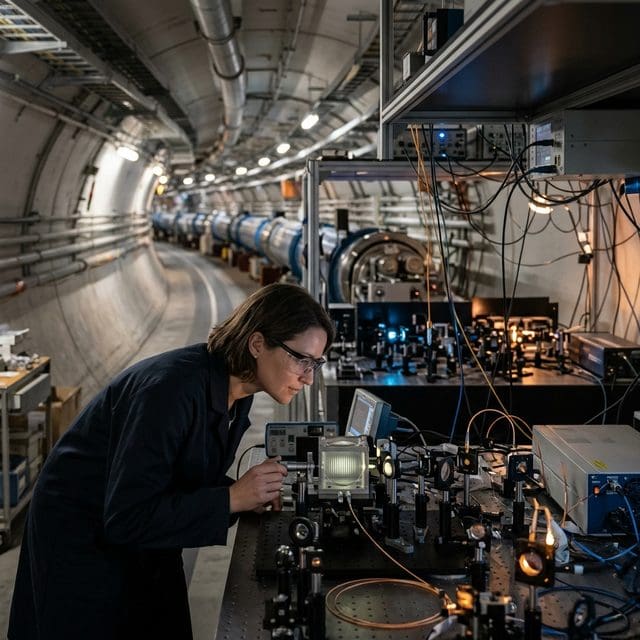
CERN’s LHCb experiment reports first evidence of an elusive particle decay, while University of Warsaw researchers observe a supersolid state in a room-temperature light-matter system.
Two very different frontiers of physics offered new reasons for attention this week: CERN researchers reported evidence of a particle decay so rare it appears only about once in every 10 billion beauty particles, while a team in Warsaw observed a quantum state with an unusual combination of properties at room temperature.
Neither result is a final answer. The particle finding has not reached the standard for a discovery, and the supersolid experiment is a laboratory result, not a ready-made technology. But both show how physicists are probing the boundaries of what current theories and tools can explain.
At the Large Hadron Collider, the LHCb experiment studied the decay of a B meson containing a beauty quark into two muons. The process, written as Bd → μ+μ−, is predicted by the Standard Model, the theory describing known fundamental particles and their interactions. Because it is so uncommon, even small departures from the expected rate could point to undiscovered particles or forces influencing the decay.
LHCb’s data from 2024 and 2025 provided 3.0-sigma evidence for the process. Combining those results with data from 2011 to 2018 raised the significance to 3.2 sigma. That is the first evidence from a single experiment, according to CERN, but it remains below the five-sigma benchmark particle physicists generally use to claim a discovery. The result has been submitted for publication, not yet published in a journal.
The measurement is reported as consistent with the Standard Model. That does not rule out new physics; it tightens the space in which deviations in this particular decay might be found. The search stretches back more than four decades, and further data will be needed to establish the signal more firmly and test whether it departs from theoretical expectations. Physicists describe the scale under investigation as the “Zeptoverse,” a realm of distances around one billionth of a trillionth of a meter.
A separate experiment at the University of Warsaw points toward a different kind of possibility. Researchers used an optical microcavity containing a specially designed liquid crystal and an organic semiconductor to create an exciton-polariton Bose–Einstein condensate. Exciton polaritons are hybrid states formed when light and matter interact strongly. Unlike many familiar quantum states that require extreme cold, this one formed at room temperature.
The team’s evidence for a supersolid—a state combining features associated with a solid and a fluid—came from regularly spaced bright fringes in the light emitted by the system, alongside a persistent spin helix, an organized pattern in polarization. Together, the observations indicated order in both light intensity and polarization. The work was published in Science Advances.
One detail offers a clue to how the pattern forms: each laser pulse produced fringes in a different position. The system was not simply locked into one fixed arrangement; it selected among equivalent configurations. That behavior helps distinguish the observed pattern from a static imprint imposed on the device.
Room-temperature operation is appealing because it avoids the demanding cooling associated with many quantum experiments. The researchers and coverage of the work point to possible future relevance for photonic devices and computing, but the result does not demonstrate a working computer or commercial application. Further work must establish how reliably the state can be produced and controlled, and what useful tasks it can perform.
Together, the findings illustrate two ways progress can arrive in physics: a faint statistical signal that must survive more scrutiny, and a striking laboratory state whose practical value remains an open question. In both cases, the next step is not a sweeping claim. It is more measurement, sharper tests, and time to see whether nature keeps telling the same story.

Ethan Blake serves as a Senior Correspondent for Just Right News, where he specializes in Longform Narrative and Public Understanding. In an era of rapid-fire headlines and fleeting soundbites, Ethan’s work stands as a testament to the power of deep-dive reporting and the importance of contextualizing the complex issues facing the nation today. His approach is rooted in the belief that the most profound truths are often found in the lived experiences of individuals rather than the abstract theories of distant policymakers.
Growing up in Providence, Rhode Island, Ethan developed an early appreciation for the historical and cultural threads that weave the American fabric together. Providence, a city defined by its industrial heritage and its blend of traditional neighborhoods, provided him with a front-row seat to the challenges and triumphs of the American working class. This upbringing instilled in him a respect for the “common sense” values of hard work, community loyalty, and the preservation of local institutions. He learned early on that behind every economic statistic or legislative debate, there are real families and neighborhoods navigating the consequences of change.
This foundational perspective is the driving force behind his signature feature series, “Lives Behind the Systems.” Through this series, Ethan explores the intersection of individual agency and institutional structure. Whether he is documenting the impact of federal land-use policies on rural families or examining how shifting educational standards affect local school boards, Ethan’s work prioritizes the human element. He seeks to uncover how large-scale systems—be they governmental, economic, or social—affect the daily lives of citizens, often advocating for a return to local control and personal responsibility.
Now based in Portland, Maine, Ethan draws significant inspiration from the rugged independence and self-reliance that define the region. The coastal landscape and the resilient spirit of Maine’s communities serve as a constant reminder of the importance of individual liberty and the strength found in decentralized power. Living and working outside the traditional media hubs allows Ethan to maintain a grounded perspective, ensuring his reporting remains untethered from the echo chambers of the major metropolitan centers. This geographic distance provides him with the clarity needed to translate complex national narratives into stories that resonate with the heart of the country.
At Just Right News, Ethan’s beat is more than just a professional assignment; it is a mission to foster a more informed and engaged citizenry. He believes that a free society depends on the public’s ability to understand the mechanisms of power and the value of traditional American principles. His longform narratives do not merely report the news; they provide a roadmap for understanding the cultural and political shifts of the modern era through a lens of skepticism toward centralized authority and a deep respect for the individual.
Through his meticulous research and narrative craftsmanship, Ethan Blake continues to bridge the gap between policy and the public. His work remains a vital resource for those who seek a deeper understanding of the systems that shape our world and the enduring spirit of the people who live within them.