

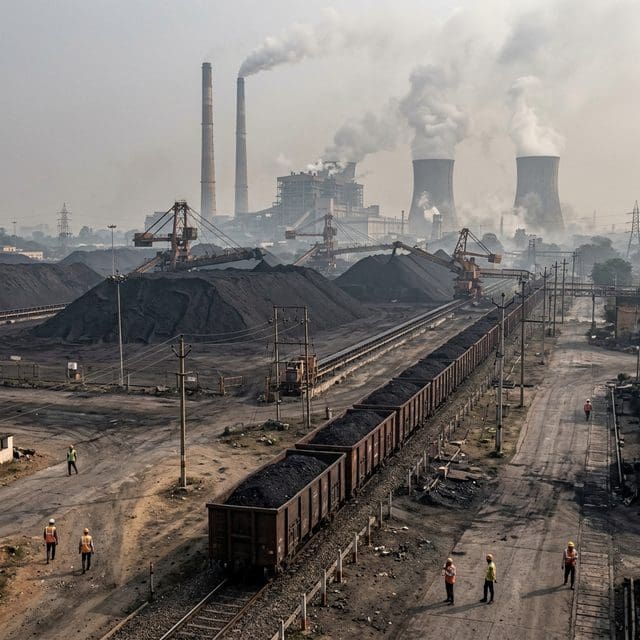
India’s Coal Ministry reported lower coal imports for the power sector in August, while plants designed to run on imported fuel brought in slightly more than a year earlier.
India’s power sector imported less coal in August than it did a year earlier, but the figures show that some power plants remain tied to fuel arriving from abroad. The distinction matters: a national import decline can coexist with persistent overseas dependence at facilities built around imported coal.
In a release dated November 1, India’s Coal Ministry said power-sector coal imports fell 6.39% to 21.32 million tonnes in August, from 22.77 million tonnes in the same month a year earlier. Yet imports by imported-coal-based power plants increased 0.98%, reaching 18.31 million tonnes from 18.13 million tonnes.
Those are separate measures in the ministry’s account. The broader power-sector figure declined, while the narrower category of plants reliant on imported coal recorded a modest increase. The ministry attributed the reduction to efforts to raise domestic coal production, improve availability and strengthen the supply chain.
The reported contrast is a reminder that aggregate import numbers do not describe every buyer’s position. If more domestic coal is available to some users, overall imports may fall even as plants built to use imported fuel continue to draw on overseas supplies. The figures do not specify which individual plants or buyers account for the increase, so they cannot show how widely that continuing reliance is distributed.
Coal’s journey from origin to electricity generation involves more than a purchase decision: fuel has to be sourced, transported and delivered to the plants that consume it. A domestic supply can reduce the need to bring some coal across borders, while imported-coal-based plants still require overseas fuel to reach them. The ministry’s release describes the policy direction—greater domestic production, improved availability and a stronger supply chain—but does not detail the operational changes behind those efforts.
Nor does the release identify the imported coal’s countries of origin, routes, prices or ports of entry. It provides no breakdown of shipping conditions or delivery costs. As a result, the August figures cannot establish which foreign suppliers gained or lost business, whether transport constraints changed, or how the import shift affected the cost of power. They measure volumes, not the full commercial or logistical chain behind them.
The verified figures also do not amount to a complete picture of India’s coal trade. They cover power-sector imports and imports by plants based on imported coal; they should not be read as totals for all coal imports or as a measure of coal’s share in national consumption. Other figures circulating alongside the report—including claims about imports for blending and coal’s share of consumption—could not be confirmed in the supplied reporting and are not included here.
For manufacturers and workers, the practical stakes of energy sourcing reach beyond a trade tally. Reliable electricity depends in part on whether fuel can be produced or procured and delivered where it is needed. A stronger domestic supply chain could reduce exposure to disruptions in overseas sourcing and shipping, but the ministry’s figures do not quantify that exposure or demonstrate how much domestic supply has replaced imports.
The August comparison is a one-month snapshot, not evidence of a lasting trend. It does, however, caution against reading a decline in power-sector imports as a clean break from overseas dependence. Imports fell across the reported category even as plants reliant on imported coal received slightly more than a year earlier. The ministry points to domestic production and supply-chain improvements as the route forward; the figures show that imported fuel remains part of the system for those plants.

Sean Bradley serves as the Senior Correspondent for Trade, Supply Chains, and Global Labor at Just Right News, where he brings a principled, clear-eyed perspective to the complex systems that power the modern world. With a focus on the economic forces that impact the American household, Bradley has distinguished himself as a leading voice in explaining how global shifts in manufacturing and logistics translate to the kitchen table.
Growing up in Long Beach, California, Bradley’s interest in the movement of goods was forged against the backdrop of one of the nation’s most vital maritime gateways. Raised in a community where the towering cranes of the port were a constant fixture on the horizon, he developed an early appreciation for the blue-collar industries that form the backbone of the American economy. This upbringing instilled in him a profound respect for the dockworkers, truckers, and laborers who keep the country moving, a sentiment that remains a cornerstone of his reporting today. For Bradley, trade is not merely a series of abstract figures on a spreadsheet; it is a human endeavor that sustains families and defines the strength of a nation.
Now based in Seattle, Washington, Bradley occupies a strategic vantage point in another of the country’s most significant trade hubs. His location allows him to witness firsthand the intersection of traditional industry and the evolving technological landscape of global logistics. From the Pacific Northwest, he monitors the flow of goods across the ocean, providing Just Right News readers with timely insights into how international tensions, regulatory hurdles, and labor disputes affect the availability and cost of essential goods.
His signature feature series, “The Journey of Things,” has become a staple for readers seeking to understand the intricate path products take from raw materials to the retail shelf. Through this series, Bradley pulls back the curtain on the global marketplace, often highlighting the risks of over-reliance on foreign adversaries and the importance of domestic manufacturing resilience. His reporting consistently emphasizes the conservative values of national sovereignty, free-market competition, and the protection of the American worker from unfair global practices.
As a journalist of Irish heritage, Bradley maintains a deep-seated respect for the dignity of the individual worker and the importance of community stability. He approaches his beat with a commitment to transparency, often questioning the status quo of globalist policies that prioritize corporate efficiency over local prosperity. Whether he is reporting from a warehouse floor or analyzing a new international trade agreement, his goal remains the same: to provide the American public with the truth about where their products come from and what it costs to get them there.
Throughout his tenure at Just Right News, Bradley has remained a steadfast advocate for economic common sense. His work serves as a vital resource for those who believe that a strong nation is built on secure borders, robust trade, and a respected workforce. By combining his local roots in Long Beach with his professional experience in Seattle, Bradley continues to offer a unique and necessary perspective on the forces that shape the American way of life.