

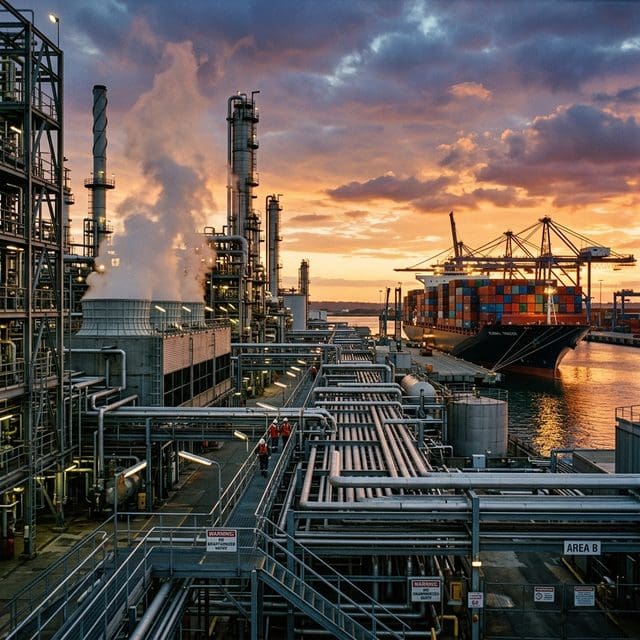
China launches a strategic anti-dumping investigation into European chemicals, escalating tensions ahead of high-stakes trade negotiations in Beijing regarding a record 103 billion euro deficit.
The global chess match over manufacturing dominance intensified this week as Beijing launched a fresh anti-dumping investigation into p-nitrotoluene imports from the European Union. This chemical, a critical building block for dyes, pharmaceuticals, and pesticides, has become the latest flashpoint in a trade relationship defined by increasing friction and massive imbalances. Chinese authorities claim that European exporters have dropped prices by nearly 60 percent cumulatively from 2022 to 2025, a move they argue threatens the stability of their domestic chemical sector. The investigation is expected to last 12 months, though it could be extended by an additional six months, casting a long shadow over the future of European chemical exports to the East.
This investigation, announced on October 3, is widely viewed as a strategic maneuver ahead of a pivotal diplomatic mission. EU Trade Commissioner Maroš Šefčovič is scheduled to arrive in Beijing on October 8 to co-chair the second EU-China Trade and Investment Council with Chinese Commerce Minister Wang Wentao. The timing is no coincidence. By targeting a specific industrial chemical, Beijing is signaling its willingness to retaliate against Brussels, which recently launched its own probe into Chinese-made polyvinyl chloride. This tit-for-tat cycle highlights a breakdown in the globalist dream of frictionless commerce, replaced instead by a gritty reality of trade-defense cases that have nearly tripled in the past year.
The scale of the economic disconnect is staggering and serves as a warning to any nation that neglects its own industrial base. Recent Eurostat data reveals the EU’s goods deficit with China hit €103 billion in the second quarter of 2026, the highest level since late 2022. While European leaders speak of “rebalancing,” the reality on the ground shows a surge of Chinese imports, which have risen 45 percent over the last five years. In the first half of 2026 alone, imports of vehicles and parts increased by €5.9 billion year-on-year. For the American observer, this serves as a cautionary tale of how quickly a domestic industrial base can be eroded when trade flows become a one-way street, favoring state-subsidized efficiency over local prosperity.
Brussels is demanding “credible” and concrete outcomes from the upcoming talks, including better market access for European firms and more predictable exports of rare-earth minerals, which are essential for modern high-tech manufacturing. Commissioner Šefčovič has warned that a lack of progress could trigger harsher measures from the EU. However, Beijing’s latest move suggests they are dug in, prepared to use every regulatory tool at their disposal to protect their market share. The immediate agenda for the October 8-9 meeting is packed, covering everything from Chinese export controls to the transparency of global supply chains, yet the atmosphere remains one of deep skepticism.
As these two entities clash, the individual worker is often left in the lurch. The journey of these chemicals—from European factories to Chinese industrial hubs—is now entangled in a web of legal threats and political posturing. If the talks in Beijing fail to produce a meaningful shift, the European Council is expected to move toward a political decision point during their meetings on October 15-16. This could redefine the flow of goods across the Eurasian landmass for a generation. For those who believe in the dignity of local production and national sovereignty, the escalating dispute highlights the inherent instability of relying on globalist supply chains that prioritize short-term corporate efficiency over the long-term health of the workforce.

Sean Bradley serves as the Senior Correspondent for Trade, Supply Chains, and Global Labor at Just Right News, where he brings a principled, clear-eyed perspective to the complex systems that power the modern world. With a focus on the economic forces that impact the American household, Bradley has distinguished himself as a leading voice in explaining how global shifts in manufacturing and logistics translate to the kitchen table.
Growing up in Long Beach, California, Bradley’s interest in the movement of goods was forged against the backdrop of one of the nation’s most vital maritime gateways. Raised in a community where the towering cranes of the port were a constant fixture on the horizon, he developed an early appreciation for the blue-collar industries that form the backbone of the American economy. This upbringing instilled in him a profound respect for the dockworkers, truckers, and laborers who keep the country moving, a sentiment that remains a cornerstone of his reporting today. For Bradley, trade is not merely a series of abstract figures on a spreadsheet; it is a human endeavor that sustains families and defines the strength of a nation.
Now based in Seattle, Washington, Bradley occupies a strategic vantage point in another of the country’s most significant trade hubs. His location allows him to witness firsthand the intersection of traditional industry and the evolving technological landscape of global logistics. From the Pacific Northwest, he monitors the flow of goods across the ocean, providing Just Right News readers with timely insights into how international tensions, regulatory hurdles, and labor disputes affect the availability and cost of essential goods.
His signature feature series, “The Journey of Things,” has become a staple for readers seeking to understand the intricate path products take from raw materials to the retail shelf. Through this series, Bradley pulls back the curtain on the global marketplace, often highlighting the risks of over-reliance on foreign adversaries and the importance of domestic manufacturing resilience. His reporting consistently emphasizes the conservative values of national sovereignty, free-market competition, and the protection of the American worker from unfair global practices.
As a journalist of Irish heritage, Bradley maintains a deep-seated respect for the dignity of the individual worker and the importance of community stability. He approaches his beat with a commitment to transparency, often questioning the status quo of globalist policies that prioritize corporate efficiency over local prosperity. Whether he is reporting from a warehouse floor or analyzing a new international trade agreement, his goal remains the same: to provide the American public with the truth about where their products come from and what it costs to get them there.
Throughout his tenure at Just Right News, Bradley has remained a steadfast advocate for economic common sense. His work serves as a vital resource for those who believe that a strong nation is built on secure borders, robust trade, and a respected workforce. By combining his local roots in Long Beach with his professional experience in Seattle, Bradley continues to offer a unique and necessary perspective on the forces that shape the American way of life.