

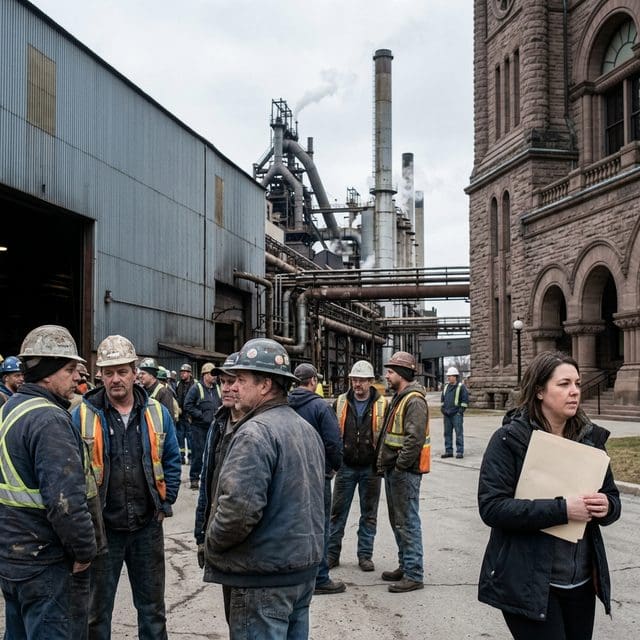
Cleveland-Cliffs says it may recall 175 laid-off Stelco workers before Christmas if Canadian steel sales rise, while Ontario child-care workers press for wage and benefit standards.
Two labor disputes on either side of the manufacturing and care economy are testing how much job security depends on demand—and how much on government policy. Cleveland-Cliffs Inc. says it hopes to recall laid-off workers at Stelco before Christmas if increased Canadian purchases of Canadian-made steel succeed. In Ontario, child-care workers are pressing the Ford government for a wage floor and basic employment standards as one centre remains locked out and another could face a strike as early as next week.
Cleveland-Cliffs CEO Lourenco Goncalves told Global News on October 28 that 175 Stelco workers were laid off, correcting an earlier figure of 500. He described a recall before Christmas as a possibility, not a commitment, and tied it to a plan to grow Canadian sales.
The conditional offer reflects a basic fact of industrial work: a job is only as durable as the orders behind it. Goncalves said Cleveland-Cliffs expected stronger Canadian demand for cold-rolled and galvanized steel when it bought Stelco in 2024, but that demand did not materialize. A policy push to buy more domestic steel could help fill the gap, though the company has not guaranteed that purchases will reach a level that brings workers back.
Ottawa has sought a jobs-restoration plan and timeline from the company. The latest public emphasis from Goncalves is on increasing Canadian sales, rather than tighter restrictions on imports. That leaves workers watching a policy debate whose outcome may determine whether a recall happens, while the company’s stated condition keeps the decision tied to market demand.
Goncalves also said Stelco is not for sale for at least the next calendar year and criticized Industry Minister Mélanie Joly for publicly discussing potential buyers. The ownership dispute adds uncertainty around the company’s direction, but the immediate question for affected workers is more concrete: whether enough orders will come in to restore their jobs.
In Toronto, CUPE Ontario says its president, Yolanda McClean, will join locked-out Ideal Child Services workers and Start Right Child Care Centre workers at Queen’s Park on October 29. The Start Right workers could strike as early as next week. The union says it will call on the Ford government for a wage floor, benefits, pension standards and an accountable bilateral agreement.
The planned press conference is scheduled for 10 a.m. in the Queen’s Park Media Room, followed by a noon rally outside the legislature. The union’s stated demands point to a broader tension in publicly funded care: the service depends on workers, but employment standards can vary across providers. The available information does not establish the precise wage gap or the cost of CUPE’s proposals, so the case for a province-wide framework remains a demand rather than a tested estimate of its effects.
Neither dispute offers a quick measure of whether jobs are improving across the wider labor market. The Stelco recall is still contingent on sales, and the child-care action is focused on workplace standards rather than a published count of jobs at risk. But both show how workers bear the uncertainty when employers face weak demand or public systems leave pay and benefits unsettled.
For steelworkers, the decisive measure will be whether additional orders translate into actual recalls. For child-care staff, it will be whether negotiations and government policy produce enforceable standards. Promises, rallies and proposed agreements may shape those outcomes; until then, workers have little certainty about what comes next.

Tom Blake serves as the Senior Correspondent for Labor, Wages, and Automation at Just Right News, where he brings a grounded, principled perspective to the most pressing economic issues facing the American heartland. As the lead voice behind the acclaimed feature series “The Price of Work,” Tom focuses his reporting on the intersection of traditional industry and the rapidly evolving technological landscape, always prioritizing the dignity of the individual worker and the health of the American family.
Tom’s deep understanding of the labor market is not merely academic; it is rooted in his upbringing in Detroit, Michigan. Growing up in the shadow of the automotive industry, he witnessed firsthand the triumphs and tribulations of the American blue-collar workforce. He saw how the stability of a manufacturing job could build a community and, conversely, how the erosion of those industries could tear the social fabric apart. This background instilled in him a lifelong respect for the trades and a healthy skepticism toward economic policies that prioritize globalist interests over the well-being of local communities.
Now based in Pittsburgh, Pennsylvania, Tom continues to report from the front lines of the shifting economy. Pittsburgh, a city that has reinvented itself while maintaining its gritty, industrious spirit, provides the perfect vantage point for his beat. From the steel mills that remain to the high-tech robotics labs reshaping the city’s future, Tom explores how automation is changing the nature of employment. His reporting often highlights the tension between innovation and tradition, arguing that while progress is inevitable, it must not come at the expense of the American worker’s ability to provide for their family through honest, meaningful labor.
In his role at Just Right News, Tom has become a vital voice for those who feel overlooked by mainstream economic coverage. He rejects the notion that the decline of American manufacturing is an unavoidable casualty of the modern era. Instead, his work often examines how regulatory overreach, rising energy costs, and the unchecked rise of automation impact the take-home pay of everyday citizens. Through “The Price of Work,” Tom delves into the true cost of economic shifts, looking beyond the raw data to tell the stories of the people behind the statistics.
Tom’s reporting is characterized by a commitment to the conservative values of self-reliance, fiscal responsibility, and the preservation of the American dream. He believes that a strong nation is built on a foundation of stable jobs and fair wages, and his work seeks to hold both government and corporate entities accountable to that standard. Whether he is interviewing a shop floor manager about the implementation of new AI technology or analyzing the impact of wage inflation on small businesses, Tom provides a clear-eyed analysis that resonates with readers who value hard work and common sense.
Through his dedicated coverage, Tom Blake remains a steadfast advocate for the American workforce, ensuring that the voices of those in the industrial heartland are heard loud and clear in the national conversation. His perspective is essential for anyone seeking to understand the complex realities of labor and automation in the twenty-first century.