

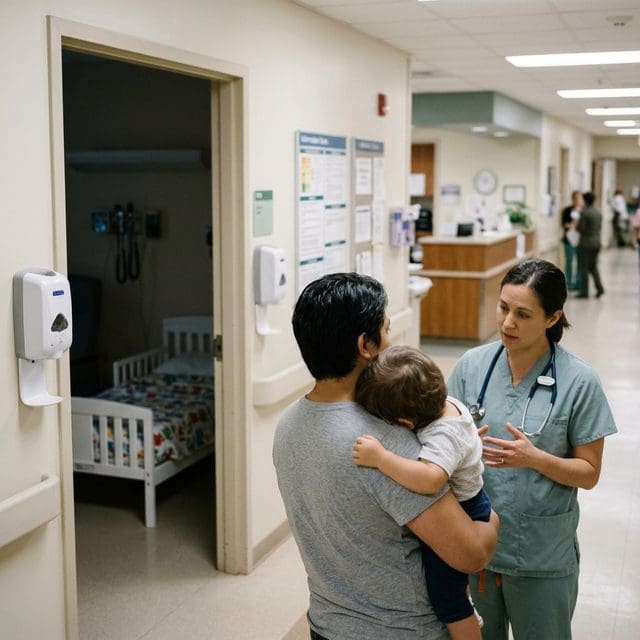
Pediatric care units have closed in several states, raising questions about access for families and the financial pressures facing hospitals that treat children.
For families whose children need critical care, a hospital bed is not an abstract line in a budget. Its location can determine how far a child must travel for treatment. Recent closures put a broader policy question in concrete terms: can hospitals sustain children’s services, particularly outside major population centers?
Pediatric intensive-care units closed during the past year in Montana, Oregon and Missouri, while pediatric overnight units also shut in Illinois and California, KFF Health News reported Oct. 28. An analysis cited by KFF found that the number of hospitals with pediatric inpatient units fell nearly 30%, from 1,749 in 2008 to 1,226 in 2022.
The national decline predates this year’s closures. The analysis counts hospitals with pediatric inpatient units, not specifically intensive-care beds, and the recent state closures do not by themselves explain the trend. Together, however, the figures show a shrinking footprint for hospital-based pediatric care.
The KFF report identifies shortages of pediatric subspecialists and difficulty recruiting staff as contributing factors. Keeping a specialized unit operating requires qualified clinicians, including when patient numbers are low or vary over time. The report does not identify one cause for every closure, and staffing or finances should not be treated as the sole explanation.
The calculation can be difficult for hospitals: maintaining pediatric intensive care requires around-the-clock capacity, while limited patient volumes and scarce staff can make that capacity harder to sustain. Closing a unit may ease pressure on a hospital’s workforce and finances, but it can shift the burden to families and other facilities. KFF reported that children needing intensive care may have to travel farther as services disappear.
The report does not quantify the added travel costs or clinical effects, and the closures do not establish how individual children fared. But fewer local services leave families with fewer options when a child needs specialized care. They may have to depend on hospitals elsewhere for available capacity.
Medicaid is central to the policy debate. About half of U.S. children are covered by Medicaid or the Children’s Health Insurance Program, according to KFF. Pediatricians warned that federal Medicaid cuts could prompt further reductions in children’s services. If public coverage is a major source of payment for children’s care, changes in funding could affect hospitals’ ability to maintain services.
The report does not provide a dollar estimate of what closures cost hospitals or establish that Medicaid policy caused the recent shutdowns. Staffing and recruitment difficulties are also part of the picture. Any assessment of proposed funding changes should distinguish documented closures from the reasons hospitals give and forecasts about what may happen next.
The policy choice is not simply whether to preserve every unit regardless of cost. It is whether families have reliable access to appropriate care, and whether payment and workforce policies support that access. Clear information about where pediatric services remain available, why units close and how patients are redirected would help families and policymakers assess the consequences.
Pediatric inpatient capacity was declining before the latest warnings about Medicaid. With units already disappearing in multiple states, the prospect of additional financial pressure raises a practical question: who will provide critical care when the nearest hospital can no longer do so?

Susan Carter serves as a Senior Correspondent for Just Right News, where she leads the network’s comprehensive coverage of Health, Medicine, and Public Policy. With a career dedicated to dissecting the complexities of the American healthcare system, Susan brings a principled perspective to the most pressing debates of the day. Her reporting is characterized by a commitment to individual liberty, fiscal responsibility, and a healthy skepticism of government overreach, making her a vital voice for audiences seeking clarity in an increasingly regulated landscape.
Raised in Minneapolis, Minnesota, Susan’s professional outlook is deeply informed by the values of the American heartland. Growing up in the Twin Cities, she witnessed firsthand the importance of community-driven solutions and the resilience of the individual. This Midwestern foundation instilled in her a firm belief that the best answers to public policy challenges often come from local innovation and personal responsibility rather than top-down federal mandates. Her background allows her to translate complex legislative jargon into stories that resonate with families who value common sense and local autonomy.
Now based in Baltimore, Maryland, Susan operates from a unique vantage point at the intersection of medical innovation and urban policy. Living and working in a city renowned for its world-class medical institutions and significant public health challenges, she has a front-row seat to the realities of the modern healthcare landscape. Her proximity to these hubs of research and policy allows her to scrutinize how government intervention affects the quality of care and the freedom of medical professionals. In Baltimore, she sees the tangible results of policy decisions, using the city as a lens through which to examine the broader national health debate and the impact of federal spending on local communities.
As the lead for the acclaimed feature series “The Cost of Care,” Susan dives deep into the economic realities facing patients and providers alike. Her work focuses on the necessity of price transparency, the benefits of market competition, and the preservation of the sacred doctor-patient relationship. She is a staunch advocate for the idea that a well-informed public is the best defense against bureaucratic inefficiency. Through this series, she has exposed the hidden drivers of rising medical expenses, always seeking to empower the individual consumer over the massive institution.
Susan’s reporting on public policy is characterized by a commitment to rigorous inquiry and a focus on constitutional limits. Whether she is analyzing new pharmaceutical regulations, investigating the impact of federal health mandates, or exploring the future of medical technology, her goal remains the same: to provide Just Right News audiences with the facts they need to navigate a complex world. By blending her Midwestern sensibilities with the insights gained from her base in Maryland, Susan Carter has become a trusted authority for those who believe that personal freedom and public health are inextricably linked. Her work continues to challenge the status quo, advocating for a system that respects the taxpayer and prioritizes the patient.