

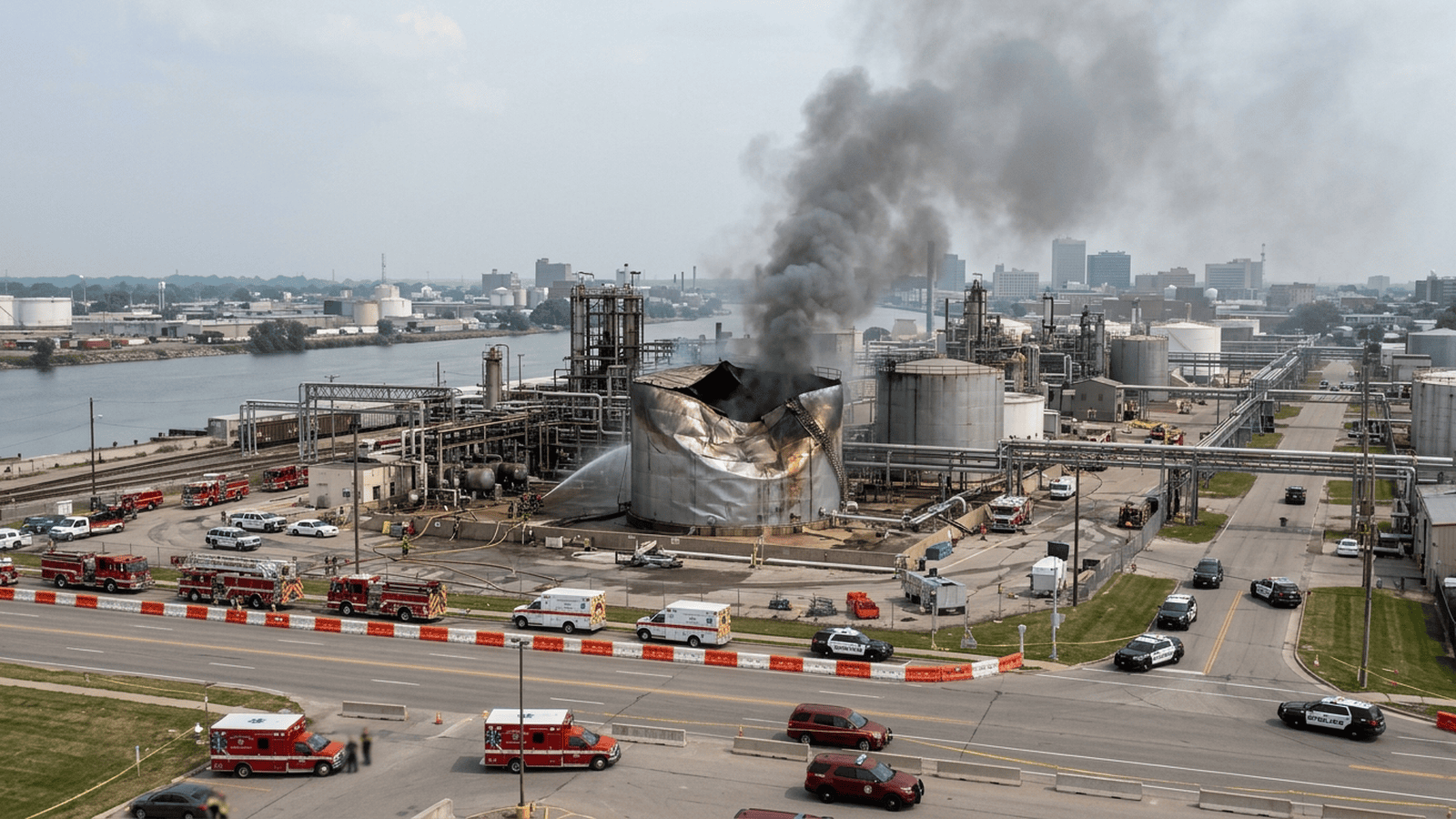
A chemical tank exploded in Toledo around 9:30 p.m. Tuesday, and city officials ordered residents within one mile to evacuate while people within three miles were told to shelter in place. More than 900 people live in the evacuation area, and the mayor said officials believed they had all left by Wednesday morning. The tank held glycidyl methacrylate, and officials warned it could still be emitting chemical and might remain explosive. Responders and hazardous-material teams held back because of the danger, while fog delayed planned drone monitoring. Officials were set to reassess conditions, but the cause, air toxicity level and timing for changing the orders had not been confirmed.
TLDR: Toledo’s evacuation and shelter orders cover residents near a tank that exploded Tuesday night and may still pose chemical and explosion risks. Officials are assessing conditions, while fog has delayed drone monitoring and the cause and air toxicity level remain unknown.
A chemical tank exploded in Toledo, Ohio, around 9:30 p.m. Tuesday, prompting the city to order evacuations and sheltering in nearby areas. Mayor Wade Kapszukiewicz said Wednesday morning that the tank could still pose an explosive risk. A sheriff’s deputy was injured while responding to the blast and drove himself to a hospital, the mayor said.
The city’s stated rationale for the orders is the risk of a toxic release and another explosion. Officials said the tank may still be emitting chemical and could be explosive within 12 hours of the incident. The evacuation and shelter instructions set clear boundaries while responders assess conditions.
The city ordered people within one mile of the explosion to leave homes and businesses Tuesday night. More than 900 people live in that area, and the mayor said officials believed all had left by Wednesday morning. Residents beyond the evacuation area and within three miles were told to shelter in place.
MC Tank Transport said the tank contained glycidyl methacrylate, an industrial chemical used in some plastics, paints and coatings. Mayor Kapszukiewicz said it is a liquid inside the tank but becomes a gas if released. The tank can hold 5,500 gallons in liquid form. Officials have not said what caused the explosion.
Video from the area showed a large plume in the sky. The city fire department said contact with the chemical may cause burning sensations in the eyes, nose, mouth or skin. It also listed headache, dizziness, tiredness, nausea and vomiting as possible effects of overexposure. Health department director Karim Baroudi said officials were trying to determine the level of toxicity in the air to provide better guidance.
Baroudi advised residents to close their windows. He also advised people who feel eye irritation or have heavy breathing to take a shower for now. The fire department said people who experience symptoms should contact a medical professional. The information available Wednesday morning did not establish how much chemical, if any, had entered the air or who may have been exposed.
The response has proceeded in stages. First responders, hazardous-material teams and safety teams were not approaching the tank because of the risk of another explosion, the mayor said. Officials planned to reassess conditions later Wednesday morning. That caution leaves the immediate site without an approach by those teams while the hazard is evaluated.
Fog complicated monitoring efforts early Wednesday in Toledo, a city of about 265,000 people. Low visibility delayed plans to use drones to monitor the site. The mayor said the fog was unrelated to the explosion, and the National Weather Service expected it to lift by mid-morning. The delay meant aerial monitoring could not proceed as initially planned during the fog.
The available account does not report evacuation expenses, fees, forms or a deadline for residents to return. It also does not describe a formal compliance penalty. The practical instructions are direct: people in the one-mile zone were ordered out of homes and businesses, while residents within the surrounding three-mile area were told to stay in place. More than 900 residents were directly within the evacuation zone, and officials believed they had left by Wednesday morning.
The incident has temporarily displaced residents and restricted access to homes and businesses. It has also limited responders’ access to the damaged tank and delayed drone monitoring because of visibility. The cause of the explosion, the amount of chemical in the air and the tank’s current condition remained unconfirmed in the Wednesday morning account. Those are material uncertainties, not details that can be settled by the evacuation boundaries alone.
MC Tank Transport said it was working with the fire department and other emergency authorities. Company representatives were on their way to Toledo, the mayor said. The company said its overriding concern was the safety of residents, emergency responders and employees. The account did not specify what additional steps the company would take or when the evacuation and shelter orders might change.
Officials said teams would reassess conditions later Wednesday morning, and monitoring depended in part on improved visibility. Those are the next necessary steps for evaluating the site and guiding residents. The report provides no further timetable for lifting the orders or confirming the chemical levels in the air, so those decisions remain with local authorities as the assessment continues.

Mason Reed serves as a Staff Writer for Just Right News, where he spearheads the Future Frontiers & Special Projects desk. In an era defined by rapid technological shifts and evolving social landscapes, Mason provides a steady, principled voice, examining the innovations of tomorrow through the lens of traditional American values. His work is most prominently featured in his signature series, “The Next Horizon,” where he explores the intersection of emerging technology, national sovereignty, and the preservation of individual liberty.
A native of San Diego, California, Mason’s worldview was shaped by the unique culture of his hometown. Growing up in a region defined by its strong military presence and its history of maritime industry, he developed a deep-seated respect for the institutions that provide national stability and the entrepreneurial spirit that drives the American economy. This upbringing instilled in him a belief that true progress is not found in discarding the past, but in building upon a foundation of proven principles. His reporting often reflects this San Diego influence, emphasizing the importance of a robust national defense and the necessity of maintaining a competitive edge in the global marketplace.
Now based in San Francisco, Mason operates from the heart of the world’s technological engine. Living and working in the Bay Area provides him with a front-row seat to the advancements—and the ideological challenges—emanating from Silicon Valley. While many in the region embrace a “move fast and break things” mentality, Mason’s reporting serves as a vital counterweight. He offers Just Right News readers a “boots on the ground” perspective, documenting how radical local policies and the concentration of tech power impact the everyday lives of citizens. His proximity to the industry allows him to cut through the marketing jargon of big tech to uncover the real-world implications for privacy, free speech, and the nuclear family.
In his “Future Frontiers” beat, Mason tackles complex subjects ranging from the ethics of artificial intelligence to the burgeoning private space race. He approaches these topics with a healthy skepticism toward centralized bureaucracy, championing instead the decentralized innovations that empower individuals. Through “The Next Horizon,” he highlights the pioneers and thinkers who are working to ensure that the future remains a place where human dignity and constitutional rights are protected. He believes that the rapid pace of change requires more than just technical expertise; it requires a moral compass rooted in the Western tradition.
Throughout his tenure at Just Right News, Mason has remained committed to the idea that the future is something to be shaped, not merely accepted. His writing is characterized by a rigorous defense of American exceptionalism and a belief that the country’s best days lie ahead, provided it remains true to its founding ideals. Whether he is investigating the impact of automation on the American workforce or profiling the next generation of aerospace engineers, Mason Reed ensures that his readers are equipped with the insights they need to navigate a changing world with confidence and clarity.