

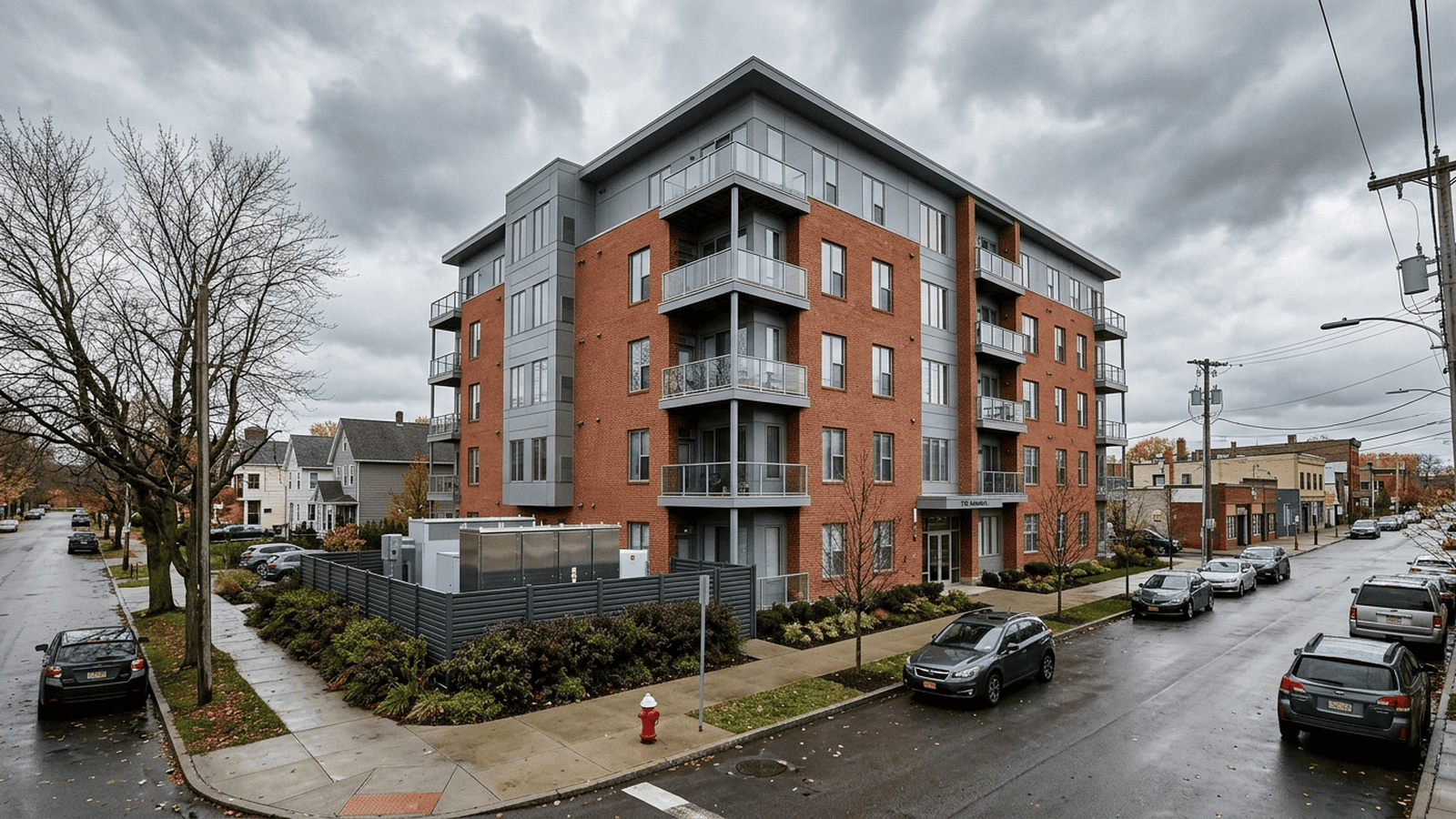
A 3.75-megawatt-hour battery at Buffalo’s Peace Bridge Place can power the affordable housing complex for several days and support it during outages. Viridi and state officials say the project is intended to demonstrate that large batteries can operate safely in residential buildings while helping manage electricity costs and grid strain. Viridi reports spending six years and $10 million on fire-resistant design and says its system passed an indoor safety standard without added building fire suppression. The utility will pay the complex for reducing grid use during high demand and for sending power back if needed. Installation costs, public funding totals, resident paperwork, and a future oversight timetable are not stated in the available account.
TLDR: A major Buffalo apartment battery will store electricity for high-demand periods and outages, while its owners seek to demonstrate safe indoor operation. Reported testing and utility payments support the project’s case, but total costs and future oversight details are not provided.
A large battery system at an affordable housing complex in Buffalo is set to store electricity when it is plentiful and supply the building when the grid is strained or power is costly. The 3.75-megawatt-hour lithium-ion system at Peace Bridge Place can power the complex for several days, according to its manufacturer, Viridi, and developer, Good Carbon Co. The project is among the largest battery installations in a U.S. residential building.
The stated purpose is to demonstrate that large batteries can operate safely in places where people live and work. State officials and the companies also present the system as a way to improve power reliability and manage electricity costs. Those aims matter because battery installations remain uncommon in residential buildings amid fire concerns and high costs.
The system stores excess electricity and releases it when demand rises. Batteries can help steady supply when wind and solar sources are not producing, and they can store surplus hydropower as well. New York is a major hydropower-producing state, and Buffalo is near Niagara Falls, where most of that power is generated.
Peace Bridge Place was selected in part because it is an all-electric building. Its heating and cooling rely on geothermal energy rather than natural gas, and the complex needed additional resilient power. Local electricity demand can exceed available supply, according to Viridi’s chief executive, while utility National Grid supported the project.
The battery can serve the building during outages. At times of high demand, the complex will also be paid by the utility for reducing its draw from the grid and for sending power back if needed. The arrangement is expected to reduce the property’s overall electricity costs, a benefit that the project’s backers say will reach residents.
The New York State Energy Research and Development Agency helped fund the installation as part of its effort to include disadvantaged communities in the clean-energy transition. Peace Bridge Place is classified as affordable housing because its renters earn no more than 80 percent of the area median income, according to Good Carbon. The developer says storage will be important in future multifamily housing projects.
Safety testing is central to the project’s case. Viridi says it spent six years and $10 million developing a fire-resistant battery container. Half of that expense went toward batteries destroyed during testing. The company says plates, pouches and spacing isolate each battery cell, so a failure in one cell does not spread to neighboring cells.
A test required the battery to be forced to fail while a cheesecloth covered the container. The test report says the cloth did not char or ignite. Viridi announced in April that its system had met Underwriters Laboratories safety standards for indoor installation without additional fire suppression in the building. Clean-energy finance expert Jigar Shah said Viridi is the only company to consistently pass the test, which he described as exceptionally difficult.
The precautions address a genuine concern. Large battery fires have drawn attention, and some communities have opposed further projects. Viridi’s chief executive said that fires involving products on the market over the past decade had held back installations at scale. At the same time, the Electric Power Research Institute reports that battery failure rates have declined as more systems have been installed. The Buffalo project is intended to add practical evidence to that record, but the supplied information does not establish that every battery design or installation carries the same safety profile.
The commercial model connects the building, its battery, the utility and public support. Viridi manufactures the system, Good Carbon developed the housing project, National Grid supported the endeavor, and NYSERDA helped fund it. The complex can lower costs by using stored power instead of drawing from the grid during high-demand periods, while utility payments for reducing grid use or returning electricity provide another source of value. The excerpt does not state the project’s total installation cost, the amount of public funding, or the precise payment terms.
Practical impacts are clear in some areas and unspecified in others. Residents of the affordable complex are the direct beneficiaries of potential lower electricity costs and backup power, while the building’s operator coordinates use with the utility. The system can provide power for several days, and the project has passed the cited indoor safety standard; the account gives no resident paperwork, compliance forms, recurring fees, enforcement schedule or project deadline. Those details are not reported, rather than evidence that no further requirements exist.
The next step is to see whether this installation demonstrates the safety and viability that state officials and the companies expect. NYSERDA’s president described it as an important demonstration, and the system’s testing record provides specific evidence behind that assessment. No additional oversight schedule or compliance deadline is provided in the account, so those matters remain unspecified. The project now offers a real-world test of residential battery storage, with safety performance, operating costs and utility coordination as the central points to watch.

Greg Sanders serves as the Senior Correspondent for Corporate Power and Antitrust at Just Right News, where he brings a principled, conservative perspective to the complex intersection of big business, government regulation, and the American consumer. With a career dedicated to investigative depth and economic clarity, Greg has become a leading voice in examining how the consolidation of industry power impacts the foundational values of the free market and individual liberty.
Raised in Denver, Colorado, Greg’s reporting is deeply informed by the Western spirit of independence and a healthy skepticism of centralized authority. Growing up in the shadows of the Rockies, he witnessed firsthand the importance of local entrepreneurship and the vital role that small-medium enterprises play in sustaining vibrant communities. This upbringing instilled in him a belief that the American Dream is best preserved when the playing field remains level and when competition—rather than backroom deals between corporate lobbyists and federal regulators—dictates success. For Greg, the rugged individualism of his home state serves as a constant reminder that the economy should serve the people, not the other way around.
Now based in Chicago, Illinois, Greg operates from the heart of the nation’s industrial and financial crossroads. His location in the Midwest provides him with a unique vantage point to observe the real-world consequences of corporate overreach. From the boardrooms of the Loop to the manufacturing hubs that define the region, he tracks the movement of capital and the shifting tides of market influence. Chicago’s history as a center of trade and labor offers a rich backdrop for his work, allowing him to bridge the gap between high-level economic theory and the lived experiences of hardworking Americans who feel the squeeze of monopolistic practices.
At Just Right News, Greg’s beat focuses on the “new monopolies” and the rise of “woke” corporate culture. He argues that when corporations become too large, they often abandon their fiduciary duties to shareholders in favor of social engineering and political posturing. His reporting seeks to hold these “Titans” accountable, ensuring that the power of the purse is not used to silence dissent or bypass the democratic process. He is a firm advocate for the idea that true conservatism requires a vigilant defense of competition, preventing any single entity—public or private—from exerting undue control over the lives of citizens.
This mission is most clearly seen in his acclaimed feature series, “The Titans and the Toll.” In this ongoing project, Greg explores the human cost of market consolidation, from the erosion of consumer choice to the decline of local economies. Through rigorous analysis and boots-on-the-ground reporting, he documents how the concentration of power in sectors like tech, agriculture, and finance creates a “toll” paid by the average family.
Greg Sanders remains committed to the idea that a transparent, competitive market is the greatest engine for prosperity ever devised. Through his work at Just Right News, he continues to provide the essential oversight necessary to protect that engine from the encroaching influence of corporate giants and the bureaucratic structures that enable them.