

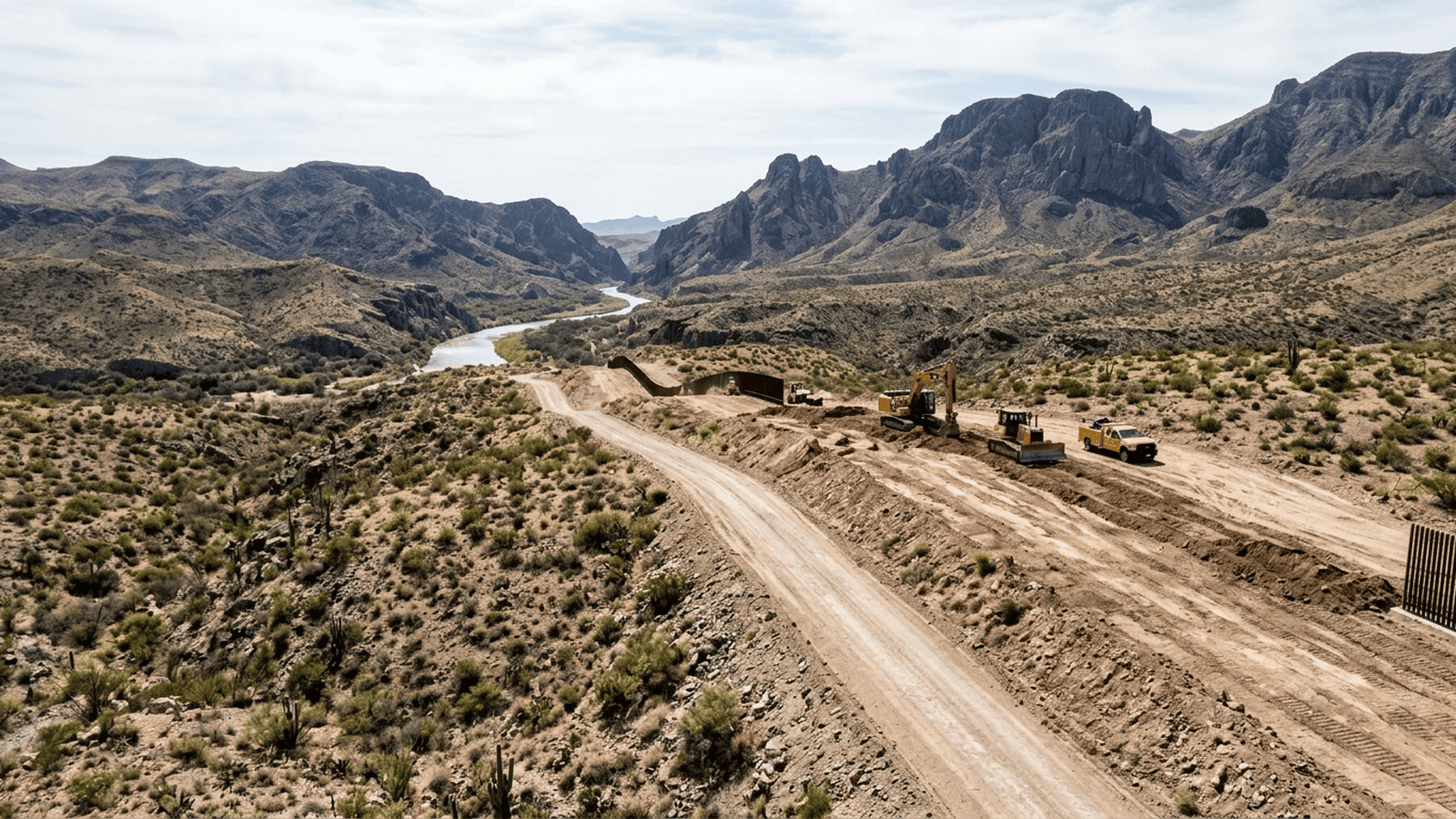
The Justice Department has asked the Supreme Court to let the Trump administration resume border-wall and infrastructure work in the Big Bend region while its legal challenge continues. The administration says construction is needed to address illegal crossings and drug smuggling, citing more than 89,000 apprehensions in the sector from 2021 through 2025. Plaintiffs counter that the sector accounts for a small share of border-wide apprehensions and that the waivers exceeded agency authority. A lower-court injunction currently bars construction and ground-disturbing activity, despite contracts awarded for five projects and work begun on a 47-mile stretch. The Supreme Court’s response will determine whether the work can restart for now; total costs and a decision deadline are not specified.
TLDR: The administration is asking the Supreme Court to lift a construction pause affecting planned barriers, roads and detection systems in West Texas. A lower-court order remains in force as judges consider the administration’s authority to waive certain legal requirements.
The Justice Department has asked the Supreme Court to let the Trump administration resume border-wall construction in the Big Bend region of West Texas. The request seeks to lift a lower-court order that bars the Department of Homeland Security from building barriers and related infrastructure there. The dispute puts border enforcement, federal authority and protections for local land and resources before the justices.
The administration says the work is needed to stop illegal crossings and drug smuggling. Solicitor General D. John Sauer argued that the injunction frustrates the government’s ability to address those flows, and said officials selected the project areas because of high rates of crossings and smuggling in recent years. That is the administration’s stated rationale for seeking emergency relief.
The affected Big Bend Sector covers more than 500 miles of the U.S.-Mexico border and 77 Texas counties. The government’s plans include walls and roads spanning more than 300 miles, with 30-foot bollard walls planned from Fort Quitman to Closed Canyon in Big Bend Ranch State Park. Customs and Border Protection has said the proposed wall will not cut through Big Bend National Park, though other infrastructure would be built in the park, including patrol roads, detection technology and roughly 17 miles of vehicle barriers.
The legal fight concerns both the project and the authority used to move it forward. A 1996 federal immigration law allows the homeland security secretary to waive legal requirements considered necessary for quick construction of barriers and roads near the southern border. Former Homeland Security Secretary Kristi Noem invoked that law for the project, and Secretary Markwayne Mullin later issued two additional waivers. A federal judge has since found that the secretaries exceeded their authority when issuing the waivers between February and July.
The scale of reported apprehensions is disputed. The government said more than 89,000 people were apprehended trying to cross illegally in the Big Bend Sector from 2021 through 2025. Plaintiffs in the case say the sector ranks last among the southern border’s seven sectors for apprehensions. They also point to court filings showing that the sector covers more than 25% of the border while accounting for between 0.3% and 2.2% of annual border-wide apprehensions.
Those competing figures inform the argument over whether the region qualifies as an area of “high illegal entry” under the law. The administration argues that crossings and drug smuggling justify the project. The plaintiffs’ figures suggest a comparatively small share of total apprehensions. The figures describe different parts of the dispute, and the Supreme Court request does not itself resolve how the law applies to the project.
The case began after an environmental nonprofit, a professional riverboat guide and a religious organization dedicated to preserving the Sacred Heart of the Church of Jesus along the Rio Grande sued in April. They sought to stop the project after the administration used the waivers. Their concerns include the project’s effects on cultural, recreational, wildlife and environmental resources. Federal agencies would typically have to ensure compliance with environmental protection and historical preservation laws before proceeding, but the waivers were intended to allow construction without those requirements deemed necessary to be met first.
Construction has already advanced in parts of the region. CBP said work on a 47-mile stretch began last month, and the Justice Department said the government has awarded contracts for five border-barrier projects there. Earlier in the year, images of bulldozers arriving at Big Bend National Park prompted pushback from lawmakers in both parties, cattle ranchers and local law enforcement officials in Texas. CBP Commissioner Rodney Scott paused construction inside the park until the end of September, while the broader legal dispute continued.
The practical impact includes a pause on construction and ground-disturbing activity across the Big Bend Sector under the preliminary injunction. Judge Kathleen Cardone issued that order earlier this month and rejected the administration’s request to pause it shortly before the Justice Department appealed to the Supreme Court. The request seeks permission to resume construction for now. The excerpt gives no total project cost, fee, form requirement or Supreme Court decision deadline, so those details remain unspecified.
The project’s tradeoffs are concrete: roads, detection systems, vehicle barriers and wall construction would affect a remote area with cultural, recreational, wildlife and environmental resources. Waivers reduce the usual role of environmental and historical-preservation requirements, while the injunction currently limits construction and ground disturbance. The legal contest also tests the balance between executive authority and court oversight. Those limits and tradeoffs remain part of the case, rather than settled outcomes.
The Supreme Court is the next venue for the administration’s request, while the lower-court injunction remains in force unless it is lifted. The ruling will determine whether construction can resume during the case and will bear on the disputed scope of the secretary’s waiver authority. Further judicial review and compliance with any applicable requirements are necessary steps in determining what work may proceed.

Jordan Lee serves as the Senior Correspondent for Wall Street, Finance, and Monetary Systems at Just Right News. Based in the heart of the world’s financial capital, New York City, Lee brings a sharp, principled eye to the complex mechanisms that drive the global economy. His reporting is defined by a commitment to fiscal responsibility, the defense of the free market, and a deep-seated belief that a transparent monetary system is the bedrock of a free society.
Raised in Portland, Oregon, Lee’s perspective was forged in a city that has undergone significant cultural and economic shifts. His upbringing in the Pacific Northwest instilled in him a profound appreciation for the industriousness of small business owners and the importance of local economic stability. Watching the evolution of his hometown’s landscape sparked an early interest in how federal fiscal policy and large-scale financial trends eventually trickle down to the average citizen. This background provides him with a unique vantage point; he understands the growing disconnect between the policy-making elite and the reality of Main Street, a theme that frequently resonates throughout his work.
Now operating from his base in New York City, Lee bridges the gap between the high-stakes trading floors of Manhattan and the households of everyday Americans. He views the financial sector not merely as a collection of numbers and tickers, but as a vital engine of American prosperity that requires constant vigilance and accountability. His reporting often highlights the dangers of centralized financial control and the necessity of maintaining a system that rewards merit, risk-taking, and innovation.
As the creator and lead of the featured series, “The Invisible Economy,” Lee pulls back the curtain on the often-opaque world of monetary systems. He specializes in translating the dense jargon of central banking and international finance into actionable insights for the Just Right News audience. His work explores the “invisible” forces—such as inflationary pressures, regulatory creep, and the expansion of the administrative state—that erode the purchasing power of American families. By focusing on these systemic issues, Lee empowers readers to understand the hidden forces shaping their financial independence.
Lee’s journalistic philosophy is rooted in a steadfast commitment to traditional American values. As an Asian American professional who has navigated the competitive corridors of the financial world, he is a vocal advocate for meritocracy and the preservation of the American Dream. He believes that a stable currency and a predictable regulatory environment are essential for national sovereignty and individual liberty. His reporting frequently warns against the risks of government overreach in the private sector, arguing that the most effective solutions to economic challenges arise from competition and individual enterprise rather than bureaucratic mandates.
At Just Right News, Jordan Lee remains dedicated to providing a clear-eyed defense of the taxpayer. Whether he is analyzing market volatility or investigating the long-term implications of national debt, his mission is to provide the truth about where the money is going and what it means for the future of the country. Through his rigorous analysis and principled stance, Lee has become a trusted voice for those who value a strong, sovereign, and fiscally sound America.