

An international team created medium-density amorphous ice by mechanically milling ordinary ice at very low temperatures. The disordered solid falls between two previously known amorphous forms and may help scientists investigate water’s unusual properties, though it does not prove that liquid water has two distinct forms.
TLDR: Researchers used steel-ball milling at very low temperatures to make a new disordered form of ice, with a density between two previously known amorphous types. The material could help test ideas about water’s unusual behavior and ice in space, but more work is needed to establish what it reveals about liquid water.
Water is familiar in its everyday forms: liquid, vapor and crystalline ice. But in 2023, an international research team reported making a type of ice unlike any previously known. The material, called medium-density amorphous ice, has no orderly crystal structure and a density between two other amorphous forms of ice.
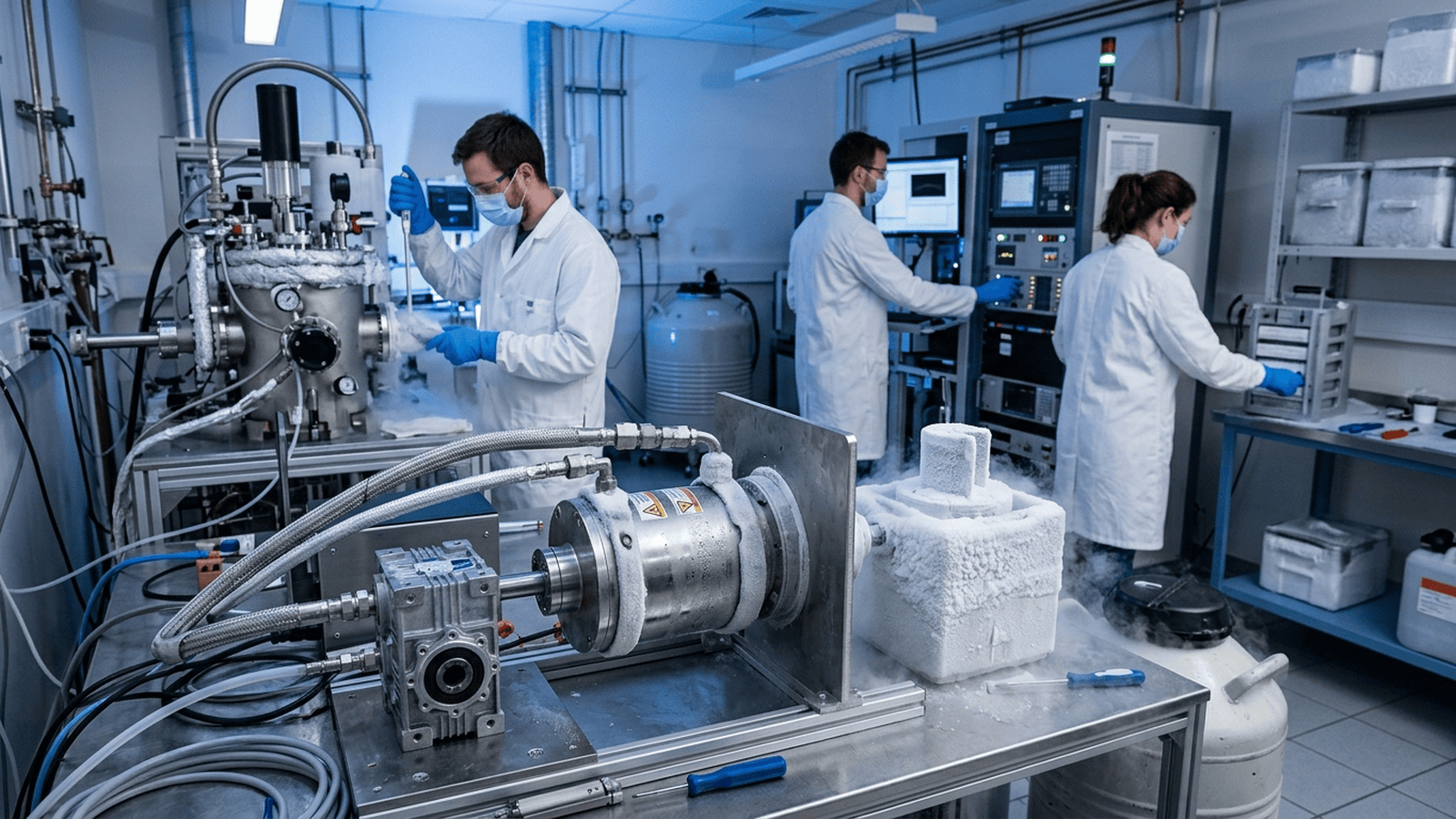
The team produced it by placing ordinary ice in a container with small steel balls and shaking the mixture at very low temperatures. The repeated impacts ground and compressed the ice without allowing it to melt. Researchers at University College London and the University of Cambridge led the work, with collaborators in other countries. Their findings appeared in the journal Nature.
Amorphous ice is a solid in which water molecules lack the regular, repeating arrangement found in familiar ice crystals. Scientists had already made low-density and high-density amorphous ice in laboratories. Those forms differ in how closely their molecules are packed, and their existence has raised questions about whether water has more than one liquid state under certain conditions.
The new material did not fit neatly into either category. Measurements indicated a density of about 1.06 grams per cubic centimeter—between the values for the known low- and high-density forms. The researchers used several techniques to examine its structure and behavior, including X-ray diffraction and calorimetry, which measures how a material responds to heating. Computer simulations helped them interpret the results.
The team’s analysis suggested that medium-density amorphous ice is not simply a mixture of the two earlier forms. Instead, it appears to have its own structure. The researchers proposed that the material could represent water’s glassy state: a solid arrangement of molecules that retains features associated with a liquid, but does not flow. That interpretation makes the finding relevant to a long-running scientific puzzle about water’s unusual behavior.
Water’s density, heat capacity and response to pressure do not change in the straightforward way many substances do. One debated explanation is that, at sufficiently low temperatures and high pressures, liquid water may separate into two distinct liquid forms with different densities. Amorphous ice could preserve clues to those possible liquids, because its disordered structure may resemble water frozen before its molecules settle into a crystal.
The experiment does not establish that two forms of liquid water exist. The ice was made under laboratory conditions, and its structure does not directly show what liquid water does at temperatures and pressures that are difficult to study. The researchers said the new material could help test competing models, but further experiments and simulations will be needed to determine what it reveals about water’s phases.
The method itself also offers a different way to investigate materials. Rather than building an ordered crystal by carefully cooling a liquid, the researchers used mechanical force to scramble and compact frozen water. The result suggests that ball milling may help scientists explore other disordered solids, though the finding does not mean that the process will work for every material.
Amorphous ice is thought to form naturally in cold environments beyond Earth, including on icy moons and in interstellar space. The discovery could therefore inform models of how water behaves in those settings, where pressure, temperature and impacts differ from conditions on Earth. It may also help researchers understand how ice changes during collisions or as it warms.
The next steps include probing the ice at different temperatures and pressures, refining structural measurements, and comparing experiments with simulations. Those studies could clarify whether medium-density amorphous ice is a distinct phase and how it relates to liquid water. For now, the work shows that even a familiar substance can produce unexpected structures when scientists find a new way to process it.

Mason Reed serves as a Staff Writer for Just Right News, where he spearheads the Future Frontiers & Special Projects desk. In an era defined by rapid technological shifts and evolving social landscapes, Mason provides a steady, principled voice, examining the innovations of tomorrow through the lens of traditional American values. His work is most prominently featured in his signature series, “The Next Horizon,” where he explores the intersection of emerging technology, national sovereignty, and the preservation of individual liberty.
A native of San Diego, California, Mason’s worldview was shaped by the unique culture of his hometown. Growing up in a region defined by its strong military presence and its history of maritime industry, he developed a deep-seated respect for the institutions that provide national stability and the entrepreneurial spirit that drives the American economy. This upbringing instilled in him a belief that true progress is not found in discarding the past, but in building upon a foundation of proven principles. His reporting often reflects this San Diego influence, emphasizing the importance of a robust national defense and the necessity of maintaining a competitive edge in the global marketplace.
Now based in San Francisco, Mason operates from the heart of the world’s technological engine. Living and working in the Bay Area provides him with a front-row seat to the advancements—and the ideological challenges—emanating from Silicon Valley. While many in the region embrace a “move fast and break things” mentality, Mason’s reporting serves as a vital counterweight. He offers Just Right News readers a “boots on the ground” perspective, documenting how radical local policies and the concentration of tech power impact the everyday lives of citizens. His proximity to the industry allows him to cut through the marketing jargon of big tech to uncover the real-world implications for privacy, free speech, and the nuclear family.
In his “Future Frontiers” beat, Mason tackles complex subjects ranging from the ethics of artificial intelligence to the burgeoning private space race. He approaches these topics with a healthy skepticism toward centralized bureaucracy, championing instead the decentralized innovations that empower individuals. Through “The Next Horizon,” he highlights the pioneers and thinkers who are working to ensure that the future remains a place where human dignity and constitutional rights are protected. He believes that the rapid pace of change requires more than just technical expertise; it requires a moral compass rooted in the Western tradition.
Throughout his tenure at Just Right News, Mason has remained committed to the idea that the future is something to be shaped, not merely accepted. His writing is characterized by a rigorous defense of American exceptionalism and a belief that the country’s best days lie ahead, provided it remains true to its founding ideals. Whether he is investigating the impact of automation on the American workforce or profiling the next generation of aerospace engineers, Mason Reed ensures that his readers are equipped with the insights they need to navigate a changing world with confidence and clarity.