

New Orleans custodian Sterling Williams received a 2.5-year prison sentence after pleading guilty to malfeasance in office tied to a 10-inmate jail escape. His attorney said Williams should have generated a work order before shutting off water to a cell, while maintaining that Williams did not knowingly help the escape plan. Another 2.5 years of the sentence was suspended, and Williams will receive three years of probation. All 10 inmates were captured and face aggravated escape charges, with jury trials scheduled for April. Separate indictments of former Sheriff Susan Hutson and chief financial officer Bianka Brown remain pending, and both have pleaded not guilty.
TLDR: Williams’ guilty plea and sentence address his role in a breakout that followed the unauthorized water shutoff and failure to generate a work order. The inmates’ April trials and pending cases against two former sheriff’s office officials remain key next steps.
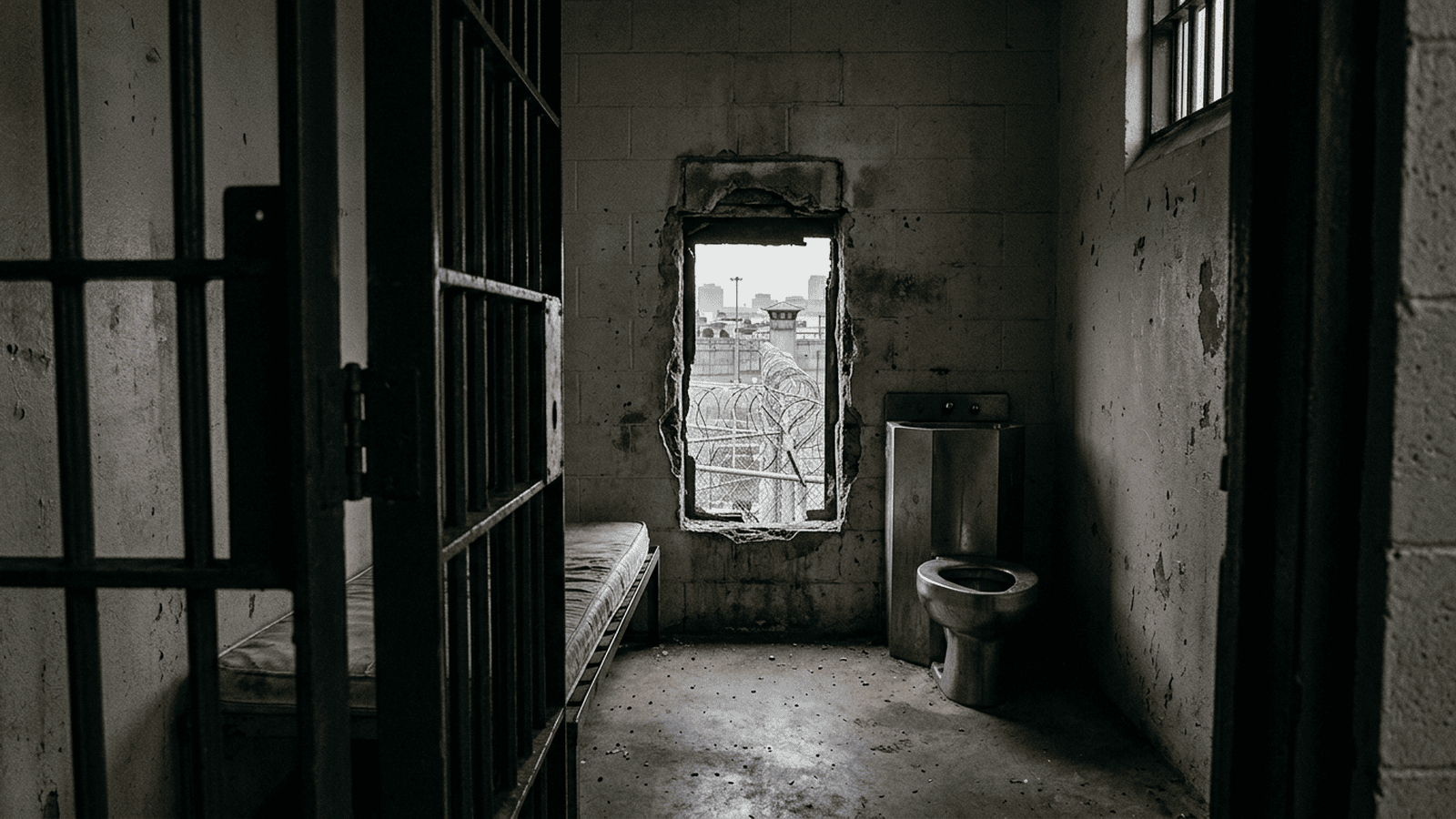
A New Orleans jail custodian received a 2.5-year prison sentence Thursday after pleading guilty to malfeasance in office connected to the escape of 10 inmates. Sterling Williams, 34, shut off water to a cell in May 2025. The inmates then removed a toilet, crawled through a gap in the wall and scaled a fence to get out of the jail.
The account gives no official policy rationale for a broader change in jail operations. It does establish the central accountability issue in Williams’ case: his attorney said a work order should have been generated before the water was shut off, and Williams admitted failing to follow protocol as a public employee. That breakdown makes the value of clear procedures plain, even though the record does not describe any new rule.
Williams pleaded guilty to one count of malfeasance in office for clearing the way for what the account calls one of the largest jailbreaks in recent U.S. history. His attorney, Michael Kennedy, said Williams did not intentionally help the inmates and acted without knowledge of their plan. Kennedy also acknowledged that Williams’ actions may have aided the escape.
The route out began with a clogged toilet. After Williams turned off the water, the inmates removed it and made their way through the opening behind it. They left a graffiti note reading “To Easy LoL.” The account describes a striking failure of jail security, while also connecting Williams’ guilty plea to a specific lapse in work procedure.
The sentence is 2.5 years in prison, with another 2.5 years suspended. Williams will also receive three years of probation. The state dropped 10 charges accusing him of being a principal to aggravated escape, an offense that carries a sentence of up to 10 years in Louisiana. Those case details define both the punishment imposed and the charges that were not pursued.
All 10 inmates were eventually captured, but the search lasted months in at least one case. One convicted murderer remained on the run for five months before being found hiding beneath a house in Atlanta. The inmates face aggravated escape charges and are scheduled for jury trial in April. Their cases remain separate from Williams’ guilty plea and sentence.
The escape investigation also reached beyond the jail worker. At least 14 other people were arrested and accused of helping the escapees, including by providing food, cash, transportation or shelter. Many were friends or family members of the inmates. Those are accusations reported in the account, not findings of guilt.
A grand jury earlier this year indicted then-Orleans Parish Sheriff Susan Hutson on 30 counts, including malfeasance, obstruction of justice and falsifying public records. Louisiana Attorney General Liz Murrill said a state probe found Hutson’s poor management led to the jailbreak. Hutson is not accused of helping the inmates escape, and she has pleaded not guilty. The sheriff’s office chief financial officer, Bianka Brown, was also indicted on 20 similar charges and has pleaded not guilty.
The practical impact in Williams’ case is concrete: prison time, a suspended prison term and three years of probation. The account says the work order should have been generated before water was shut off, but does not specify a form, fee, new compliance rule or deadline for staff. It also does not describe any broader security changes or the cost of the investigation. Those details are not established in the available account.
For jail operations, the reported failure involved a maintenance action that preceded a route through a wall and over a fence. The case shows the consequence of a public employee’s guilty plea, while the separate allegations against Hutson and Brown remain unresolved. The record supports a straightforward lesson about protocol and accountability, but does not state that new government requirements have been adopted.
The account does not say whether the jail has changed its maintenance process since the escape. It also gives no estimate of staff time spent on new checks, extra security costs, or the timing of any operational review. Without those details, the effects beyond Williams’ sentence cannot be measured from the reported facts.
The next steps are the April jury trials for the 10 inmates and the ongoing legal cases involving the indicted officials. Those proceedings and the probation term are necessary steps in the accountability process. The reported facts establish what happened in Williams’ case; they do not establish that every security problem has been fixed.

Greg Sanders serves as the Senior Correspondent for Corporate Power and Antitrust at Just Right News, where he brings a principled, conservative perspective to the complex intersection of big business, government regulation, and the American consumer. With a career dedicated to investigative depth and economic clarity, Greg has become a leading voice in examining how the consolidation of industry power impacts the foundational values of the free market and individual liberty.
Raised in Denver, Colorado, Greg’s reporting is deeply informed by the Western spirit of independence and a healthy skepticism of centralized authority. Growing up in the shadows of the Rockies, he witnessed firsthand the importance of local entrepreneurship and the vital role that small-medium enterprises play in sustaining vibrant communities. This upbringing instilled in him a belief that the American Dream is best preserved when the playing field remains level and when competition—rather than backroom deals between corporate lobbyists and federal regulators—dictates success. For Greg, the rugged individualism of his home state serves as a constant reminder that the economy should serve the people, not the other way around.
Now based in Chicago, Illinois, Greg operates from the heart of the nation’s industrial and financial crossroads. His location in the Midwest provides him with a unique vantage point to observe the real-world consequences of corporate overreach. From the boardrooms of the Loop to the manufacturing hubs that define the region, he tracks the movement of capital and the shifting tides of market influence. Chicago’s history as a center of trade and labor offers a rich backdrop for his work, allowing him to bridge the gap between high-level economic theory and the lived experiences of hardworking Americans who feel the squeeze of monopolistic practices.
At Just Right News, Greg’s beat focuses on the “new monopolies” and the rise of “woke” corporate culture. He argues that when corporations become too large, they often abandon their fiduciary duties to shareholders in favor of social engineering and political posturing. His reporting seeks to hold these “Titans” accountable, ensuring that the power of the purse is not used to silence dissent or bypass the democratic process. He is a firm advocate for the idea that true conservatism requires a vigilant defense of competition, preventing any single entity—public or private—from exerting undue control over the lives of citizens.
This mission is most clearly seen in his acclaimed feature series, “The Titans and the Toll.” In this ongoing project, Greg explores the human cost of market consolidation, from the erosion of consumer choice to the decline of local economies. Through rigorous analysis and boots-on-the-ground reporting, he documents how the concentration of power in sectors like tech, agriculture, and finance creates a “toll” paid by the average family.
Greg Sanders remains committed to the idea that a transparent, competitive market is the greatest engine for prosperity ever devised. Through his work at Just Right News, he continues to provide the essential oversight necessary to protect that engine from the encroaching influence of corporate giants and the bureaucratic structures that enable them.