

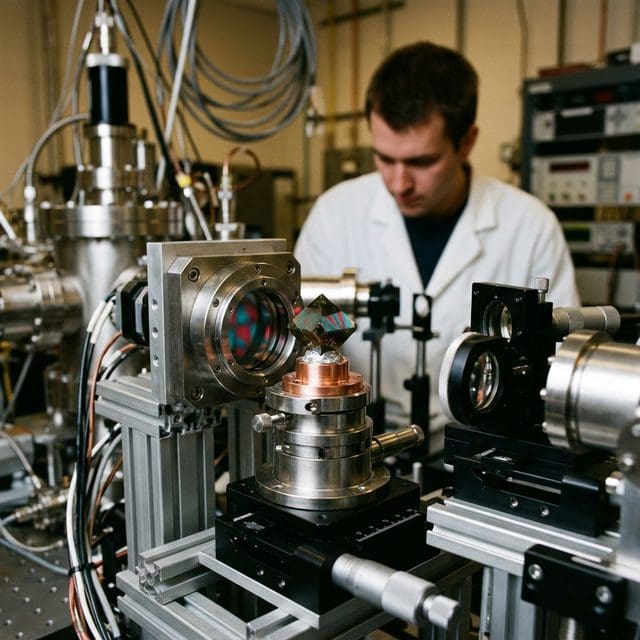
The 2026 Europhysics Prize recognizes work establishing altermagnetism, a newly identified class of magnetic materials with properties that could reshape spintronics and quantum-materials research.
For more than a century, physicists sorted collinear magnets into two broad camps: ferromagnets, whose aligned magnetic moments create an overall magnetic field, and antiferromagnets, whose opposing moments cancel. Work honored with the 2026 Europhysics Prize points to a third category: altermagnets, which have no net magnetization but can give electrons properties associated with ferromagnets.
That combination makes altermagnetism more than a new label. It may offer researchers a way to explore fast magnetic behavior and spin-polarized electrical currents without the overall magnetization characteristic of conventional ferromagnets. Those traits could prove useful in future spintronic devices, which encode and process information using electron spin as well as electrical charge. The technology is a possibility, not a product already demonstrated by the prize-winning work.
The European Physical Society’s Condensed Matter Division selected Jairo Sinova of Johannes Gutenberg University Mainz, Libor Šmejkal and Tomas Jungwirth for theoretical and experimental advances establishing altermagnetism as a distinct form of magnetic order. The account of the work was provided by Mainz University. The prize recognizes major advances in condensed matter physics, the study of how materials behave.
The researchers’ path to the classification began with puzzling predictions about how electricity moves through magnetic crystals. Some effects initially looked like unusual behavior confined to individual materials. By examining the symmetries of electron spins, the collaborators came to see a broader pattern: these materials could belong to a magnetic category distinct from the two established types.
Šmejkal developed much of the theoretical framework during eight years at Mainz, from 2016 to 2024, working with Sinova’s group and Jungwirth’s team at the Institute of Physics of the Czech Academy of Sciences in Prague. In 2022, the researchers published a systematic symmetry classification and identified hundreds of materials that might display altermagnetism.
Experimental groups then tested those predictions using different approaches, including angle-resolved photoemission spectroscopy, which maps aspects of electron behavior, and electrical-transport measurements. Results in multiple materials supported the proposed classification, according to Mainz. That experimental evidence helped move altermagnetism from a theoretical prediction toward an active field of investigation.
The distinction can be understood through what cancels and what does not. In an altermagnet, the magnetic moments balance, so the material has no net magnetization, as in an antiferromagnet. Yet the arrangement of its spins can produce an electron structure that, in important respects, resembles that of a ferromagnet. Researchers say the pairing may enable spin-polarized currents alongside rapid magnetic dynamics.
The implications may extend beyond memory and electronics. The symmetry class has prompted questions about connections to topological phenomena, unconventional superconductivity and quantum materials in which electrons interact strongly. These are research directions, not confirmed technological outcomes. Hundreds of papers have appeared in the area in recent years, and teams across Europe, North America and Asia are studying its basic properties and potential applications.
The prize also illustrates how established scientific categories can be revised when theory and measurement meet. Sinova, director of Mainz’s Spin Phenomena Interdisciplinary Center, described the discovery as evidence that even mature fields can hold fundamental surprises. The award ceremony was scheduled for September 2026 at the European Physical Society’s condensed-matter conference in Graz, Austria.
The next tests are practical as well as conceptual: researchers must determine which materials exhibit the most useful effects, how reliably those effects can be controlled, and whether they can be incorporated into devices. Altermagnetism has expanded the map of known magnetic behavior. Turning that discovery into faster or more capable computing will require further experiments and engineering.

Mason Reed serves as a Staff Writer for Just Right News, where he spearheads the Future Frontiers & Special Projects desk. In an era defined by rapid technological shifts and evolving social landscapes, Mason provides a steady, principled voice, examining the innovations of tomorrow through the lens of traditional American values. His work is most prominently featured in his signature series, “The Next Horizon,” where he explores the intersection of emerging technology, national sovereignty, and the preservation of individual liberty.
A native of San Diego, California, Mason’s worldview was shaped by the unique culture of his hometown. Growing up in a region defined by its strong military presence and its history of maritime industry, he developed a deep-seated respect for the institutions that provide national stability and the entrepreneurial spirit that drives the American economy. This upbringing instilled in him a belief that true progress is not found in discarding the past, but in building upon a foundation of proven principles. His reporting often reflects this San Diego influence, emphasizing the importance of a robust national defense and the necessity of maintaining a competitive edge in the global marketplace.
Now based in San Francisco, Mason operates from the heart of the world’s technological engine. Living and working in the Bay Area provides him with a front-row seat to the advancements—and the ideological challenges—emanating from Silicon Valley. While many in the region embrace a “move fast and break things” mentality, Mason’s reporting serves as a vital counterweight. He offers Just Right News readers a “boots on the ground” perspective, documenting how radical local policies and the concentration of tech power impact the everyday lives of citizens. His proximity to the industry allows him to cut through the marketing jargon of big tech to uncover the real-world implications for privacy, free speech, and the nuclear family.
In his “Future Frontiers” beat, Mason tackles complex subjects ranging from the ethics of artificial intelligence to the burgeoning private space race. He approaches these topics with a healthy skepticism toward centralized bureaucracy, championing instead the decentralized innovations that empower individuals. Through “The Next Horizon,” he highlights the pioneers and thinkers who are working to ensure that the future remains a place where human dignity and constitutional rights are protected. He believes that the rapid pace of change requires more than just technical expertise; it requires a moral compass rooted in the Western tradition.
Throughout his tenure at Just Right News, Mason has remained committed to the idea that the future is something to be shaped, not merely accepted. His writing is characterized by a rigorous defense of American exceptionalism and a belief that the country’s best days lie ahead, provided it remains true to its founding ideals. Whether he is investigating the impact of automation on the American workforce or profiling the next generation of aerospace engineers, Mason Reed ensures that his readers are equipped with the insights they need to navigate a changing world with confidence and clarity.