

A Japanese team found that one-atom-high steps can steer superconducting vortices, while separate Oxford work used quantum hardware to reproduce an effect in which magnetic flux stops tunneling.
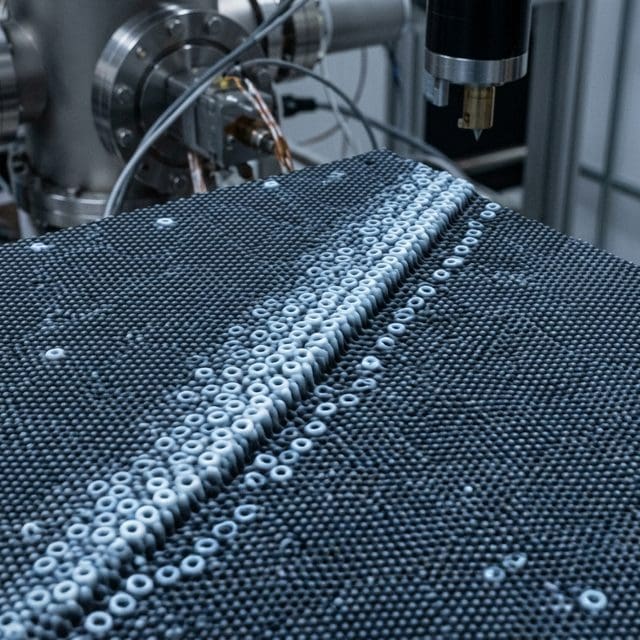
A step just one atom high can act like a preferred road for a quantum disturbance. A ScienceDaily report published October 16 describes a team led by Takashi Uchihashi at Japan’s MANA/NIMS finding that Josephson vortices in an atomic-layer superconductor moved more than 1,000 times more easily along such steps than across them.
The result shows how a material’s smallest features can shape its behavior. Superconductors carry electrical current without resistance, but magnetic vortices moving through them can disrupt that flow. Controlling the vortices could matter for superconducting electronics and other devices that rely on a stable superconducting state. The finding, however, is a laboratory result, not evidence that a new device is ready for use.
The researchers examined Josephson vortices, localized magnetic structures associated with superconducting currents, in an atomic-layer superconductor. They used scanning-tunneling microscopy to study the material at small scales and four-terminal resistance measurements to assess its electrical transport. The measurements showed that the one-atom-high steps guided vortex motion along the steps rather than across them.
The team found a particular magnetic-field range in which the behavior became especially clear. Between approximately 0.10 and 0.20 tesla, vortices flowed in one dimension without pinning. Pinning occurs when obstacles or imperfections trap vortices. Avoiding it matters because vortex movement can interfere with the performance of superconducting devices.
At the lowest temperatures, vortex motion was governed by quantum tunneling: passage through an energy barrier rather than over it. Temperature and magnetic field emerged as control parameters. The study, “Anisotropic transport of Josephson vortices in atomic-layer superconductors on vicinal surfaces,” appeared in Physical Review B in 2026.
Several practical questions remain. The report does not establish how broadly the effect applies to other superconductors, whether it can be maintained in a working device, or how it might be manufactured at useful scale. For now, the advance is a measured method for guiding vortices using atomic-scale surface structure—and a starting point for testing whether that control can improve stability.
A separate quantum-computing result, reported by Oxford Physics in September and ScienceDaily in October, demonstrates a different kind of control: shaping interference between possible paths. Oxford researchers combined trapped-ion qubits and quantum oscillators in a hybrid system to simulate the Aharonov–Bohm effect within a dynamical Z₂ lattice gauge theory.
In the Aharonov–Bohm effect, a magnetic field can influence a charged particle even when it does not travel through the field itself. In the Oxford simulation, adding magnetic flux caused two possible tunneling paths to interfere destructively. The paths canceled each other’s effects, completely suppressing tunneling and leaving the particle in its starting state.
The significance is not that researchers stopped an ordinary particle with a laboratory magnet. They used quantum hardware to simulate a physical principle, with the gauge field itself participating in the dynamics. That goes beyond a demonstration with a fixed field and offers a way to investigate how particles and fields influence one another, a central question in particle physics. The source material does not establish a near-term practical application.
The Oxford result predates the October 16 vortex report, and the available evidence does not support treating the two studies as a comprehensive survey of discoveries from this week. They nevertheless illustrate two ways of probing quantum behavior: steering vortices through atomic-scale surface structure and using programmable quantum hardware to study interactions that are difficult to reproduce directly. Further experiments will show how far either approach can go.

Mason Reed serves as a Staff Writer for Just Right News, where he spearheads the Future Frontiers & Special Projects desk. In an era defined by rapid technological shifts and evolving social landscapes, Mason provides a steady, principled voice, examining the innovations of tomorrow through the lens of traditional American values. His work is most prominently featured in his signature series, “The Next Horizon,” where he explores the intersection of emerging technology, national sovereignty, and the preservation of individual liberty.
A native of San Diego, California, Mason’s worldview was shaped by the unique culture of his hometown. Growing up in a region defined by its strong military presence and its history of maritime industry, he developed a deep-seated respect for the institutions that provide national stability and the entrepreneurial spirit that drives the American economy. This upbringing instilled in him a belief that true progress is not found in discarding the past, but in building upon a foundation of proven principles. His reporting often reflects this San Diego influence, emphasizing the importance of a robust national defense and the necessity of maintaining a competitive edge in the global marketplace.
Now based in San Francisco, Mason operates from the heart of the world’s technological engine. Living and working in the Bay Area provides him with a front-row seat to the advancements—and the ideological challenges—emanating from Silicon Valley. While many in the region embrace a “move fast and break things” mentality, Mason’s reporting serves as a vital counterweight. He offers Just Right News readers a “boots on the ground” perspective, documenting how radical local policies and the concentration of tech power impact the everyday lives of citizens. His proximity to the industry allows him to cut through the marketing jargon of big tech to uncover the real-world implications for privacy, free speech, and the nuclear family.
In his “Future Frontiers” beat, Mason tackles complex subjects ranging from the ethics of artificial intelligence to the burgeoning private space race. He approaches these topics with a healthy skepticism toward centralized bureaucracy, championing instead the decentralized innovations that empower individuals. Through “The Next Horizon,” he highlights the pioneers and thinkers who are working to ensure that the future remains a place where human dignity and constitutional rights are protected. He believes that the rapid pace of change requires more than just technical expertise; it requires a moral compass rooted in the Western tradition.
Throughout his tenure at Just Right News, Mason has remained committed to the idea that the future is something to be shaped, not merely accepted. His writing is characterized by a rigorous defense of American exceptionalism and a belief that the country’s best days lie ahead, provided it remains true to its founding ideals. Whether he is investigating the impact of automation on the American workforce or profiling the next generation of aerospace engineers, Mason Reed ensures that his readers are equipped with the insights they need to navigate a changing world with confidence and clarity.