

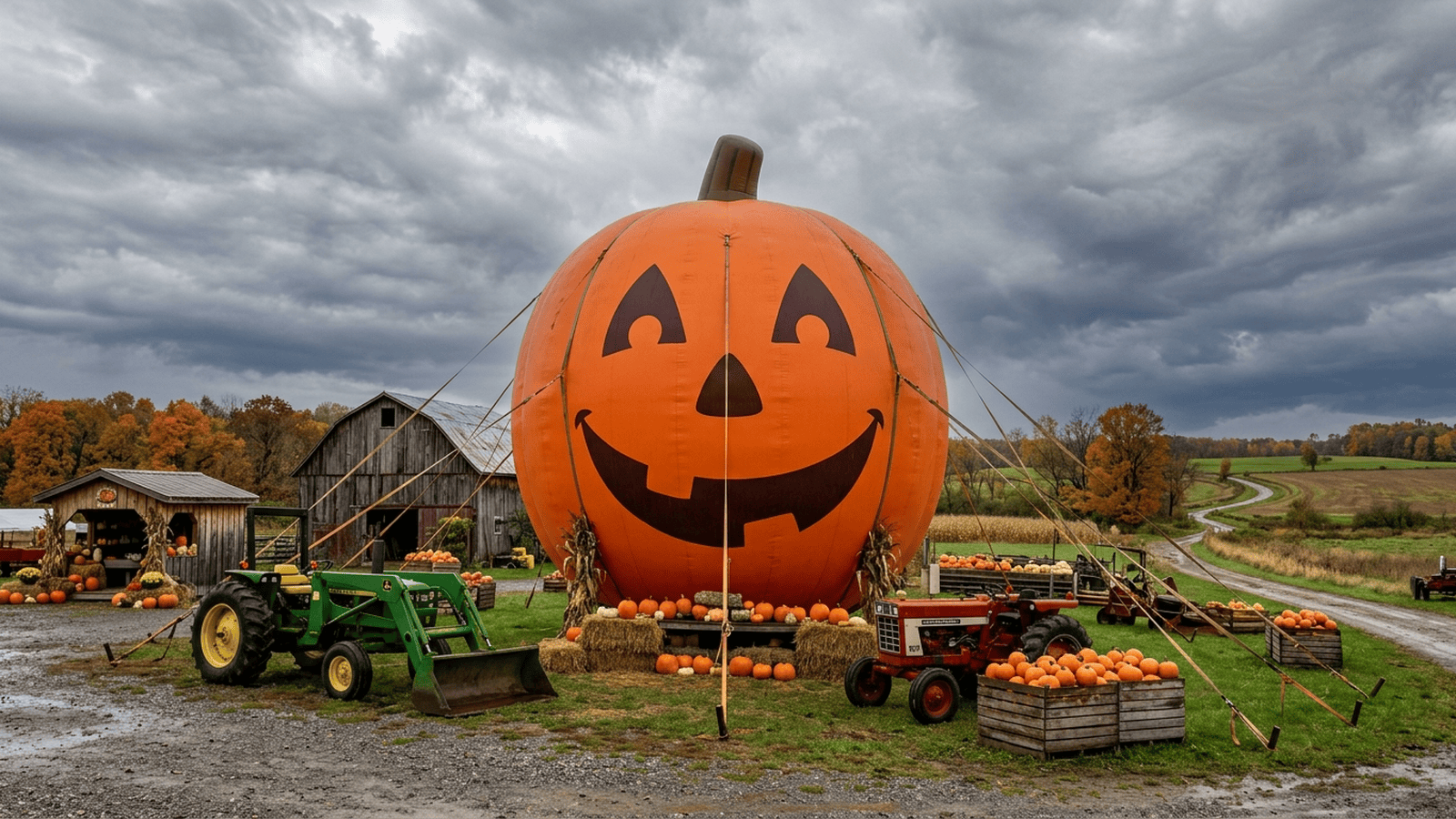
A two-story inflatable pumpkin at Phillips Farm in Cary, North Carolina, broke loose during strong winds as the remnants of Hurricane Isaias passed through. Workers had held off inflating it during a tornado warning, but it was inflated after the sun appeared, before gusts of roughly 35 to 40 miles per hour arrived. The pumpkin rolled along a fence, past a church and down the road. Owner Michael Phillips said workers had it under control in about a minute and no one was in danger. With six weeks of hurricane season remaining, the farm has secured the decoration with paracord, baling twine, corkscrew spikes and two tractors. The video also brought widespread online attention.
TLDR: A runaway inflatable pumpkin traveled through Cary during strong winds, but Phillips Farm workers brought it under control in about a minute. The farm has since anchored it to two tractors as hurricane season continues, while videos of the episode draw a large online response.
A two-story inflatable jack-o’-lantern made an unexpected trip through Cary, North Carolina, on Sunday, turning a gusty afternoon into a widely shared Halloween story. The pumpkin broke free as the remnants of Hurricane Isaias passed through the area. Workers had chosen not to inflate it while a tornado warning was in effect, but it went up later, after the sun appeared. The episode ended with the decoration secured again and its owner describing the brief escape as good advertising for Phillips Farm.
The practical rationale was straightforward: workers held off while the tornado warning was active, and the farm later took steps to keep the pumpkin from moving again. No broader policy or official rationale is described in the account. The farm’s response reflects a familiar safety principle: a large outdoor display needs to be secured when strong winds are possible. The result was not a government rule or a formal enforcement action, but a local decision followed by a more substantial tie-down.
The giant pumpkin had the classic features of a jack-o’-lantern, with black triangular eyes and a lopsided grin. Michael Phillips, owner of Phillips Farm, said his father, Lee Phillips, inflated it when the sun peeked out. Then, according to Michael, wind gusts reached roughly 35 to 40 miles per hour. The decoration began moving, and Phillips recalled the moment with a brief description: “And then, ‘Bam.’ It just started going.”
The pumpkin rolled along a post-and-rail fence, past a church and down the road. The remnants of Hurricane Isaias were passing through, and a tornado had reportedly touched down about a quarter mile away. The account does not say that the pumpkin caused damage or that anyone was hurt. Phillips said workers had the situation under control in about a minute and that no one was ever in danger.
The sequence offers a clear look at the logistics behind a large seasonal display. First came the decision to leave the ornament uninflated during the tornado warning. Later came the choice to inflate it when conditions appeared calmer. The weather then changed quickly, leaving the workers to respond as the pumpkin moved. The episode shows how a brief lull in a storm can give way to strong gusts, even when the sky has begun to clear.
The response after the escape was more than a quick recovery. With six weeks of hurricane season left, Phillips said he was not taking chances. The pumpkin is now held with paracord, baling twine and corkscrew spikes, with the lines tied to two tractors. That arrangement replaces the freedom of an unsecured inflatable with a fixed setup that takes materials, labor and space. The report gives no cost for those materials and does not describe any required forms, fees or outside inspections.
The farm’s choice puts reliability ahead of convenience. The decoration is no longer free to move with the breeze, and the added ties and anchors are a visible part of the display’s setup. That is a modest trade for keeping a two-story inflatable in place as the storm season continues. The account does not describe a legal mandate or a loss of any formal right; the change is a practical precaution chosen by the farm after seeing what wind could do.
There was also an unexpected benefit for the business. Videos of the runaway pumpkin drew a strong online response, and Phillips said he wakes to between 80 and 150 notifications each morning from people commenting on them. Some viewers turned the footage into a meme, portraying the pumpkin as an alien creature coming to destroy the city. Phillips called the attention “the best advertising we could ask for.” The viral reaction does not alter the basic lesson: a memorable promotion can arrive alongside an unplanned safety challenge.
The practical impact is limited to what the account reports. Workers delayed inflation during the tornado warning, then handled the moving pumpkin in about a minute. The farm has since secured it with three kinds of tie-down materials and two tractors, while hurricane season continues for six more weeks. No fees, paperwork, public enforcement measures or formal compliance deadlines are identified, and the report does not name a government office overseeing the setup. Those missing details are not evidence of a wider rule; they are simply not part of the account.
For now, the next steps are local and concrete: the pumpkin remains tied down, and the farm faces the remaining weeks of hurricane season with that arrangement in place. The source reports no scheduled inspection or outside review, so none can be presumed. The farm’s own precautions are the only oversight described. The Great Pumpkin has made its flight, the workers brought the situation under control, and the added anchors are intended to keep the next gust from sending it down the road again.

Tom Blake serves as the Senior Correspondent for Labor, Wages, and Automation at Just Right News, where he brings a grounded, principled perspective to the most pressing economic issues facing the American heartland. As the lead voice behind the acclaimed feature series “The Price of Work,” Tom focuses his reporting on the intersection of traditional industry and the rapidly evolving technological landscape, always prioritizing the dignity of the individual worker and the health of the American family.
Tom’s deep understanding of the labor market is not merely academic; it is rooted in his upbringing in Detroit, Michigan. Growing up in the shadow of the automotive industry, he witnessed firsthand the triumphs and tribulations of the American blue-collar workforce. He saw how the stability of a manufacturing job could build a community and, conversely, how the erosion of those industries could tear the social fabric apart. This background instilled in him a lifelong respect for the trades and a healthy skepticism toward economic policies that prioritize globalist interests over the well-being of local communities.
Now based in Pittsburgh, Pennsylvania, Tom continues to report from the front lines of the shifting economy. Pittsburgh, a city that has reinvented itself while maintaining its gritty, industrious spirit, provides the perfect vantage point for his beat. From the steel mills that remain to the high-tech robotics labs reshaping the city’s future, Tom explores how automation is changing the nature of employment. His reporting often highlights the tension between innovation and tradition, arguing that while progress is inevitable, it must not come at the expense of the American worker’s ability to provide for their family through honest, meaningful labor.
In his role at Just Right News, Tom has become a vital voice for those who feel overlooked by mainstream economic coverage. He rejects the notion that the decline of American manufacturing is an unavoidable casualty of the modern era. Instead, his work often examines how regulatory overreach, rising energy costs, and the unchecked rise of automation impact the take-home pay of everyday citizens. Through “The Price of Work,” Tom delves into the true cost of economic shifts, looking beyond the raw data to tell the stories of the people behind the statistics.
Tom’s reporting is characterized by a commitment to the conservative values of self-reliance, fiscal responsibility, and the preservation of the American dream. He believes that a strong nation is built on a foundation of stable jobs and fair wages, and his work seeks to hold both government and corporate entities accountable to that standard. Whether he is interviewing a shop floor manager about the implementation of new AI technology or analyzing the impact of wage inflation on small businesses, Tom provides a clear-eyed analysis that resonates with readers who value hard work and common sense.
Through his dedicated coverage, Tom Blake remains a steadfast advocate for the American workforce, ensuring that the voices of those in the industrial heartland are heard loud and clear in the national conversation. His perspective is essential for anyone seeking to understand the complex realities of labor and automation in the twenty-first century.