

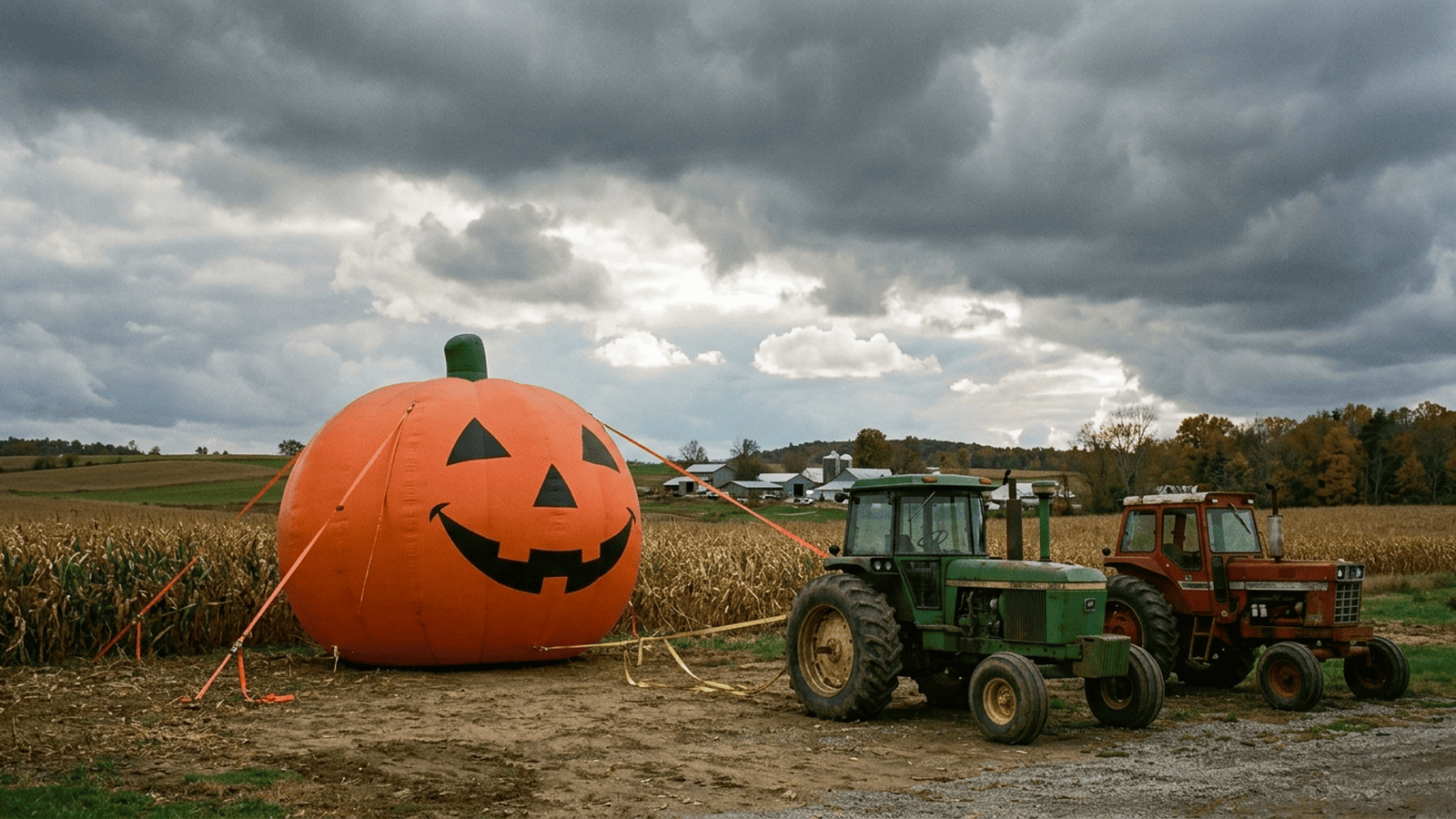
A two-story inflatable pumpkin at Phillips Farm in Cary, North Carolina, rolled down the road after wind gusts of 35 to 40 miles per hour arrived as the remnants of Hurricane Isaias passed through. Workers had earlier decided not to inflate it while a tornado warning was in effect, and owner Michael Phillips said his staff brought the situation under control in about a minute with no one in danger. The pumpkin is now tied down with paracord, baling twine, corkscrew spikes and two tractors. Its unexpected flight drew heavy social media attention and, Phillips said, became valuable advertising. The account reports no injuries, damage costs, official inspections or government enforcement.
TLDR: A giant inflatable pumpkin escaped its display in Cary during strong wind, then workers quickly regained control without reported injuries. Phillips Farm has secured it with rope, spikes and two tractors as hurricane season continues.
A two-story inflatable pumpkin took an unexpected trip through Cary, North Carolina, on Sunday, turning a stretch of stormy weather into an unusually effective advertisement for Phillips Farm. The bright orange jack-o’-lantern rolled along a fence, passed a church and continued down the road as the remnants of Hurricane Isaias moved through the area. Its flight ended without anyone being hurt, according to farm owner Michael Phillips.
There was no government policy change or official policy rationale in the account. The practical reason for the later safety measures is clear: after the pumpkin was lifted by strong gusts, Phillips Farm secured it against further movement. Workers had earlier decided not to inflate the decoration while a tornado warning was in effect.
The warning was active Sunday afternoon, and a twister reportedly touched down about a quarter mile away. Once the sun appeared, however, Michael’s father, Lee Phillips, decided to inflate the pumpkin, which has black triangular eyes and a lopsided grin. Michael Phillips said winds then rose to an estimated 35 to 40 miles per hour, and the inflatable began moving.
The pumpkin did not simply shift in place. It rolled along a post-and-rail fence, passed a church and went down the road. Phillips described the moment as sudden, saying the pumpkin started moving after the gusts arrived. The brief account leaves out details about the precise route, how far it traveled and the exact steps workers took to recover it.
Phillips said his workers brought the situation under control in about a minute. He also said no one was ever in danger. Those are the farm owner’s reported statements; the account does not describe a separate safety review or identify any public agency involved in the response.
The excursion quickly became a social media story. Videos of the runaway decoration drew between 80 and 150 notifications of comments for Phillips each morning, he said. Some viewers turned the footage into a meme and portrayed the pumpkin as an alien creature coming to destroy the city. Phillips called the online reaction intense and said the incident had become the best advertising the farm could ask for.
That publicity came with an obvious tradeoff. The decoration that had been intended to mark the season became a moving object during unsettled weather, and workers had to regain control of it. The account does not report damage, injuries, repair costs or lost business. It also gives no estimate of how long the pumpkin remained loose or how many people saw it in person.
The response now centers on securing the display rather than relying on its weight or location. The pumpkin has been tied down with paracord and baling twine, with corkscrew spikes and two tractors used as anchors. Phillips said it would stay put unless the tractors themselves flew away. The account does not specify the cost of the materials, the amount of labor involved or whether the farm used a written safety checklist.
Those details matter because the incident began after workers had already chosen not to inflate the pumpkin during the tornado warning. The account does not explain why it was inflated after the sun appeared, or whether a formal weather threshold guided that decision. It reports no forms, fees, government enforcement action or compliance deadline. There is no indication that a new rule is being considered or that local officials directed the farm’s precautions.
The immediate impact is therefore specific and limited. Phillips Farm has added physical restraints to a large inflatable display, while the people directly involved are the farm’s workers and the Phillips family. The restraint system includes paracord, baling twine, corkscrew spikes and two tractors. With six weeks of hurricane season remaining at the time of the report, the farm is taking precautions against another episode of strong wind.
The next step described is continued security of the pumpkin through the remaining hurricane season. No official inspection, oversight process or deadline appears in the account, so none can be reported as part of the plan. The reported facts show workers responding quickly and the farm using concrete anchors; that is the available assurance, not an outside expert assessment.

Dylan Brooks serves as the Senior Correspondent for Statehouses and Local Governance at Just Right News, where he brings a principled, constitutionalist lens to the often-overlooked machinery of state-level politics. As the lead voice behind the acclaimed feature series “Fifty Laboratories of Power,” Dylan has dedicated his career to the idea that the most impactful governance happens closest to home. His reporting consistently champions the Tenth Amendment, exploring how individual states can serve as testing grounds for innovative, conservative policy solutions that prioritize personal liberty and fiscal responsibility.
A native of Des Moines, Iowa, Dylan’s journalistic philosophy was forged in the heart of the American Midwest. Growing up in a community where local school board meetings and town halls were the bedrock of civic life, he developed a deep appreciation for the “retail politics” of the heartland. This upbringing instilled in him a fundamental belief that the American experiment is best preserved when power is decentralized. He carries the values of his Iowa roots into every assignment, maintaining a healthy skepticism of federal overreach and a steadfast commitment to the concerns of everyday citizens over the interests of the administrative state.
Now based in Madison, Wisconsin, Dylan operates from one of the nation’s most pivotal political battlegrounds. His location in a state capital known for its rigorous policy debates allows him to provide Just Right News readers with a front-row seat to the legislative process. From Madison, he tracks the ripple effects of statehouse decisions on local municipalities, ensuring that the connection between high-level policy and community impact is never lost. His work often highlights the success of conservative governors and legislatures in fostering economic growth, protecting parental rights, and securing the integrity of local institutions.
As an African American man in the conservative media landscape, Dylan offers a vital perspective on how limited government and free-market principles empower individuals and families. He frequently reports on how deregulation and school choice initiatives provide new avenues for success in underserved communities, challenging the monolithic narratives often presented by legacy media outlets. Dylan’s work is characterized by a commitment to the facts and a refusal to shy away from the complex realities of modern governance.
Throughout his tenure at Just Right News, Dylan has become a trusted authority for readers who value a rigorous, principled approach to the news. Whether he is dissecting a complex state budget or profiling a local grassroots movement, his goal remains the same: to provide the American public with the information they need to hold their local leaders accountable. By focusing on the “Fifty Laboratories of Power,” Dylan Brooks ensures that the vital work being done in statehouses across the country receives the national attention it deserves, always through a lens that respects the traditions and sovereignty of the American people.