

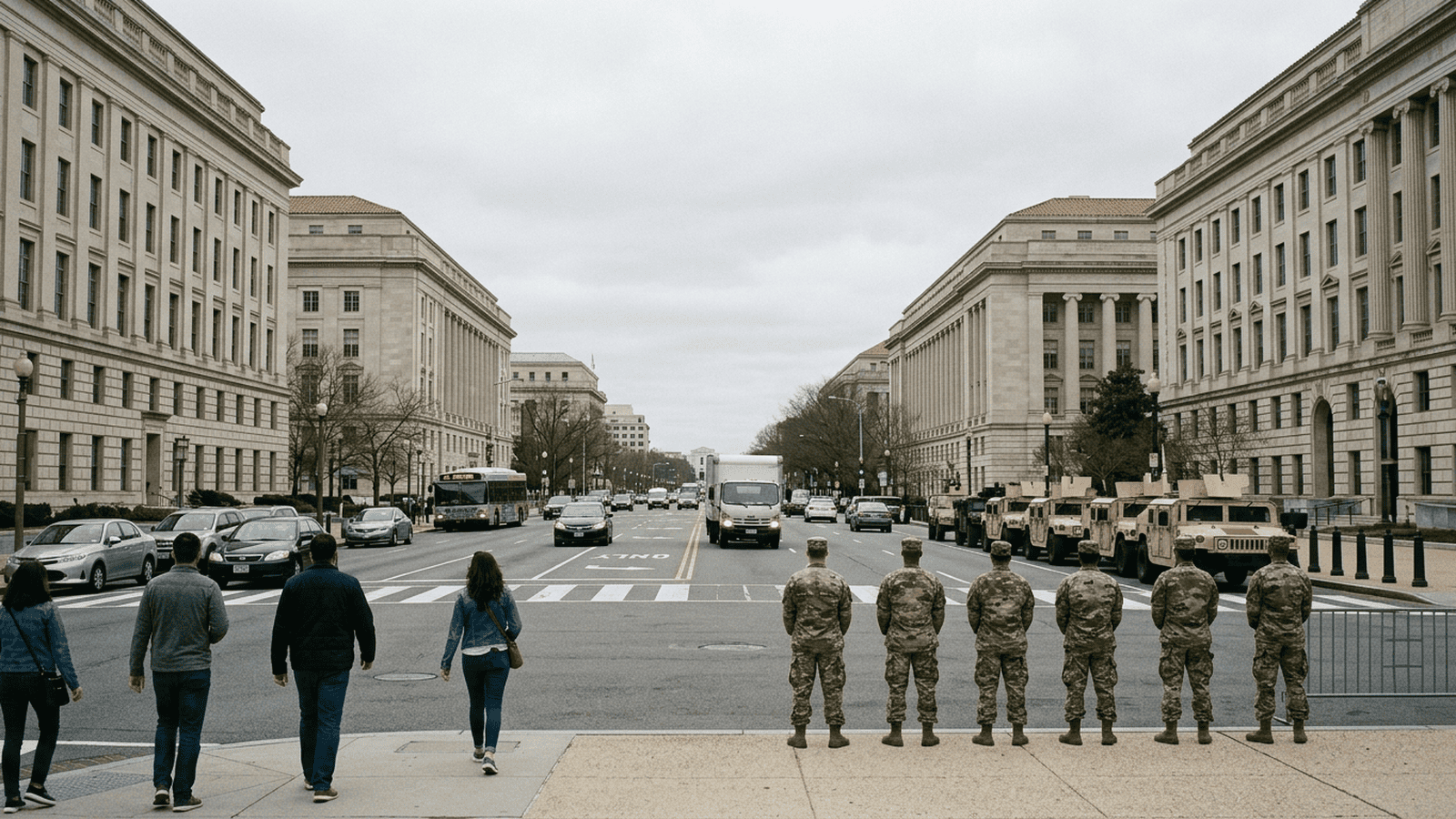
The D.C. Circuit is hearing arguments over whether the National Guard should remain in Washington, where troops have patrolled for more than 14 months. The administration says the deployment supports crime-fighting and has contributed to a decline in crime, while the city argues that it intrudes on local authority and uses the military for domestic law enforcement. The court previously paused a lower court order against the deployment, and an earlier panel said the president might have unique authority to mobilize the Guard in the capital. The force reached about 5,000 troops and recently stood at about 2,900; its extension runs through January 2029. A $292 million federal contract provides apartments for task force members. The appeals court’s review is the next stage in a dispute that could continue to the Supreme Court.
TLDR: The appeals court is weighing presidential authority against Washington’s claim that the Guard deployment intrudes on local law enforcement powers. The troops remain in place under an extension through January 2029, with further court review possible.
More than 14 months after National Guard members began patrolling Washington, a federal appeals court is scheduled to hear arguments over whether the troops should remain in the capital. The case puts presidential authority, local control and the protection of federal property before the U.S. Court of Appeals for the District of Columbia Circuit. The court previously paused a lower court ruling that found the deployment illegal, allowing the Guard to stay in place while the case proceeds.
The administration says President Donald Trump sent the Guard to Washington in August 2025 as part of a crime-fighting mission and says the deployment has contributed to a decrease in crime. Crime was already declining before Guard members arrived, according to the account of the case. The administration has also argued that the president has an interest in protecting federal government functions and property in the nation’s capital. Those stated aims frame the dispute, but the appeals court has not yet issued a decision on the merits.
The lawsuit was brought by the District of Columbia’s attorney general. The city argues that the mobilization improperly uses the military for domestic law enforcement and intrudes on local officials’ authority. The central legal question is whether the president can deploy the National Guard in the district under these circumstances. Washington is not a state and has limited autonomy over its own affairs, making the balance between federal authority and local government a central issue.
The Constitution gives federal lawmakers authority over the District of Columbia. The Home Rule Act of 1973 allows residents to elect a mayor, a council and neighborhood commissioners. That arrangement gives the district local institutions while leaving Congress with constitutional authority over the capital. The city says the deployment conflicts with its role in directing local law enforcement, while the administration relies on the president’s authority as commander in chief and the federal government’s responsibilities in Washington.
A lower court ruling last November found that the president could protect federal functions and property but could not unilaterally deploy the D.C. National Guard for crime control as he saw fit or call in troops from other states. Judge Jia Cobb concluded that the deployment intruded on local officials’ authority. She delayed enforcement of her order for 21 days to allow the administration to appeal. The appeals court then put the order on hold, so the Guard has remained in the city pending further proceedings.
In December, a three-judge appeals panel said the president might prevail on his argument that he “possesses a unique power” to mobilize the Guard in Washington. The panel’s unanimous, 32-page ruling also cited the disruption to thousands of service members and the administration’s interest in protecting federal functions and property. The judges said the district had not identified an ongoing injury to its statutory interests. That earlier ruling addressed the order while the case continued; Wednesday’s arguments will give the court another opportunity to consider the dispute.
Legal experts have identified competing points for the judges to weigh. Syracuse law professor William Banks said the district may have a limited argument under home rule if Guard units were deployed without authorization under local law. He also said the president has broad discretion over the local Guard and units from other states because the district is not a state and the president is commander in chief. William and Mary law professor Margaret Hu noted that states supporting the deployment have argued the president was responding to an emergency. She said the deployment’s open-ended nature could complicate that justification.
The practical footprint is substantial, even though the excerpt does not provide a full accounting of operating costs, local infrastructure effects or enforcement rules. The force reached about 5,000 troops at its summer peak and stood at about 2,900 as of last week. The Defense Department extended the mobilization until January 2029, and the federal government awarded a private company a $292 million contract to provide apartments for members of Joint Task Force-D.C. Guard members have supported arrest operations, patrolled streets and neighborhoods, and taken part in cleanup efforts. Officials and activists in the city say the deployment wastes taxpayer money and normalizes a military presence in a major American city; the administration says crime has fallen further during the operation.
The court’s decision will determine the next legal stage, not necessarily the final one. The account says the administration would take the case to the Supreme Court if the district prevails at the appeals level. No decision date, new compliance deadline, filing requirement or troop drawdown schedule is specified. The Guard remains in place while the case is pending, and the deployment is scheduled to continue through January 2029 under the Defense Department extension. The appeals court’s review and any later proceedings are the next necessary steps for resolving the dispute over authority and oversight.

Deborah Cole serves as a Senior Correspondent for Just Right News, where she spearheads the network’s coverage of Housing, Infrastructure, and Mobility. With a career defined by a commitment to rigorous reporting and a focus on the fundamental pillars of American community life, Deborah brings a principled perspective to the complex issues that dictate how and where we live. Her work is grounded in the belief that sound policy, fiscal responsibility, and respect for private property are the essential foundations of a prosperous society.
Originally from Boston, Massachusetts, Deborah’s upbringing in one of the nation’s oldest and most historically significant cities deeply influenced her professional trajectory. Growing up amidst the architectural legacy and dense urban planning of New England, she developed an early appreciation for the importance of durable infrastructure and the role of local tradition in shaping neighborhoods. Her perspective is informed by the classic American values of her hometown—hard work, community cohesion, and a healthy skepticism of top-down bureaucratic mandates that often overlook the unique needs of individual citizens.
Today, Deborah operates from her base in Austin, Texas, a city that serves as a primary laboratory for her reporting. Austin’s rapid expansion and its status as a hub for innovation and migration provide her with a front-row seat to the most pressing challenges in modern infrastructure and housing. From the Lone Star State, she chronicles the tensions between rapid growth and the preservation of the American Dream, often highlighting how market-driven solutions and deregulation can address the housing shortages that plague many of the country’s metropolitan areas.
At Just Right News, Deborah is perhaps best known for her signature feature series, “Where We Live.” Through this platform, she explores the intersection of public policy and private life, moving beyond mere statistics to tell the stories of families, small business owners, and local developers. Her reporting frequently highlights the importance of mobility—not just in terms of transportation and transit, but as a vehicle for economic opportunity and social stability. She remains a staunch advocate for the taxpayer, consistently scrutinizing government spending on large-scale projects and advocating for transparency in how infrastructure dollars are allocated.
Deborah’s beat is more than just a collection of policy topics; it is an investigation into the physical and legal structures that allow families to flourish. Whether she is reporting on the impact of zoning laws on suburban development or the necessity of maintaining the nation’s highway systems, her work is characterized by a dedication to the facts and a respect for the constitutional principles that protect the rights of homeowners.
As a Senior Correspondent, Deborah Cole continues to be a vital voice for Just Right News, providing the audience with the clarity and context needed to navigate an ever-changing landscape. Her reporting ensures that the values of individual liberty and local sovereignty remain at the forefront of the national conversation regarding the future of our cities and towns. Through her tireless efforts, she remains committed to informing the public on the issues that hit closest to home.