

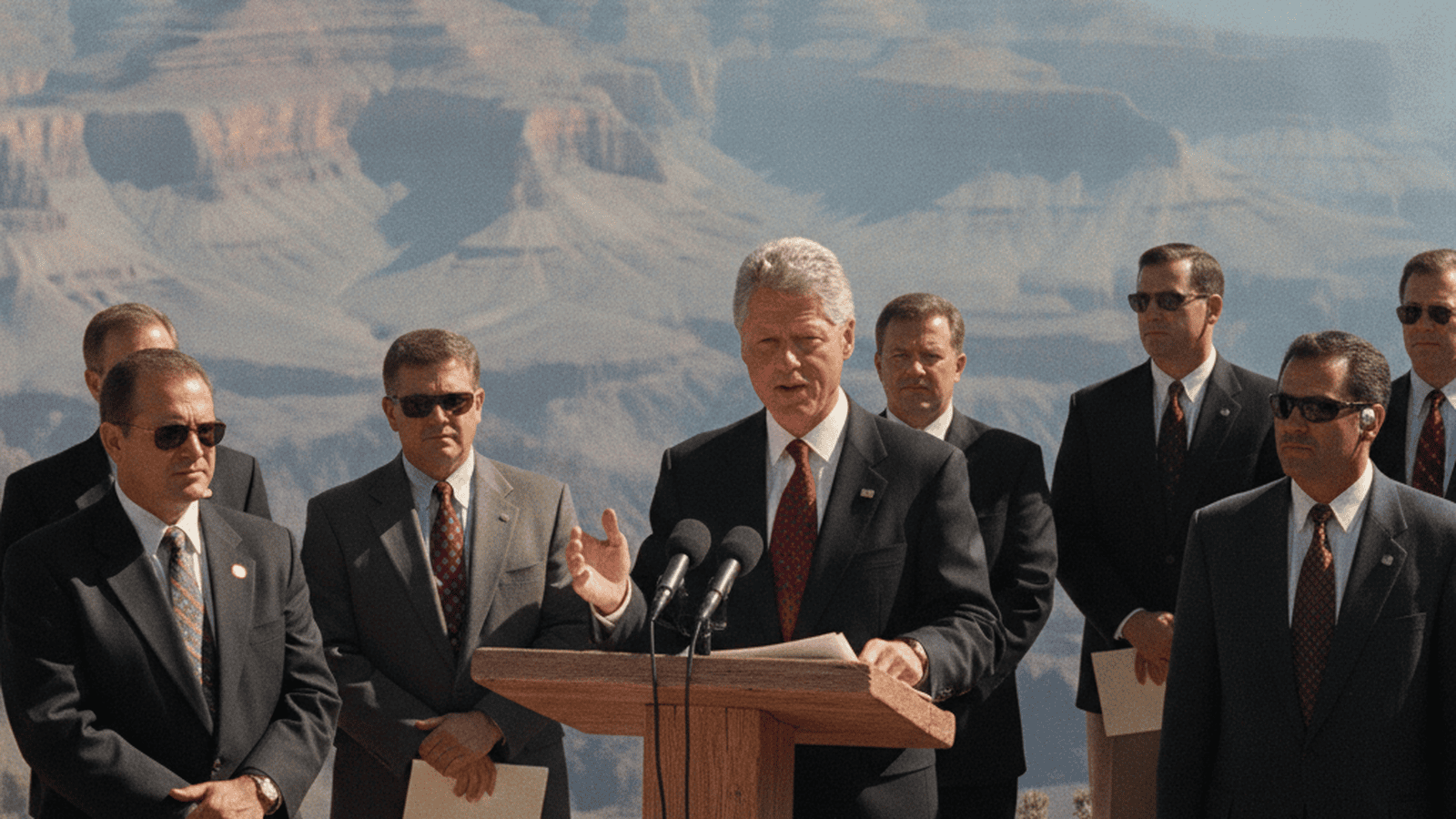
In 1996, President Bill Clinton utilized the Antiquities Act to designate 1.7 million acres in southern Utah as the Grand Staircase-Escalante National Monument. This exercise of executive power in the United States sparked intense backlash from local officials who were excluded from the decision-making process.
TLDR: President Bill Clinton’s 1996 designation of the Grand Staircase-Escalante National Monument bypassed Congress and local Utah officials. This use of the Antiquities Act redefined executive authority over federal lands in the United States, sparking decades of legal challenges and political debates regarding the limits of presidential power in the Mountain West.
On September 18, 1996, President Bill Clinton stood at the South Rim of the Grand Canyon in Arizona to sign a proclamation that would reverberate through the halls of power in the Mountain West for decades. Using the authority granted by the Antiquities Act of 1906, Clinton designated 1.7 million acres of southern Utah as the Grand Staircase-Escalante National Monument. The move was a masterstroke of environmental protection for some, but for Utah’s political leadership, it represented a stunning and unilateral exercise of executive power.
The designation was shrouded in secrecy until the final days before the announcement. Utah Governor Mike Leavitt and the state’s congressional delegation, including Senators Orrin Hatch and Bob Bennett, were largely excluded from the deliberations. This breach of traditional political etiquette fueled immediate resentment, as the officials were notified only hours before the public ceremony. By the time the President put pen to paper, the decision was a fait accompli, effectively bypassing the legislative process and public hearings that typically accompany major land-use changes in the United States.
At the heart of the controversy was the Kaiparowits Plateau, a rugged expanse within the new monument boundaries that held vast deposits of low-sulfur coal. A Dutch company, Andalex Resources, had been in the process of developing a large-scale mining operation that promised hundreds of jobs and significant tax revenue for the rural counties of Kane and Garfield. The monument designation effectively killed the project, prioritizing the preservation of the “grand staircase” of cliffs and canyons over industrial development. Clinton argued that the land was a “spectacular treasure” that required immediate federal protection from commercial exploitation.
The legal basis for the action, the Antiquities Act, allows presidents to protect “objects of historic or scientific interest” on federal land. However, the act specifies that such reservations should be limited to the “smallest area compatible with the proper care and management of the objects to be protected.” Critics argued that a 1.7-million-acre designation—an area larger than the state of Delaware—stretched the definition of “smallest area” beyond its constitutional and statutory intent. This sparked a debate over whether the executive branch had overstepped its bounds by creating what was essentially a new national park without congressional approval.
The political fallout was immediate and lasting. In the 1996 election, Clinton’s move was seen as a play for environmentally conscious voters in swing states like California and Colorado, but it cost him dearly in Utah. Local residents in the town of Kanab burned effigies of the President and released black balloons to symbolize the “death” of their local economy. The event galvanized the “Sagebrush Rebellion” sentiment, a movement dedicated to reducing federal control over Western lands and asserting state sovereignty.
In the years following the designation, the Grand Staircase-Escalante National Monument became a focal point for debates over executive overreach. It prompted several attempts in Congress to amend the Antiquities Act to require legislative approval or state consent for large-scale monuments. While these legislative efforts largely stalled, the precedent set by Clinton opened the door for future presidents to use the act more aggressively for landscape-scale conservation.
The legacy of the 1996 proclamation remains a central pillar of modern land-use law and executive policy. In 2017, President Donald Trump issued an executive order significantly reducing the size of the monument, arguing that the original designation was an abuse of power. This reduction was subsequently reversed by President Joe Biden in 2021. These shifting boundaries underscore the enduring tension between executive authority and local governance, ensuring that the Red Rock Decree remains a touchstone for constitutional debate regarding federal land management.

Miles Harrington serves as the Senior Correspondent for Federal Systems & Executive Power at Just Right News, where he brings a disciplined, constitutionalist lens to the inner workings of the American government. With a focus on the mechanics of the federal bureaucracy and the limits of executive authority, Harrington has established himself as a vital voice for readers who value transparency, accountability, and the preservation of the separation of powers.
A native of Richmond, Virginia, Harrington’s perspective is deeply rooted in the traditions of the Old Dominion. Growing up in a city defined by its historical significance and its role as a center of American jurisprudence, he developed an early appreciation for the foundational principles of the Republic. His upbringing in Richmond—a place where the legacy of the Founding Fathers is woven into the landscape—instilled in him a belief that the federal government should remain within its constitutional bounds. This background informs his skepticism of centralized overreach and his commitment to reporting on the ways in which the administrative state impacts the lives of everyday citizens.
In his current role, Harrington specializes in the complexities of federal systems. He doesn’t just report on the headlines of the day; he digs into the structural shifts within the executive branch that often go unnoticed by the mainstream press. Whether he is analyzing the implications of a new federal regulation or investigating the expansion of agency jurisdiction, his work is characterized by a rigorous adherence to the facts and a dedication to the rule of law.
Harrington is perhaps best known for his signature feature series, “How Washington Works.” Through this ongoing project, he demystifies the often-opaque processes of the nation’s capital, pulling back the curtain on the “Deep State” and the unelected officials who wield significant influence over national policy. By breaking down complex legislative maneuvers and executive orders, he empowers Just Right News readers to understand the true levers of power in Washington. His reporting serves as a necessary check on the federal government, ensuring that the actions of those in power are held up to the light of public scrutiny.
Now based in Washington, D.C., Harrington operates at the epicenter of the political world, yet he remains intentionally distanced from the “Beltway bubble.” His proximity to the halls of power allows him to maintain a robust network of sources across the federal landscape, but his heart remains in the principled conservatism of his Virginia roots. He views his role not merely as a reporter, but as a steward of the public trust, dedicated to providing the clarity and context that conservative voters need to navigate an increasingly complex political environment.
Through his sharp analysis and unwavering commitment to the truth, Miles Harrington continues to be a cornerstone of the Just Right News team. His work ensures that the principles of limited government and executive restraint remain at the forefront of the national conversation, providing a crucial service to those who believe in a government that is truly of, by, and for the people.