

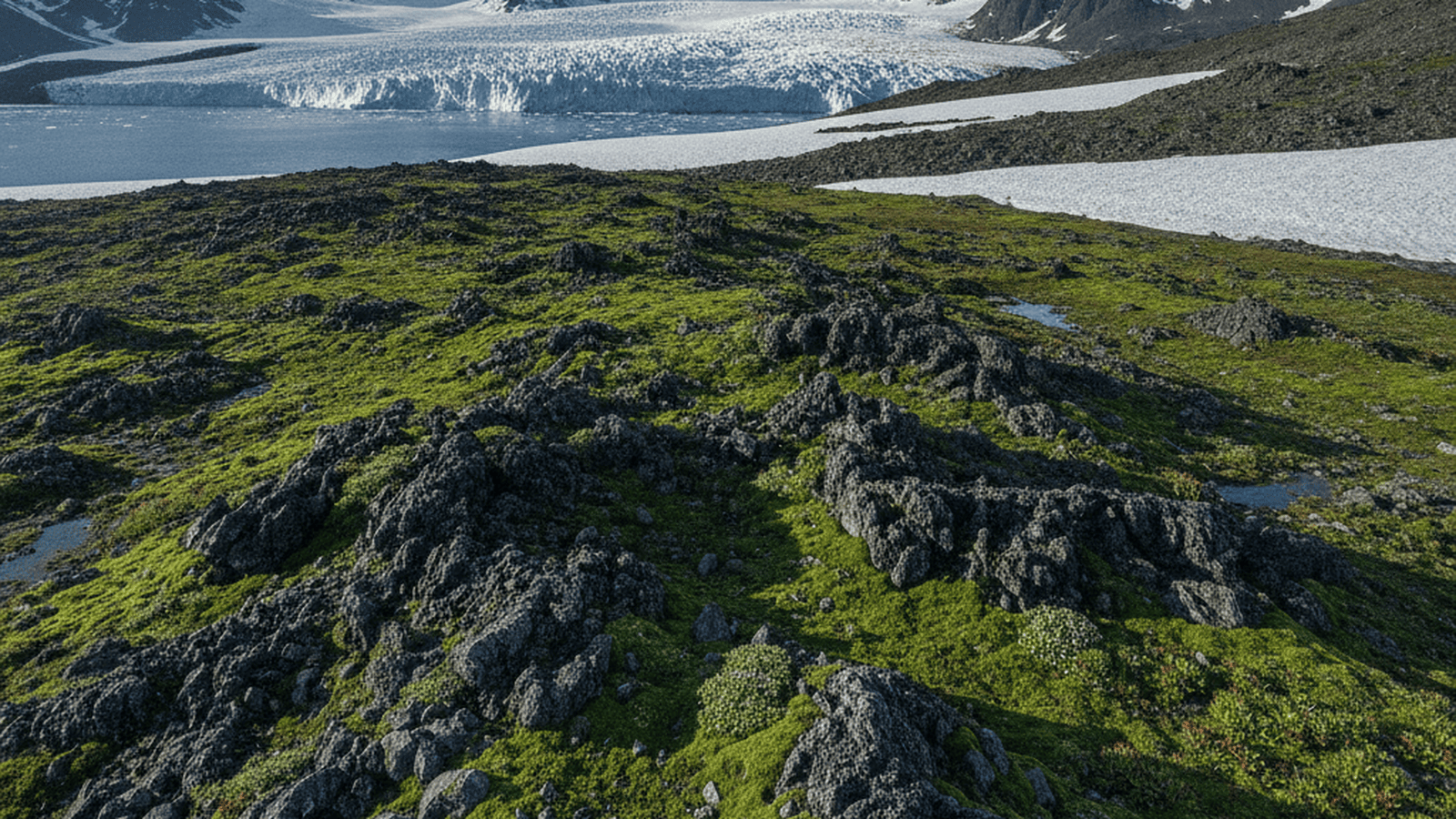
Researchers have found that the Antarctic Peninsula is greening at an accelerating rate as temperatures rise. Satellite imagery shows a tenfold increase in vegetation cover over the last four decades, signaling profound changes to the continent’s ecosystem.
TLDR: A study led by the University of Exeter reveals that vegetation cover on the Antarctic Peninsula has increased from less than one square kilometer in 1986 to nearly 12 square kilometers in 2021. This rapid greening, driven by rising temperatures, could facilitate the arrival of invasive species and alter the region’s carbon balance.
The Antarctic Peninsula, one of the fastest-warming regions on Earth, is undergoing a visible transformation as rising temperatures trigger a rapid expansion of plant life. A study led by researchers at the University of Exeter, the University of Hertfordshire, and the British Antarctic Survey has utilized decades of satellite imagery to quantify this shift. The findings, published in the journal Nature Geoscience, indicate that vegetation cover across the peninsula has increased more than tenfold over the last 35 years. This dramatic change serves as a stark indicator of the terrestrial ecosystem’s response to anthropogenic climate change.
Using data from NASA’s Landsat satellite missions, the research team analyzed the extent of greening from 1986 to 2021. In the mid-1980s, the area of vegetation—consisting almost entirely of mosses and liverworts—was estimated to be less than one square kilometer. By 2021, that footprint had expanded to nearly 12 square kilometers. While the peninsula remains dominated by ice and bare rock, this relatively small area of plant life represents a massive percentage increase that signals a fundamental shift in the region’s biology.
The rate of change has notably accelerated in recent years. Between 2016 and 2021, the pace of vegetation expansion increased by approximately 33 percent compared to the average across the entire study period. This acceleration coincides with a period of record-low sea ice extent around the continent. Scientists suggest that warmer, wetter conditions are creating a more hospitable environment for hardy plant species that can survive the harsh polar climate. The presence of liquid water, rather than ice, is the primary driver for these biological changes.
While the total area of greening remains small relative to the entire peninsula, the implications for the local ecosystem are significant. Mosses are primary colonizers that play a crucial role in soil formation. As these plants grow and decay, they create an organic layer that can eventually support more complex plant life. This process could pave the way for invasive species, potentially introduced by human visitors, researchers, or migratory birds, to establish themselves and outcompete native flora. The development of soil also changes the nutrient cycling within the region, potentially affecting nearby marine environments.
The expansion of vegetation also alters the region’s albedo, or its ability to reflect sunlight. Darker surfaces, such as moss-covered ground, absorb more solar radiation than reflective ice or snow. This absorption leads to localized warming, which can further accelerate the melting of nearby ice and the growth of more vegetation. This feedback loop is a hallmark of climate-driven changes in polar regions, similar to the Arctic greening observed in the northern hemisphere over the past several decades.
The researchers emphasize that the Antarctic Peninsula is warming at a rate significantly higher than the global average. Extreme heat events are becoming more frequent, providing the necessary liquid water for plant growth during the short summer season. The study highlights the sensitivity of the Antarctic landscape to even small increases in temperature, suggesting that the continent’s white identity is under threat. The researchers used Google Earth Engine to process the vast amounts of satellite data, allowing for a high-resolution view of the changes.
Future research will focus on how these newly established plant communities interact with the changing climate and whether the greening trend will spread to other parts of the continent. The team plans to investigate the specific mechanisms of soil development and the potential for more complex vascular plants, such as the two native flowering species, to expand their range. Understanding these shifts is essential for predicting the long-term stability of the Antarctic ecosystem and its role in the global climate system.

Mark Davis serves as the Senior Correspondent for Energy, Climate, and Resource Economics at Just Right News. In an era where the conversation around the environment is often dominated by alarmism and top-down mandates, Mark provides a vital, market-oriented perspective on the complex forces shaping our world. As the lead voice behind the acclaimed feature series “Power and the Planet,” he explores the intersection of environmental policy, global energy markets, and the fundamental economic principles that sustain modern civilization.
Mark’s pragmatic approach to resource management was forged in the high desert of his hometown, Albuquerque, New Mexico. Growing up in a region defined by both its breathtaking natural beauty and its rugged, resource-dependent landscape, he developed an early appreciation for the delicate balance between conservation and utilization. New Mexico’s unique position as a hub for both traditional energy production and cutting-edge scientific research provided Mark with a front-row seat to the evolution of the American energy sector. This upbringing instilled in him a deep-seated belief that true environmental stewardship is inseparable from economic prosperity and technological innovation.
Now based in Boulder, Colorado, Mark operates from the heart of the nation’s climate research community. While Boulder is often seen as a bastion of environmental idealism, Mark utilizes his post to provide a necessary counterweight, grounded in the realities of resource economics. He understands that energy policy does not exist in a vacuum; it has tangible consequences for the American taxpayer, the stability of the national power grid, and the strength of the domestic manufacturing sector. By reporting from the front lines of the climate debate, he is able to challenge prevailing narratives with hard data and a commitment to the principles of the free market.
Throughout his tenure at Just Right News, Mark has distinguished himself by focusing on the “Resource Economics” aspect of his beat. He frequently highlights the hidden costs of rapid energy transitions and advocates for an “all-of-the-above” energy strategy that prioritizes American energy independence. His work often shines a light on the geopolitical implications of resource scarcity, arguing that a secure nation must first be an energy-secure nation. Whether he is analyzing the impact of federal land-use regulations or investigating the supply chains required for new technologies, Mark remains focused on how policy decisions affect the lives and livelihoods of everyday citizens.
In “Power and the Planet,” Mark continues to bridge the gap between complex scientific concepts and the economic realities facing the country. He rejects the false choice between a healthy environment and a thriving economy, instead seeking out solutions that leverage American ingenuity and private-sector competition. For Mark, reporting on the climate is not about following the latest trends, but about ensuring that the conversation remains tethered to the foundational values of liberty, property rights, and fiscal responsibility. His contributions ensure that Just Right News readers receive a comprehensive, clear-eyed view of the challenges and opportunities defining the future of our planet.