

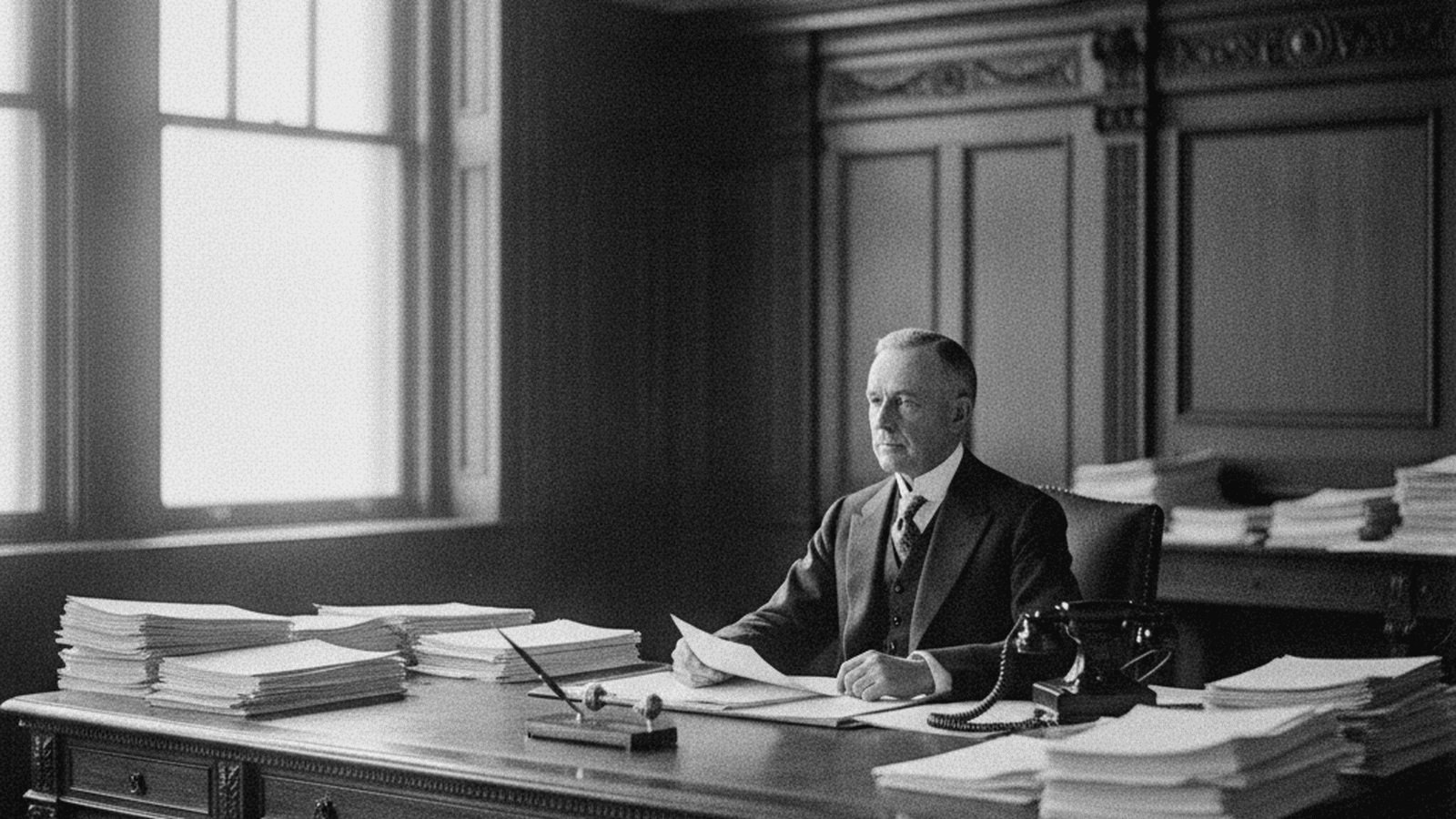
In 1917, Illinois Governor Frank Lowden spearheaded the Civil Administrative Code, which consolidated over 100 independent state agencies into nine departments. This landmark reorganization in the United States established a model for executive efficiency and the modern cabinet system.
TLDR: Governor Frank Lowden’s 1917 reorganization of the Illinois executive branch replaced a fragmented system of 100 agencies with nine cabinet departments. This “Illinois Plan” introduced the first state executive budget and became a national model for centralizing executive power to improve government efficiency and accountability across the United States.
In the early 20th century, state governments across the United States operated as a chaotic patchwork of independent boards, commissions, and agencies. Illinois was no exception, with over 100 separate entities managing everything from prisons to public health. These bodies often functioned without central oversight, leading to massive inefficiencies, overlapping jurisdictions, and a lack of accountability to the governor. The Progressive Era demand for business-like efficiency in government found its champion in Frank O. Lowden, who was elected Governor of Illinois in 1916.
Lowden campaigned on a platform of radical administrative reform. Upon taking office in 1917, he pushed for the Civil Administrative Code, a piece of legislation that would fundamentally alter the structure of state executive power. The goal was to replace the fragmented system with a hierarchical structure where the governor held clear authority and responsibility. This move was seen as a direct challenge to the patronage systems that had long dominated state politics, as it centralized control under a professionalized cabinet. The path to reform was not without political friction, as many legislators feared that centralizing so much power in the governor’s office would lead to an executive tyranny. Lowden had to navigate intense negotiations within the General Assembly, convincing skeptical lawmakers that efficiency would lead to lower taxes.
The Illinois General Assembly passed the Civil Administrative Code in March 1917. The act abolished more than 100 independent agencies and consolidated their functions into nine major departments: Finance, Agriculture, Labor, Mines and Minerals, Public Works and Buildings, Public Welfare, Public Health, Trade and Commerce, and Registration and Education. Each department was headed by a director appointed by the governor, creating a direct line of command that had never existed before in the state’s history. This reorganization was not merely a clerical change; it was a significant expansion of executive power.
By creating a Department of Finance, Lowden established the first comprehensive state budget system in the United States. This allowed the governor to prepare a unified financial plan for the entire state government, rather than having individual agencies lobby the legislature for funds independently. The “invisible government” Lowden sought to dismantle was a system where political machines exerted control through a web of minor appointments and uncoordinated spending. By seizing the power of the purse from the shadows, the Department of Finance was tasked with auditing every other department, ensuring that every dollar spent was accounted for in a public record.
The “Illinois Plan” became a national sensation, drawing praise from reformers and political scientists who saw it as the solution to the fragmented governance of party bosses. The success of the 1917 reorganization had immediate practical benefits, including a reduction in administrative costs and an increase in the speed of public service delivery. Within a decade, more than a dozen states, including New York and Massachusetts, adopted similar reorganization plans based on the Illinois model. The movement toward executive consolidation reflected a broader shift in American political thought, prioritizing efficiency and expert management over the decentralized systems of the 19th century.
The legacy of the Lowden reorganization persists in the modern structure of both state and federal executive branches. The principles of cabinet-level management and executive budgeting became standard practice across the country. However, the centralization of power also sparked ongoing debates about the balance between executive efficiency and legislative oversight. Subsequent reforms in the mid-20th century often sought to refine these structures, ensuring that the increased power of the executive remained transparent and accountable to the public.

Miles Harrington serves as the Senior Correspondent for Federal Systems & Executive Power at Just Right News, where he brings a disciplined, constitutionalist lens to the inner workings of the American government. With a focus on the mechanics of the federal bureaucracy and the limits of executive authority, Harrington has established himself as a vital voice for readers who value transparency, accountability, and the preservation of the separation of powers.
A native of Richmond, Virginia, Harrington’s perspective is deeply rooted in the traditions of the Old Dominion. Growing up in a city defined by its historical significance and its role as a center of American jurisprudence, he developed an early appreciation for the foundational principles of the Republic. His upbringing in Richmond—a place where the legacy of the Founding Fathers is woven into the landscape—instilled in him a belief that the federal government should remain within its constitutional bounds. This background informs his skepticism of centralized overreach and his commitment to reporting on the ways in which the administrative state impacts the lives of everyday citizens.
In his current role, Harrington specializes in the complexities of federal systems. He doesn’t just report on the headlines of the day; he digs into the structural shifts within the executive branch that often go unnoticed by the mainstream press. Whether he is analyzing the implications of a new federal regulation or investigating the expansion of agency jurisdiction, his work is characterized by a rigorous adherence to the facts and a dedication to the rule of law.
Harrington is perhaps best known for his signature feature series, “How Washington Works.” Through this ongoing project, he demystifies the often-opaque processes of the nation’s capital, pulling back the curtain on the “Deep State” and the unelected officials who wield significant influence over national policy. By breaking down complex legislative maneuvers and executive orders, he empowers Just Right News readers to understand the true levers of power in Washington. His reporting serves as a necessary check on the federal government, ensuring that the actions of those in power are held up to the light of public scrutiny.
Now based in Washington, D.C., Harrington operates at the epicenter of the political world, yet he remains intentionally distanced from the “Beltway bubble.” His proximity to the halls of power allows him to maintain a robust network of sources across the federal landscape, but his heart remains in the principled conservatism of his Virginia roots. He views his role not merely as a reporter, but as a steward of the public trust, dedicated to providing the clarity and context that conservative voters need to navigate an increasingly complex political environment.
Through his sharp analysis and unwavering commitment to the truth, Miles Harrington continues to be a cornerstone of the Just Right News team. His work ensures that the principles of limited government and executive restraint remain at the forefront of the national conversation, providing a crucial service to those who believe in a government that is truly of, by, and for the people.