

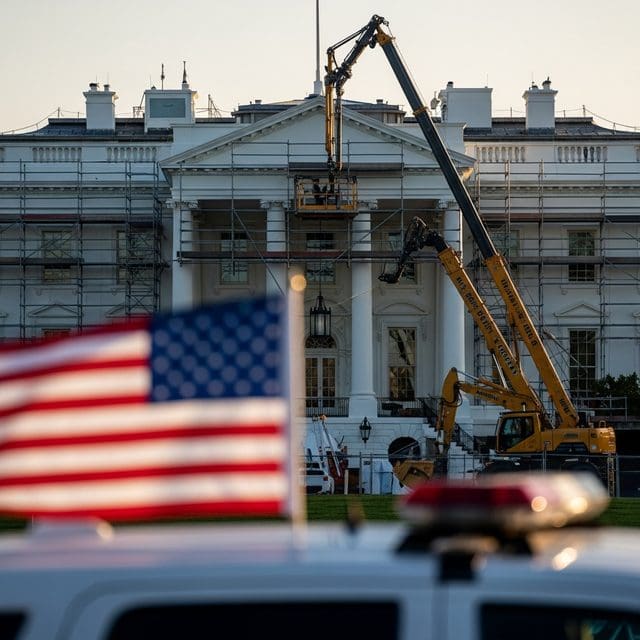
The Trump administration extended a historic maritime waiver for 90 days while facing congressional questions over a $900 million White House renovation project funded outside traditional appropriations.
The executive branch continues to test the boundaries of administrative discretion this week, most notably through a second 90-day extension of the Jones Act waiver. Effective August 17, the extension allows foreign-flagged vessels to continue transporting critical energy commodities between U.S. ports, a practice generally prohibited by the Merchant Marine Act of 1920. While White House spokeswoman Taylor Rogers framed the move as essential for ensuring the military and key industries maintain “uninterrupted access to critical resources,” the policy shift signals a growing tension between executive expediency and statutory protectionism. The waiver, which was set to expire on August 16, now represents the longest suspension of these maritime rules in the program’s history, with approximately 208 exemptions granted over the last four and a half months.
Unlike previous blanket exemptions, the new guidance from U.S. Customs and Border Protection (CBP) introduces a more rigorous compliance process. Parties seeking to use foreign ships must now submit a written “vessel availability request” to the Department of War, MARAD, and CBP before each voyage. This case-by-case scrutiny requires detailing vessel ownership, cargo types, and a specific justification for why the move serves national defense interests. Furthermore, the scope has been narrowed to specific energy-related commodities such as gasoline, jet fuel, crude oil, LNG, and fertilizers. This refinement appears to be a direct concession to domestic shipbuilders and their allies in Congress who have intensified their scrutiny of the administration’s reliance on foreign hulls.
While the maritime sector faces these new regulatory hurdles, the White House is navigating a different set of constraints regarding its own backyard. Reports indicate the administration is moving forward with a $900 million construction plan for the White House grounds, including a $400 million ballroom project. Rather than seeking direct appropriations from a skeptical Congress, the administration is reportedly pooling funds from other agency budgets and private donors into a small maintenance account. A White House spokesperson defended the renovations, particularly those in the East Wing, as being “inextricably tied to the security of the president” and the broader security infrastructure. However, the maneuver raises significant constitutional questions regarding the separation of powers and the “power of the purse” traditionally held by the legislature, especially following a federal appeals court order that previously halted the ballroom’s construction.
On Capitol Hill, the Senate recently acted to maintain the status quo, passing a short-term funding bill by a 90–6 margin on August 8. The measure keeps federal agencies operational through December 11, notably blocking a White House budget office rule that would have granted political appointees greater control over hundreds of billions in grant money. This legislative stopgap ensures that the broader fight over executive spending and bureaucratic control will be deferred until after the November midterm elections, preventing the reallocation of funds toward border security during the sensitive pre-election period.
Beyond these fiscal and maritime debates, the administration’s influence is being felt across multiple agencies. The Navy is currently evaluating a redesign of Ford-class aircraft carriers to mirror the aesthetic of World War II-era vessels, a move aligned with President Trump’s personal preferences. This comes as the USS Abraham Lincoln returns to the U.S. following a Middle East deployment, replaced by the USS George Washington. Simultaneously, the financial sector saw a crypto firm partially owned by the President’s family receive preliminary conditional approval for a national trust bank charter on August 15. Whether through the tactical use of maritime waivers, the creative financing of capital projects, or the reshaping of military aesthetics, the executive branch is asserting a level of autonomy that continues to challenge the traditional oversight mechanisms of the federal system.

Miles Harrington serves as the Senior Correspondent for Federal Systems & Executive Power at Just Right News, where he brings a disciplined, constitutionalist lens to the inner workings of the American government. With a focus on the mechanics of the federal bureaucracy and the limits of executive authority, Harrington has established himself as a vital voice for readers who value transparency, accountability, and the preservation of the separation of powers.
A native of Richmond, Virginia, Harrington’s perspective is deeply rooted in the traditions of the Old Dominion. Growing up in a city defined by its historical significance and its role as a center of American jurisprudence, he developed an early appreciation for the foundational principles of the Republic. His upbringing in Richmond—a place where the legacy of the Founding Fathers is woven into the landscape—instilled in him a belief that the federal government should remain within its constitutional bounds. This background informs his skepticism of centralized overreach and his commitment to reporting on the ways in which the administrative state impacts the lives of everyday citizens.
In his current role, Harrington specializes in the complexities of federal systems. He doesn’t just report on the headlines of the day; he digs into the structural shifts within the executive branch that often go unnoticed by the mainstream press. Whether he is analyzing the implications of a new federal regulation or investigating the expansion of agency jurisdiction, his work is characterized by a rigorous adherence to the facts and a dedication to the rule of law.
Harrington is perhaps best known for his signature feature series, “How Washington Works.” Through this ongoing project, he demystifies the often-opaque processes of the nation’s capital, pulling back the curtain on the “Deep State” and the unelected officials who wield significant influence over national policy. By breaking down complex legislative maneuvers and executive orders, he empowers Just Right News readers to understand the true levers of power in Washington. His reporting serves as a necessary check on the federal government, ensuring that the actions of those in power are held up to the light of public scrutiny.
Now based in Washington, D.C., Harrington operates at the epicenter of the political world, yet he remains intentionally distanced from the “Beltway bubble.” His proximity to the halls of power allows him to maintain a robust network of sources across the federal landscape, but his heart remains in the principled conservatism of his Virginia roots. He views his role not merely as a reporter, but as a steward of the public trust, dedicated to providing the clarity and context that conservative voters need to navigate an increasingly complex political environment.
Through his sharp analysis and unwavering commitment to the truth, Miles Harrington continues to be a cornerstone of the Just Right News team. His work ensures that the principles of limited government and executive restraint remain at the forefront of the national conversation, providing a crucial service to those who believe in a government that is truly of, by, and for the people.