

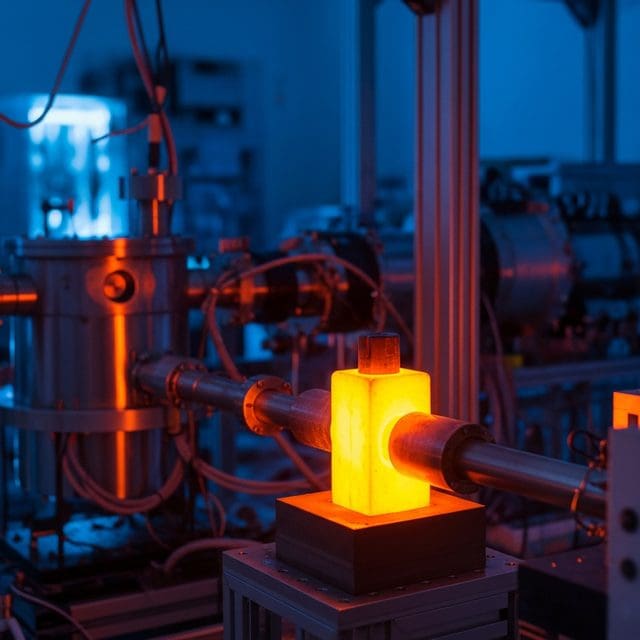
Recent experiments led by SLAC demonstrate that copper can withstand extreme superheating, offering a breakthrough for the durability and design of future fusion energy plants.
The quest for clean, limitless energy took a significant step forward this week as researchers revealed new insights into how materials survive the interior of a star. In findings published in Nature Communications and highlighted by Phys.org, scientists led by the SLAC National Accelerator Laboratory have decoded the ultrafast melting dynamics of copper, a critical component in the heat sinks and structural leads of fusion reactors. These components must survive conditions where core plasma burns at hundreds of millions of degrees while the surrounding structures remain comparatively cool enough to maintain their integrity.
Using femtosecond electron diffraction, the team observed that copper can be superheated to approximately 1,424 degrees Celsius—roughly 1.25 times its standard bulk melting point—without catastrophic failure. Instead of a sudden collapse, the material undergoes a gradual melting process driven by dynamic pressure relaxation and premelting at nanoscale grain boundaries. This discovery challenges long-held assumptions in condensed matter physics and provides engineers with a more accurate model for predicting how reactor walls will behave under the intense thermal loads of burning plasma. The results are particularly timely as multiple national programs in the EU, UK, and Asia are currently finalizing component choices for next-stage reactors, where changing the model of copper behavior could alter which alloys and cooling strategies are viable.
This development comes at a pivotal moment for international energy sovereignty. As global powers race to finalize designs for DEMO-class reactors, the ability to utilize copper more efficiently could lower costs and extend the operational life of these facilities. In the UK, the MAST Upgrade spherical tokamak recently completed its most ambitious campaign to date, achieving record high plasma pressure. Such experimental successes, combined with the new SLAC data, ensure that the infrastructure surrounding the plasma remains stable even when pushed to its physical limits. Furthermore, the IFMIF-DONES project in Spain recently launched the OPTIMA-DONES digital twin to enable predictive maintenance of high-flux neutron sources, further securing the materials pipeline for these massive energy projects.
Beyond the fusion chamber, the week also saw breakthroughs in directional light control that promise to revolutionize domestic telecommunications. A new theoretical framework has emerged that allows for the suppression of light scattering in disordered media. Unlike previous methods that required perfectly ordered crystals, this new approach enables engineers to route photons through irregular materials. This is a vital development for scalable photonic architectures, as it allows for the design of components that route single photons or entangled states with tailored scattering patterns, directly improving readout fidelity and loss budgets in quantum networks.
Furthermore, the discovery of altermagnetism as a third distinct type of magnetism offers a new frontier for spintronics and spin-transport applications like computer memory. By applying uniaxial strain—stretching or compressing the material along a single axis—researchers can now tune electron flow with unprecedented precision. This offers a path toward low-power computer memory and logic that operates independently of the centralized, energy-hungry architectures currently dominating the tech landscape. A tunable altermagnet gives designers a novel material system with highly controllable spin currents, potentially offering better integration with existing CMOS technology while reducing energy use.
These advancements represent a shift toward decentralized, high-efficiency technology. Whether it is stabilizing the walls of a fusion reactor or perfecting the flow of information through a photonic circuit, the focus remains on mastering the physical world to secure a future defined by energy independence and technological liberty. As Silicon Valley continues to push for centralized AI models, these fundamental discoveries in physics provide the tools for a more distributed and resilient technological infrastructure.

Mason Reed serves as a Staff Writer for Just Right News, where he spearheads the Future Frontiers & Special Projects desk. In an era defined by rapid technological shifts and evolving social landscapes, Mason provides a steady, principled voice, examining the innovations of tomorrow through the lens of traditional American values. His work is most prominently featured in his signature series, “The Next Horizon,” where he explores the intersection of emerging technology, national sovereignty, and the preservation of individual liberty.
A native of San Diego, California, Mason’s worldview was shaped by the unique culture of his hometown. Growing up in a region defined by its strong military presence and its history of maritime industry, he developed a deep-seated respect for the institutions that provide national stability and the entrepreneurial spirit that drives the American economy. This upbringing instilled in him a belief that true progress is not found in discarding the past, but in building upon a foundation of proven principles. His reporting often reflects this San Diego influence, emphasizing the importance of a robust national defense and the necessity of maintaining a competitive edge in the global marketplace.
Now based in San Francisco, Mason operates from the heart of the world’s technological engine. Living and working in the Bay Area provides him with a front-row seat to the advancements—and the ideological challenges—emanating from Silicon Valley. While many in the region embrace a “move fast and break things” mentality, Mason’s reporting serves as a vital counterweight. He offers Just Right News readers a “boots on the ground” perspective, documenting how radical local policies and the concentration of tech power impact the everyday lives of citizens. His proximity to the industry allows him to cut through the marketing jargon of big tech to uncover the real-world implications for privacy, free speech, and the nuclear family.
In his “Future Frontiers” beat, Mason tackles complex subjects ranging from the ethics of artificial intelligence to the burgeoning private space race. He approaches these topics with a healthy skepticism toward centralized bureaucracy, championing instead the decentralized innovations that empower individuals. Through “The Next Horizon,” he highlights the pioneers and thinkers who are working to ensure that the future remains a place where human dignity and constitutional rights are protected. He believes that the rapid pace of change requires more than just technical expertise; it requires a moral compass rooted in the Western tradition.
Throughout his tenure at Just Right News, Mason has remained committed to the idea that the future is something to be shaped, not merely accepted. His writing is characterized by a rigorous defense of American exceptionalism and a belief that the country’s best days lie ahead, provided it remains true to its founding ideals. Whether he is investigating the impact of automation on the American workforce or profiling the next generation of aerospace engineers, Mason Reed ensures that his readers are equipped with the insights they need to navigate a changing world with confidence and clarity.