

The White House has reordered its war aims to focus on securing oil flows while signaling potential territorial control over the Strait of Hormuz.
The Trump administration has formally reordered its strategic priorities in the conflict with Iran, placing global energy price stability above the long-standing goal of denuclearization. Vice President JD Vance confirmed this shift on August 16, stating that the primary objective is ensuring Gulf oil and gas continue to flow to protect the American economy. While White House spokesperson Caroline Levitt maintained that blocking an Iranian nuclear weapon remains critical, analysts view the elevation of energy security as a significant departure from earlier maximalist rhetoric. This realist pivot acknowledges that the immediate threat to the American heartland is economic volatility caused by a closed Strait of Hormuz.
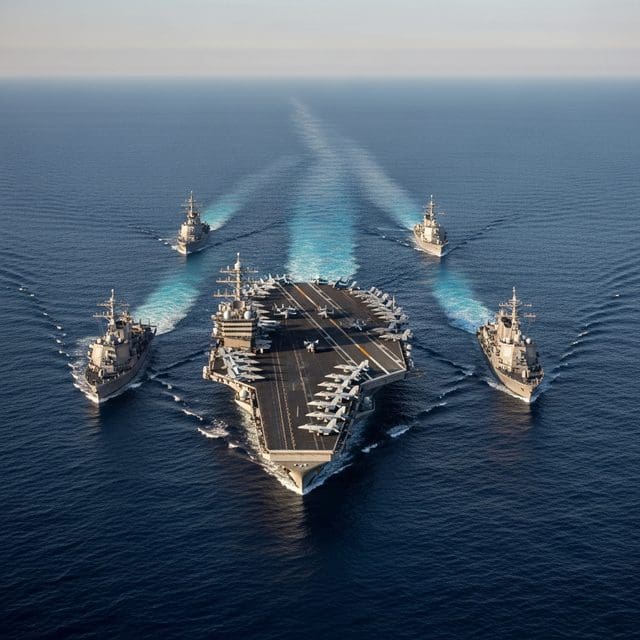
This shift coincides with a hardening of the U.S. military posture. The Pentagon has surged special operations forces, fighter squadrons, and bombers to regional bases to provide the President with muscular military options. Beyond combat units, the U.S. deployed over 150 medics to Landstuhl, Germany, signaling preparations for a sustained engagement. Defense Secretary Pete Hegseth asserted the Navy can maintain its blockade of Iran indefinitely. U.S. Central Command reported that 53 commercial vessels have already been redirected, illustrating the scale of the operation intended to choke Iranian exports while securing international shipping. The USS George Washington has been dispatched to replace the USS Abraham Lincoln, ensuring carrier-based air power remains constant.
President Trump intensified the rhetoric on August 16, signaling an intent to designate the Strait of Hormuz as U.S. territory once the conflict concludes. This follows the President’s August 10 demand that Tehran compensate the families of war victims and regional states for damages. The administration’s approach remains rooted in economic leverage; Trump recently extended a 90-day waiver for foreign ships transporting goods between U.S. ports to mitigate domestic supply chain pressures while Hormuz remains restricted. During what the President described as “semi-negotiations,” the U.S. has maintained a firm line on reparations, refusing to ease pressure until Iran accounts for regional instability.
The strategic pivot comes at a cost to U.S. presence elsewhere. The withdrawal of the last aircraft carrier from Asia to support Middle East operations has raised concerns regarding the U.S. ability to deter Chinese expansion. However, the updated 2026 CENTCOM posture statement argues that deterring Iran is essential to preserving America’s long-term advantage over China. The document lists three core priorities: defending the homeland from terror, deterring Iran, and maintaining a competitive edge against Beijing. By framing the Iran conflict as a prerequisite for global stability, the administration signals a commitment to a protracted engagement that links Middle Eastern security to the Western tradition of maritime freedom.
Tehran has responded by reorganizing its military for a more aggressive foreign stance, suggesting the Iranian leadership is preparing for a war of attrition rather than a diplomatic settlement. As the U.S. military bolsters its logistical footprint, the focus has moved beyond regime pressure toward a comprehensive effort to control the energy corridors that power the Western world. This strategy reflects a cold-eyed assessment of national interest, prioritizing the economic realities of American citizens over ideological goals. With the Strait of Hormuz now at the center of U.S. policy, the stakes for American power have rarely been higher.

Olivia Kendall serves as the Senior Correspondent for Geopolitics, Defense, and Foreign Policy at Just Right News, where she provides a principled, conservative perspective on the complex forces shaping the global stage. With a career dedicated to deconstructing the intricacies of international relations, Kendall has become a trusted voice for readers who value national sovereignty, a robust military, and a foreign policy that prioritizes American interests above all else.
A native of Washington, D.C., Kendall’s professional journey is deeply rooted in her upbringing within the nation’s capital. Growing up in the epicenter of American political life, she developed an early and profound understanding of how policy is crafted and, more importantly, how it often fails to account for the values of the American heartland. This unique vantage point allowed her to witness firsthand the rise of globalist bureaucracies, fueling her commitment to reporting that champions the constitutional foundations of the United States. Her background as a British White American further informs her worldview, providing her with a keen appreciation for the Western tradition and the enduring importance of the “Special Relationship” in maintaining global stability.
Now based in Arlington, Virginia, Kendall operates from the doorstep of the Pentagon and the heart of the nation’s defense establishment. Her proximity to the decision-makers in the military and intelligence communities allows her to provide boots-on-the-ground reporting that is both timely and deeply informed. For Kendall, Arlington is more than just a base of operations; it is a daily reminder of the sacrifices made by the men and women in uniform. This connection to the defense community drives her rigorous coverage of military readiness and her advocacy for a “peace through strength” approach to diplomacy.
At Just Right News, Kendall is perhaps best known for her acclaimed feature series, “The World’s Shadow on America.” In this ongoing project, she explores the direct correlation between international developments and the daily lives of American citizens. Whether she is analyzing the encroachment of foreign adversaries in domestic supply chains or the impact of international treaties on local economies, Kendall’s work serves as a vital bridge between distant geopolitical shifts and their consequences at home. She rejects the notion that foreign policy is an abstract concern for elites, instead proving that what happens in the corridors of power in Brussels or Beijing has a tangible “shadow” that falls across every American doorstep.
Throughout her tenure, Kendall has remained a steadfast critic of international overreach and a vocal proponent of a clear-eyed, realistic foreign policy. She brings a sharp analytical mind to her beat, often challenging the prevailing narratives of the mainstream media to uncover the underlying truths that affect national security. Her reporting is characterized by a refusal to compromise on the truth and a dedication to the idea that a strong, secure America is the world’s best hope for liberty. As a Senior Correspondent, Olivia Kendall continues to lead the charge in providing the essential context and conservative insight necessary to navigate an increasingly volatile world.