

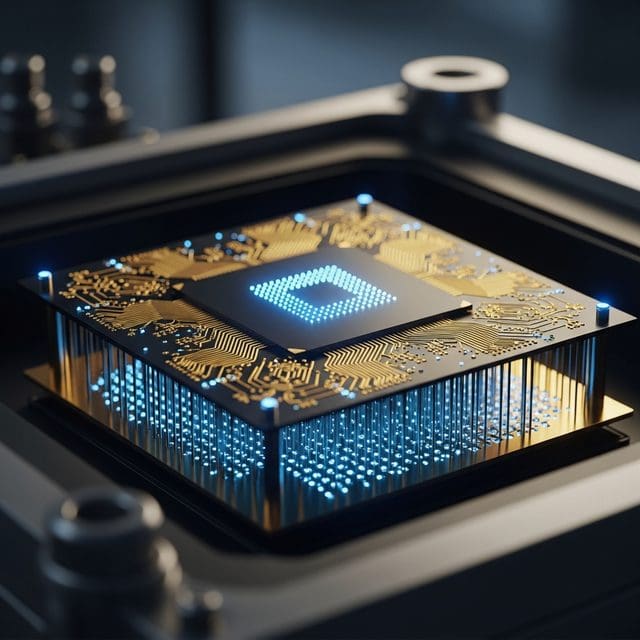
Researchers have demonstrated the first superconducting quantum heat engine, a discovery that could eliminate the massive cooling infrastructure currently hindering the scale of advanced quantum processors.
The quest for American technological supremacy in the quantum age has long been stalled by a physical wall: heat. As Silicon Valley giants and national laboratories attempt to scale quantum processors to hundreds of thousands of qubits, they have been forced to rely on massive, energy-hungry dilution refrigerators and a chaotic web of microwave cabling. This week, a breakthrough in experimental physics suggests a way to dismantle that wall from the inside out, potentially decentralizing the future of high-performance computing.
Researchers have successfully demonstrated the world’s first superconducting quantum heat engine. Reported by ScienceDaily and detailed in recent Nature Communications findings, this tiny device operates at temperatures near absolute zero, converting heat into useful work. Unlike traditional engines that power vehicles or factories, this cyclic engine is integrated directly onto superconducting circuits, the same platform used in the nation’s most promising quantum computing architectures. This is not merely a theoretical curiosity; it is a functional machine that operates in repeatable thermodynamic cycles.
The technical specifics of the demonstration are particularly telling. The engine utilizes a flux-tunable transmon qubit paired with a single-junction quantum-circuit refrigerator. By implementing sequential heating and cooling through frequency ramps, the device reached a mean output power of 0.039 eV/s. While the current efficiency stands at approximately 27 percent of the ideal Otto efficiency, the proof of concept validates that heat management can be handled locally at the atomic level. This moves the field of experimental quantum thermodynamics from the chalkboard to the laboratory floor.
For the American citizen concerned with the trajectory of emerging technology, the implications are significant. Current quantum computers are fundamentally limited by the ‘cabling bottleneck.’ To control a single qubit, engineers often require multiple microwave cables that snake out of the ultra-cold environment into room-temperature controls. These cables are not only expensive but are primary sources of noise and heat leakage. The ScienceDaily report emphasizes that integrated quantum engines could eventually eliminate these costly, noise-producing microwave cables by generating coherent microwave power directly from hot and cold reservoirs on the chip.
Furthermore, the timing of this discovery coincides with a broader push for quantum resilience. While DARPA recently selected Qunnect to strengthen quantum network reliability, the underlying hardware remains fragile. The ability to achieve autonomous thermal management means that the next generation of processors could be more robust and less dependent on the massive, centralized cryogenic infrastructures that currently make quantum computing the exclusive domain of a few mega-corporations. If a processor can manage its own heat, it becomes a more viable tool for decentralized innovation and private-sector sovereignty.
Looking toward the near future, the research community is already eyeing the next milestone. A July 2026 theory paper being cross-referenced by experts suggests that superconducting-circuit engines could soon approach Carnot efficiency—the absolute theoretical maximum for heat conversion—through collective enhancement mechanisms. This would represent a total paradigm shift in how we power and cool the most sensitive electronics in existence.
As the United States competes to lead in Future Frontiers, the transition from bulky, external cooling to integrated, autonomous quantum engines will be the deciding factor. By solving the heat problem at its source, we are not just building faster computers; we are ensuring that the infrastructure of the future remains efficient, scalable, and within the reach of American ingenuity rather than buried under the weight of bureaucratic, centralized engineering hurdles.

Mason Reed serves as a Staff Writer for Just Right News, where he spearheads the Future Frontiers & Special Projects desk. In an era defined by rapid technological shifts and evolving social landscapes, Mason provides a steady, principled voice, examining the innovations of tomorrow through the lens of traditional American values. His work is most prominently featured in his signature series, “The Next Horizon,” where he explores the intersection of emerging technology, national sovereignty, and the preservation of individual liberty.
A native of San Diego, California, Mason’s worldview was shaped by the unique culture of his hometown. Growing up in a region defined by its strong military presence and its history of maritime industry, he developed a deep-seated respect for the institutions that provide national stability and the entrepreneurial spirit that drives the American economy. This upbringing instilled in him a belief that true progress is not found in discarding the past, but in building upon a foundation of proven principles. His reporting often reflects this San Diego influence, emphasizing the importance of a robust national defense and the necessity of maintaining a competitive edge in the global marketplace.
Now based in San Francisco, Mason operates from the heart of the world’s technological engine. Living and working in the Bay Area provides him with a front-row seat to the advancements—and the ideological challenges—emanating from Silicon Valley. While many in the region embrace a “move fast and break things” mentality, Mason’s reporting serves as a vital counterweight. He offers Just Right News readers a “boots on the ground” perspective, documenting how radical local policies and the concentration of tech power impact the everyday lives of citizens. His proximity to the industry allows him to cut through the marketing jargon of big tech to uncover the real-world implications for privacy, free speech, and the nuclear family.
In his “Future Frontiers” beat, Mason tackles complex subjects ranging from the ethics of artificial intelligence to the burgeoning private space race. He approaches these topics with a healthy skepticism toward centralized bureaucracy, championing instead the decentralized innovations that empower individuals. Through “The Next Horizon,” he highlights the pioneers and thinkers who are working to ensure that the future remains a place where human dignity and constitutional rights are protected. He believes that the rapid pace of change requires more than just technical expertise; it requires a moral compass rooted in the Western tradition.
Throughout his tenure at Just Right News, Mason has remained committed to the idea that the future is something to be shaped, not merely accepted. His writing is characterized by a rigorous defense of American exceptionalism and a belief that the country’s best days lie ahead, provided it remains true to its founding ideals. Whether he is investigating the impact of automation on the American workforce or profiling the next generation of aerospace engineers, Mason Reed ensures that his readers are equipped with the insights they need to navigate a changing world with confidence and clarity.