

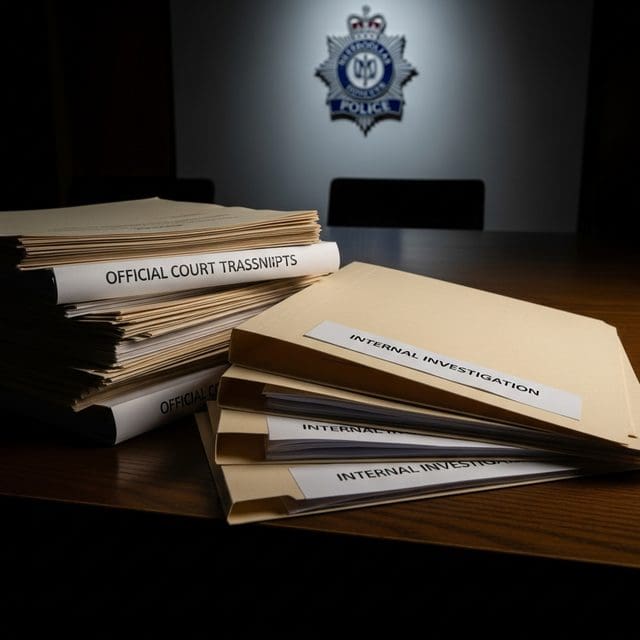
Court filings and official disclosures reveal systemic investigative lapses within the Met Police and an unprecedented tax data breach in France.
Official court transcripts and judicial remarks from Southwark Crown Court have exposed significant procedural failures within the Metropolitan Police’s internal investigative units. Following the unanimous acquittal of Inspector Dave Newman on August 15, 2026, Judge Philip Bartle KC issued a scathing assessment of the force’s conduct. The records show that the investigation into allegations of sexual assault against three female officers was marred by late and incomplete witness statements. Most notably, the court record confirms that one officer was not even approached for a formal statement until the very morning the trial was scheduled to begin.
Judge Bartle described the circumstances surrounding the 2023 Soho drinks event, where the alleged incidents occurred, as “very troubling.” The judge pointed to a failure in leadership, noting that a senior officer had hosted a social gathering where heavy drinking and the consumption of shots were “inevitable.” This judicial commentary suggests that the issues within the Met Police extend beyond mere administrative errors, pointing toward a systemic culture that lacks professional rigor during off-duty hours. The judge’s critique serves as a rare public rebuke of the Met’s investigative standards and its ability to prioritize criminal proceedings effectively when its own members are under scrutiny.
In a formal rebuttal issued shortly after the verdict, the Metropolitan Police denied any suggestion that the case was treated with less than total thoroughness. The department explicitly rejected the notion that Inspector Newman’s rank or status as a serving officer influenced the quality of the investigation. However, the documented delays in evidence gathering provide a factual counter-narrative to the force’s public assertions of diligence. While the jury’s verdict clears Newman of criminal wrongdoing, the judicial record remains a permanent account of the administrative state’s struggle to hold its own accountable through standardized legal processes.
Simultaneously, across the English Channel, the French government is grappling with a massive breach of public trust documented through official prosecutorial disclosures. The Paris Public Prosecutor’s Office cybercrime unit, in coordination with the French Office for Anti-Corruption (Ofac), has launched an investigation into what officials describe as an “unprecedented” and highly sophisticated cyberattack on the national tax administration’s personal information system. The breach, confirmed on August 15, involved the fraudulent extraction of sensitive tax data belonging to 678,000 users, including both private individuals and corporate entities.
According to data provided by the Direction Générale des Finances Publiques (DGFiP), the compromised fields for individuals include full names, family quotients, reference taxable incomes, and specific withholding tax rates. For businesses, the exposed data includes SIREN numbers and the physical addresses of business representatives. While Public Accounts Minister David Amiel stressed that the stolen information does not grant hackers direct access to secure impots.gouv.fr accounts, the data is highly valuable for secondary fraud and phishing attempts. The minister has ordered the DGFiP to begin notifying all affected taxpayers starting Monday and has demanded a formal proposal to strengthen security procedures.
This breach follows a string of similar failures at other French public-sector institutions, including the ANTS and INSEE agencies. The recurring nature of these incidents, documented through government audits and public statements, has intensified the debate over the adequacy of French data protection regimes. As the cybercrime unit works to identify the attack vectors and the perpetrators, the focus remains on the documented failure of the administrative state to safeguard the private financial information of its citizens. Both the London judicial records and the Parisian tax disclosures highlight a growing gap between institutional policy and the reality of public-sector accountability.
Ben Taylor serves as the Senior Correspondent and Investigations Lead for Just Right News, where he anchors the network’s commitment to government transparency and institutional accountability. With a career defined by a relentless pursuit of the facts, Taylor spearheads the acclaimed feature series “The Paper Trail,” a deep-dive investigative column that prioritizes primary source documentation over political rhetoric. Based in the heart of the nation’s capital, he has earned a reputation as one of the most formidable investigative journalists in Washington, D.C., known specifically for his mastery of public records and the Freedom of Information Act.
Taylor’s approach to journalism is deeply rooted in his upbringing in Kansas City, Missouri. Growing up in the “Show Me State,” he developed a healthy skepticism of centralized power and a profound respect for the common-sense values of the American heartland. This Midwestern foundation informs his reporting today, as he bridges the gap between the complex machinations of federal bureaucracy and the everyday concerns of citizens across the country. For Taylor, investigative reporting is not about chasing headlines; it is about ensuring that the government remains answerable to the people it serves.
As an African American man working within the conservative media landscape, Taylor brings a principled perspective to his beat. He views the Constitution and the right to information as the ultimate equalizers in a free society. His work often highlights how bureaucratic overreach and lack of transparency disproportionately affect individual liberties. By focusing on the “paper trail,” Taylor strips away the spin of partisan talking points, instead providing Just Right News readers with the raw data and internal communications that reveal how their tax dollars are spent and how policy decisions are actually made.
In his role as Investigations Lead, Taylor oversees a team dedicated to uncovering the stories that mainstream outlets often overlook. Whether he is auditing federal spending, investigating regulatory overreach, or exposing inefficiencies within the administrative state, his methodology remains consistent: follow the evidence wherever it leads. His presence in Washington, D.C., allows him to maintain a constant watch over the halls of power, yet he remains steadfastly connected to his roots, ensuring his reporting reflects the clarity and directness of his Missouri home.
Throughout his tenure at Just Right News, Taylor has become a vital voice for those who demand integrity in public office. He believes that a well-informed electorate is the strongest defense against government overreach, and he has dedicated his career to providing the public with the tools they need to hold their leaders accountable. Through “The Paper Trail” and his broader investigative work, Ben Taylor continues to set the standard for rigorous, document-driven journalism that champions the values of transparency, individual responsibility, and the rule of law.