

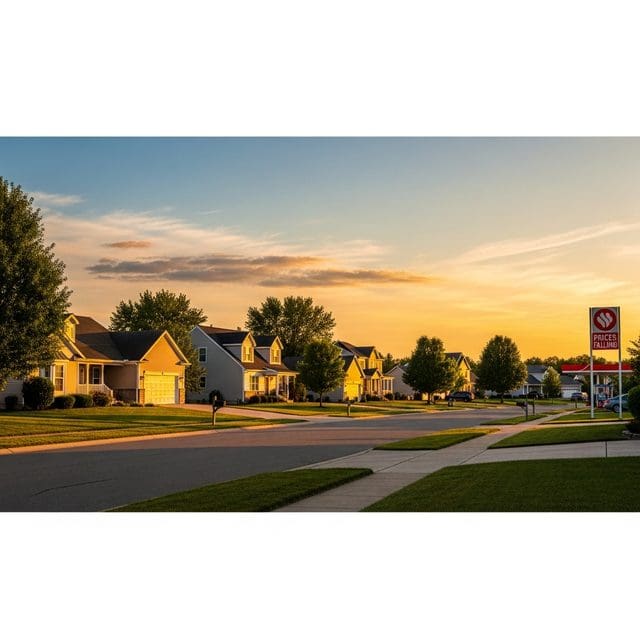
A sharp decline in global oil prices and strategic diplomatic breakthroughs provide a vital economic buffer for American families currently facing historic housing and cost-of-living challenges.
American households, long besieged by the dual pressures of elevated mortgage rates and stagnant housing inventory, received a rare signal of economic relief this week. The announcement of a 10-day ceasefire between Israel and Lebanon, set to commence on April 17, 2026, has combined with a significant breakthrough in U.S.-Iran relations to stabilize global energy markets. For the American taxpayer, the most immediate impact is felt at the pump and in monthly utility bills, as oil prices plummeted over 10% following the reopening of the Strait of Hormuz. This geopolitical shift, formalized through a U.S.-Iran memorandum of understanding, ensures the transit of goods through the critical waterway without the burden of tolls, a move that directly lowers the cost of moving goods and people across the country.
While housing costs typically remain sticky, often consuming more than one-third of the median household budget, the reduction in energy overhead provides a necessary buffer for families struggling to maintain their standard of living. The preservation of local sovereignty and the reduction of federal inflationary pressures remain paramount as these international developments filter down to the kitchen table. The memorandum includes a 60-day ceasefire extension including Lebanon, offering a window of stability that market analysts suggest could lead to more predictable consumer spending patterns in the housing and transit sectors. As the Director of National Intelligence transition begins with the nomination of Jay Clayton, the focus remains on how these high-level security decisions translate into fiscal security for the average citizen.
Infrastructure and mobility also stand to benefit from the easing of energy costs. As transit agencies and logistics providers face lower fuel expenditures, the immediate pressure to hike fares or shipping surcharges may subside, providing a reprieve for commuters who have seen their mobility costs climb alongside inflation. This is particularly relevant as the private sector continues to drive innovation in connectivity. Recent expansions in strategic collaborations between providers like Spectrum and Optimum in New York, Texas, and North Carolina demonstrate that market-driven solutions continue to enhance local infrastructure. By restoring reciprocal carriage of news networks, these private entities are improving the information infrastructure that local communities rely on to stay informed about regional policy changes.
However, the broader housing market remains a complex landscape of private property rights and fiscal hurdles. While energy relief is welcome, the underlying issues of supply and high borrowing costs persist. The recent $75 billion IPO of SpaceX, valuing the firm at $1.77 trillion, highlights a robust appetite for private enterprise and capital investment, yet this massive concentration of capital in the aerospace sector has not yet translated into a significant easing for the average homebuyer or a reduction in local rent burdens. Furthermore, the tech sector’s move toward content-licensing deals, such as Apple’s reported nine-figure budget for Siri’s news integration, underscores a shifting digital economy that continues to evolve even as the physical costs of living remain high.
As the 60-day ceasefire extension remains contingent on compliance, the long-term stability of the American cost-of-living index depends on continued fiscal responsibility and the avoidance of further international entanglements that disrupt supply chains. For now, the reopening of global trade routes offers a brief moment of respite for the American taxpayer, providing a market-based correction to the rising costs of daily life. The intersection of global diplomacy and local affordability remains the primary frontier for the American family, as they navigate a landscape where the price of a barrel of oil can be just as impactful as the local zoning board’s latest decision on multi-family housing.

Deborah Cole serves as a Senior Correspondent for Just Right News, where she spearheads the network’s coverage of Housing, Infrastructure, and Mobility. With a career defined by a commitment to rigorous reporting and a focus on the fundamental pillars of American community life, Deborah brings a principled perspective to the complex issues that dictate how and where we live. Her work is grounded in the belief that sound policy, fiscal responsibility, and respect for private property are the essential foundations of a prosperous society.
Originally from Boston, Massachusetts, Deborah’s upbringing in one of the nation’s oldest and most historically significant cities deeply influenced her professional trajectory. Growing up amidst the architectural legacy and dense urban planning of New England, she developed an early appreciation for the importance of durable infrastructure and the role of local tradition in shaping neighborhoods. Her perspective is informed by the classic American values of her hometown—hard work, community cohesion, and a healthy skepticism of top-down bureaucratic mandates that often overlook the unique needs of individual citizens.
Today, Deborah operates from her base in Austin, Texas, a city that serves as a primary laboratory for her reporting. Austin’s rapid expansion and its status as a hub for innovation and migration provide her with a front-row seat to the most pressing challenges in modern infrastructure and housing. From the Lone Star State, she chronicles the tensions between rapid growth and the preservation of the American Dream, often highlighting how market-driven solutions and deregulation can address the housing shortages that plague many of the country’s metropolitan areas.
At Just Right News, Deborah is perhaps best known for her signature feature series, “Where We Live.” Through this platform, she explores the intersection of public policy and private life, moving beyond mere statistics to tell the stories of families, small business owners, and local developers. Her reporting frequently highlights the importance of mobility—not just in terms of transportation and transit, but as a vehicle for economic opportunity and social stability. She remains a staunch advocate for the taxpayer, consistently scrutinizing government spending on large-scale projects and advocating for transparency in how infrastructure dollars are allocated.
Deborah’s beat is more than just a collection of policy topics; it is an investigation into the physical and legal structures that allow families to flourish. Whether she is reporting on the impact of zoning laws on suburban development or the necessity of maintaining the nation’s highway systems, her work is characterized by a dedication to the facts and a respect for the constitutional principles that protect the rights of homeowners.
As a Senior Correspondent, Deborah Cole continues to be a vital voice for Just Right News, providing the audience with the clarity and context needed to navigate an ever-changing landscape. Her reporting ensures that the values of individual liberty and local sovereignty remain at the forefront of the national conversation regarding the future of our cities and towns. Through her tireless efforts, she remains committed to informing the public on the issues that hit closest to home.