

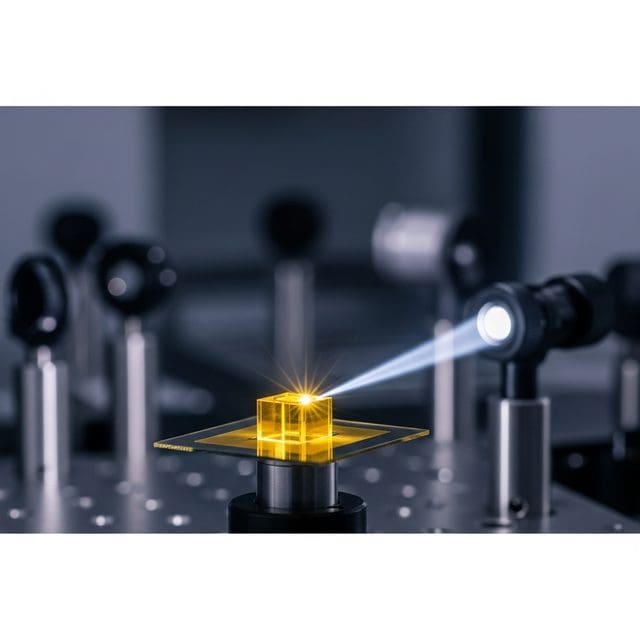
Recent discoveries in room-temperature quantum materials and sunlight-driven entanglement are paving the way for decentralized, energy-efficient computing that bypasses traditional cryogenic barriers.
The long-standing barrier to practical quantum computing—the requirement for massive, energy-intensive cryogenic cooling—is beginning to crumble under the weight of new discovery. In a series of breakthroughs reported this August, scientists have demonstrated that quantum states can be managed at room temperature, potentially paving the way for a new era of decentralized innovation that does not rely on centralized, power-hungry infrastructure. This shift represents a significant victory for the prospect of localized, secure computing that remains within the reach of private citizens and smaller institutions rather than being sequestered in the basements of massive government or corporate data centers.
On August 8, researchers announced the creation of the first quantum material capable of sorting and transporting different quantum states of light at room temperature. Utilizing a tiny gold crystal, this innovation removes the need for the bulky, ultra-cold refrigeration units that currently define the quantum landscape. By enabling light-based information to be steered and read on a single device at ambient temperatures, the discovery aligns with a vision of technology that is both high-performing and physically accessible. This material could eventually allow quantum sensors and processors to operate in standard domestic and industrial environments, preserving individual privacy and local control over sensitive data processing without the overhead of a liquid-helium cooling plant.
Further challenging the status quo of energy consumption, an outdoor experiment conducted on August 7 successfully generated quantum entanglement directly from sunlight. The process achieved a 94% similarity to results typically produced by high-powered laboratory lasers. This suggests a future where quantum communication networks could be powered by natural resources, reducing the reliance on the centralized power grid and lowering the barrier to entry for secure, sovereign communication systems. If entanglement can be harvested from the sun, the infrastructure for a secure “quantum internet” becomes significantly more resilient and less dependent on fragile, centralized utilities.
While terrestrial labs focus on heat management, NASA is utilizing the unique environment of the International Space Station to push the boundaries of matter. The upgraded Cold Atom Lab is currently producing ultra-cold matter in microgravity, providing a pristine environment to observe quantum behaviors that are masked by Earth’s gravity. These orbital experiments are essential for refining the mathematical models that will eventually govern room-temperature applications on the ground. By observing how atoms behave when freed from the weight of the atmosphere, researchers are gaining the insights necessary to simulate these effects in more practical, everyday settings.
Complementing these material advances is the development of PLATON, a new particle detector that simplifies complex hardware. By using a single block of light-producing material combined with AI and light-field cameras, PLATON can replace millions of individual components. This move toward hardware simplification mirrors the broader push for efficient, elegant engineering that respects resource limits while maximizing output. Instead of building ever-larger machines, the focus is shifting toward smarter, more integrated designs that do more with less.
As these technologies move from the laboratory toward the marketplace, the focus shifts to integration. Researchers at Nanyang Technological University have already demonstrated that 200-year-old optical principles, such as the Poisson spot effect, can be used to create complex “optical skyrmions.” This blend of classical physics and quantum potential suggests that the next generation of American innovation will not require a total abandonment of the past, but rather a principled application of new discoveries to timeless engineering challenges. From the cosmic accelerators of LHAASO J1912+1014u to the programmable optical chips that slow light on demand, the frontier of physics is moving toward a future where the quantum world is finally compatible with the human one.

Mason Reed serves as a Staff Writer for Just Right News, where he spearheads the Future Frontiers & Special Projects desk. In an era defined by rapid technological shifts and evolving social landscapes, Mason provides a steady, principled voice, examining the innovations of tomorrow through the lens of traditional American values. His work is most prominently featured in his signature series, “The Next Horizon,” where he explores the intersection of emerging technology, national sovereignty, and the preservation of individual liberty.
A native of San Diego, California, Mason’s worldview was shaped by the unique culture of his hometown. Growing up in a region defined by its strong military presence and its history of maritime industry, he developed a deep-seated respect for the institutions that provide national stability and the entrepreneurial spirit that drives the American economy. This upbringing instilled in him a belief that true progress is not found in discarding the past, but in building upon a foundation of proven principles. His reporting often reflects this San Diego influence, emphasizing the importance of a robust national defense and the necessity of maintaining a competitive edge in the global marketplace.
Now based in San Francisco, Mason operates from the heart of the world’s technological engine. Living and working in the Bay Area provides him with a front-row seat to the advancements—and the ideological challenges—emanating from Silicon Valley. While many in the region embrace a “move fast and break things” mentality, Mason’s reporting serves as a vital counterweight. He offers Just Right News readers a “boots on the ground” perspective, documenting how radical local policies and the concentration of tech power impact the everyday lives of citizens. His proximity to the industry allows him to cut through the marketing jargon of big tech to uncover the real-world implications for privacy, free speech, and the nuclear family.
In his “Future Frontiers” beat, Mason tackles complex subjects ranging from the ethics of artificial intelligence to the burgeoning private space race. He approaches these topics with a healthy skepticism toward centralized bureaucracy, championing instead the decentralized innovations that empower individuals. Through “The Next Horizon,” he highlights the pioneers and thinkers who are working to ensure that the future remains a place where human dignity and constitutional rights are protected. He believes that the rapid pace of change requires more than just technical expertise; it requires a moral compass rooted in the Western tradition.
Throughout his tenure at Just Right News, Mason has remained committed to the idea that the future is something to be shaped, not merely accepted. His writing is characterized by a rigorous defense of American exceptionalism and a belief that the country’s best days lie ahead, provided it remains true to its founding ideals. Whether he is investigating the impact of automation on the American workforce or profiling the next generation of aerospace engineers, Mason Reed ensures that his readers are equipped with the insights they need to navigate a changing world with confidence and clarity.