

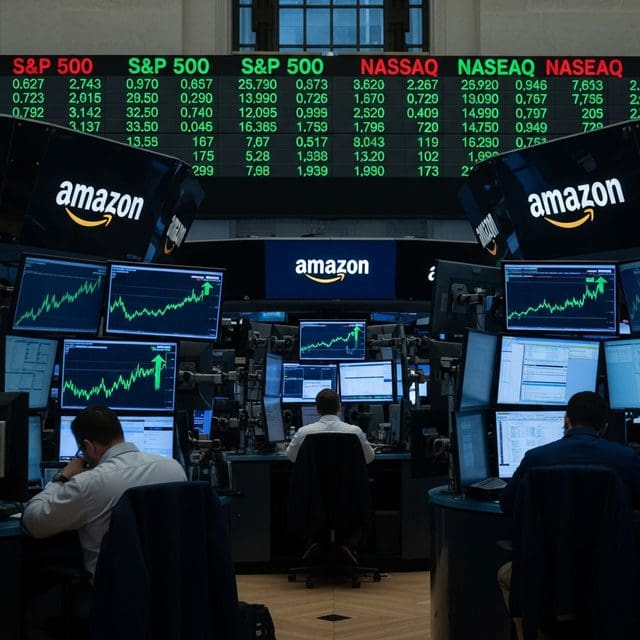
Major indices rallied as megacap technology and communication services stocks surged on robust AI-driven earnings, with Amazon reaching a historic $3 trillion market capitalization despite underlying concerns regarding capital expenditure and cash flow.
The American equity market demonstrated renewed vigor on Tuesday, as the S&P 500 climbed 1.64% to reach 7,600.50, placing the benchmark within touching distance of a new all-time high. This resurgence, characterized by a decisive return to the “AI trade,” follows a period of summer volatility that institutional analysts at Citadel Securities now declare a completed technical reset. For the American taxpayer and the retail investor, the day’s action underscores a market increasingly bifurcated between a booming digital infrastructure and a manufacturing sector grappling with the inflationary side effects of that very expansion. The rally was not merely a domestic phenomenon; global equities followed the U.S. lead, with the German DAX and French CAC 40 both marking fresh intraday records as falling oil prices and positive AI-related momentum supported risk appetite across the Atlantic.
Leadership was concentrated in the technology and communication services sectors, which significantly outperformed the broader market benchmark. Amazon made financial history by crossing the $3 trillion market capitalization threshold for the first time, gaining 4.6% on the session. Other pillars of the so-called “Magnificent Seven” followed suit, with Meta surging 6.7% and Alphabet rising 5.2%. Microsoft led the S&P 500 point-contribution with a 4.9% gain, while Apple remained the lone laggard among the giants, slipping 0.5%. These gains were fueled by a narrative of insatiable demand for artificial intelligence development, which has already pushed U.S. manufacturing to its fastest growth pace in more than four years. However, this industrial acceleration has come at a cost, as manufacturers report persistent supply shortages and higher inflation driven by the tech-heavy demand for specialized components.
However, a closer inspection of the “Invisible Economy” reveals a more complex fiscal reality that working households must navigate. While Microsoft’s Azure revenue exceeded $100 billion and Amazon’s combined AI and chip businesses reached a $25 billion annual run-rate, the capital required to sustain this growth is staggering. Alphabet reported its first-ever negative quarterly free cash flow in Q2 2026, while Meta’s cash generation plummeted by 91% year-on-year. Amazon itself reported a $7.6 billion negative free cash flow over the last twelve months. Much of the reported earnings strength currently driving index levels is derived from mark-to-market gains on private stakes in firms like Anthropic, OpenAI, and SpaceX, rather than core operating growth—a distinction that merit-based investors must monitor closely as these valuations are subject to the whims of private market appraisals.
On the monetary front, the U.S. Treasury Department and the Federal Reserve took the rare step of jointly intervening with Japanese counterparts to boost the yen on August 3. This move toward centralized currency management coincided with a cooling of geopolitical tensions in the Middle East, providing a stable backdrop for passive investment flows. While the headline indices suggest a period of unbridled prosperity, the reliance on massive capital expenditures and government-assisted currency stability suggests that the road to a stable monetary future remains paved with significant fiscal challenges. Even in the mid-market, signs of a shifting landscape are evident; Prudent Growth Partners recently offloaded the Carolina Commerce Center for $5.5 million, and Platinum Equity announced a major investment in LMPG, signaling that while tech dominates the headlines, the underlying machinery of American commerce is in a state of rapid transition.
As the market awaits the upcoming JOLTS job openings report and the Reserve Bank of Australia’s rate decision, the current rally reflects a bet on technological exceptionalism. For the working household, the primary takeaway is a market that has successfully “soothed” previous jitters regarding AI returns, even as the cost of maintaining that lead begins to weigh on the balance sheets of the nation’s largest corporations. The investigate claims by Pomerantz LLP into Metropolitan Bank Holding Corp and Rollins, Inc. serve as a reminder that even in a bull market, corporate accountability remains paramount. Ultimately, the 1.64% climb in the SPY represents a vote of confidence in the AI-driven future, but the sustainability of this growth will depend on whether these massive investments can eventually translate into the stable, core operating cash flow that defines a healthy and sovereign economy.

Jordan Lee serves as the Senior Correspondent for Wall Street, Finance, and Monetary Systems at Just Right News. Based in the heart of the world’s financial capital, New York City, Lee brings a sharp, principled eye to the complex mechanisms that drive the global economy. His reporting is defined by a commitment to fiscal responsibility, the defense of the free market, and a deep-seated belief that a transparent monetary system is the bedrock of a free society.
Raised in Portland, Oregon, Lee’s perspective was forged in a city that has undergone significant cultural and economic shifts. His upbringing in the Pacific Northwest instilled in him a profound appreciation for the industriousness of small business owners and the importance of local economic stability. Watching the evolution of his hometown’s landscape sparked an early interest in how federal fiscal policy and large-scale financial trends eventually trickle down to the average citizen. This background provides him with a unique vantage point; he understands the growing disconnect between the policy-making elite and the reality of Main Street, a theme that frequently resonates throughout his work.
Now operating from his base in New York City, Lee bridges the gap between the high-stakes trading floors of Manhattan and the households of everyday Americans. He views the financial sector not merely as a collection of numbers and tickers, but as a vital engine of American prosperity that requires constant vigilance and accountability. His reporting often highlights the dangers of centralized financial control and the necessity of maintaining a system that rewards merit, risk-taking, and innovation.
As the creator and lead of the featured series, “The Invisible Economy,” Lee pulls back the curtain on the often-opaque world of monetary systems. He specializes in translating the dense jargon of central banking and international finance into actionable insights for the Just Right News audience. His work explores the “invisible” forces—such as inflationary pressures, regulatory creep, and the expansion of the administrative state—that erode the purchasing power of American families. By focusing on these systemic issues, Lee empowers readers to understand the hidden forces shaping their financial independence.
Lee’s journalistic philosophy is rooted in a steadfast commitment to traditional American values. As an Asian American professional who has navigated the competitive corridors of the financial world, he is a vocal advocate for meritocracy and the preservation of the American Dream. He believes that a stable currency and a predictable regulatory environment are essential for national sovereignty and individual liberty. His reporting frequently warns against the risks of government overreach in the private sector, arguing that the most effective solutions to economic challenges arise from competition and individual enterprise rather than bureaucratic mandates.
At Just Right News, Jordan Lee remains dedicated to providing a clear-eyed defense of the taxpayer. Whether he is analyzing market volatility or investigating the long-term implications of national debt, his mission is to provide the truth about where the money is going and what it means for the future of the country. Through his rigorous analysis and principled stance, Lee has become a trusted voice for those who value a strong, sovereign, and fiscally sound America.