

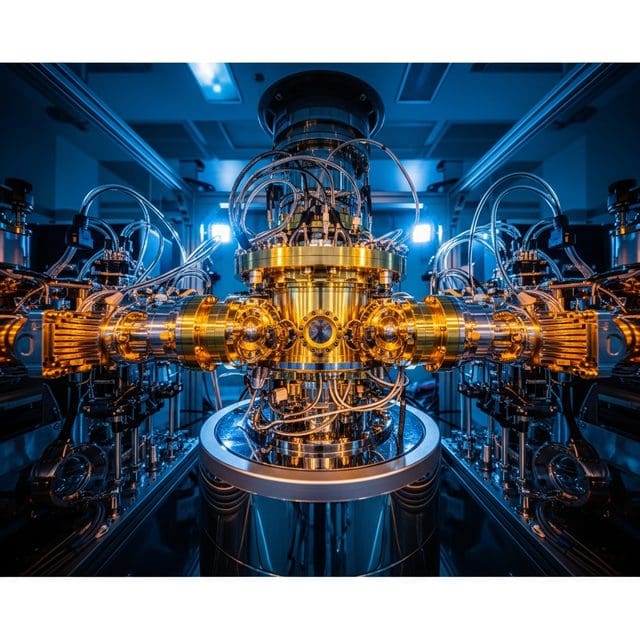
Researchers at IBM and the University of Chicago have demonstrated a verifiable quantum advantage, completing a complex simulation task in fifteen minutes that would take classical supercomputers an impractical amount of time.
A significant milestone in the race for computational sovereignty was reached this week as researchers from IBM and the University of Chicago announced a verified demonstration of quantum advantage. The collaboration successfully executed a complex simulation task that remains beyond the practical reach of even the most powerful classical supercomputers, completing the operation in approximately fifteen minutes. This achievement represents a principled step toward American leadership in a critical frontier, ensuring that the next generation of computing remains grounded in rigorous, verifiable science rather than mere Silicon Valley hype.
Published in a new report by Simon Martiel and his colleagues, the experiment utilized 97 physical qubits to run 70-qubit circuits at a depth of 70. By employing a technique known as ‘doped Clifford sampling,’ the team achieved a tenfold reduction in gate errors. This technical achievement allowed them to establish a certified fidelity lower bound of 0.284, providing a level of statistical confidence that has historically eluded the quantum computing field. While previous ‘quantum supremacy’ claims often relied on random circuit sampling that was difficult to check, this new approach uses structured, error-suppressed circuits that are amenable to statistical verification.
The implications of this discovery extend beyond the laboratory. As the United States faces increasing competition in the digital realm, the ability to perform trusted computations that outpace classical machines is a matter of national importance. The IBM quantum system demonstrated that many leading classical simulation approaches would require prohibitive runtimes to match this specific task. By using logical, encoded quantum circuit constructions, the experiment pushes toward scalable quantum computing that can eventually defend constitutional rights and individual liberty against the encroaching reach of centralized bureaucracy and foreign digital influence.
While the quantum world focuses on the infinitesimal, the astrophysical world is revealing its own massive accelerators. Simultaneously this week, scientists utilizing the Large High Altitude Air Shower Observatory (LHAASO) confirmed that Cygnus X-3 has been identified as the most powerful natural particle accelerator in the Milky Way. This binary system, likely containing a black hole or neutron star, is capable of accelerating cosmic-ray protons to at least 30 peta-electronvolts (PeV). The LHAASO data detected a 4.8-hour periodicity in the gamma-ray signal, matching the system’s orbital period and constraining the acceleration region to a mere three solar radii across. This discovery provides a natural counterpart to the man-made accelerators being developed in labs across the West.
These dual breakthroughs—one in the controlled environment of a quantum chip and the other in the chaotic depths of the Cygnus constellation—highlight a pivotal moment for physics. The IBM and University of Chicago result specifically addresses the skepticism that has long shadowed quantum research. By providing a ‘self-verifying’ alternative to earlier methods, the team has created a reference test case for all future hardware. This ensures that as we scale these systems, we do so with a commitment to accuracy and transparency.
As these technologies move from the ‘Future Frontiers’ into the mainstream, the focus must remain on decentralized innovation. The investment in these projects, such as the $57 million Series B recently raised by Convex for AI reliability or the launch of the NEO.AI Memory Platform, suggests a robust ecosystem is forming to support these high-performance demands. For the American public, these advancements promise a future where our computational infrastructure is not only faster but more secure against the threats of an increasingly digitized world. The path forward requires a balance of bold exploration and the traditional values of verification and accountability.

Mason Reed serves as a Staff Writer for Just Right News, where he spearheads the Future Frontiers & Special Projects desk. In an era defined by rapid technological shifts and evolving social landscapes, Mason provides a steady, principled voice, examining the innovations of tomorrow through the lens of traditional American values. His work is most prominently featured in his signature series, “The Next Horizon,” where he explores the intersection of emerging technology, national sovereignty, and the preservation of individual liberty.
A native of San Diego, California, Mason’s worldview was shaped by the unique culture of his hometown. Growing up in a region defined by its strong military presence and its history of maritime industry, he developed a deep-seated respect for the institutions that provide national stability and the entrepreneurial spirit that drives the American economy. This upbringing instilled in him a belief that true progress is not found in discarding the past, but in building upon a foundation of proven principles. His reporting often reflects this San Diego influence, emphasizing the importance of a robust national defense and the necessity of maintaining a competitive edge in the global marketplace.
Now based in San Francisco, Mason operates from the heart of the world’s technological engine. Living and working in the Bay Area provides him with a front-row seat to the advancements—and the ideological challenges—emanating from Silicon Valley. While many in the region embrace a “move fast and break things” mentality, Mason’s reporting serves as a vital counterweight. He offers Just Right News readers a “boots on the ground” perspective, documenting how radical local policies and the concentration of tech power impact the everyday lives of citizens. His proximity to the industry allows him to cut through the marketing jargon of big tech to uncover the real-world implications for privacy, free speech, and the nuclear family.
In his “Future Frontiers” beat, Mason tackles complex subjects ranging from the ethics of artificial intelligence to the burgeoning private space race. He approaches these topics with a healthy skepticism toward centralized bureaucracy, championing instead the decentralized innovations that empower individuals. Through “The Next Horizon,” he highlights the pioneers and thinkers who are working to ensure that the future remains a place where human dignity and constitutional rights are protected. He believes that the rapid pace of change requires more than just technical expertise; it requires a moral compass rooted in the Western tradition.
Throughout his tenure at Just Right News, Mason has remained committed to the idea that the future is something to be shaped, not merely accepted. His writing is characterized by a rigorous defense of American exceptionalism and a belief that the country’s best days lie ahead, provided it remains true to its founding ideals. Whether he is investigating the impact of automation on the American workforce or profiling the next generation of aerospace engineers, Mason Reed ensures that his readers are equipped with the insights they need to navigate a changing world with confidence and clarity.