

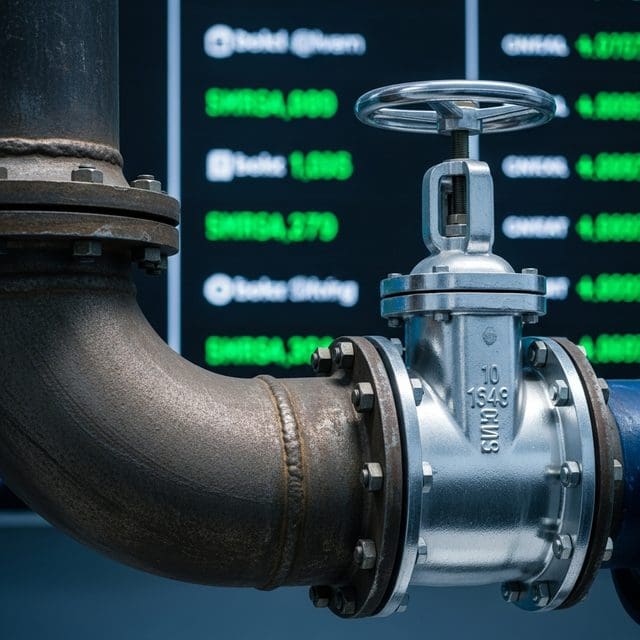
American Water Works and Solstice Advanced Materials report surging profits as they leverage regional monopolies and strategic acquisitions to dominate essential infrastructure and high-tech supply chains.
The consolidation of American infrastructure moved into a higher gear this week as two dominant players in the utility and industrial sectors reported second-quarter results that underscore the financial rewards of market concentration. American Water Works (NYSE: AWK) and Solstice Advanced Materials (NASDAQ: SOLS) both exceeded earnings expectations, leveraging a combination of aggressive acquisitions and increased pricing power to secure their market positions. For the American consumer, these reports signal a tightening grip by corporate entities over essential services and critical supply chains.
American Water Works posted adjusted earnings per share of $1.61, an 8% increase year-over-year, on operating revenues of $1.355 billion. The company’s growth strategy is increasingly reliant on absorbing smaller municipal and private systems, effectively reducing the number of independent providers in the water and wastewater sector. In the first half of 2026, the firm completed $346 million in regulated acquisitions, adding approximately 52,000 customer connections. The centerpiece of this expansion was the $319 million cash purchase of Nexus Regulated Utilities, which closed on June 1, 2026, after navigating a complex web of approvals across eight different states.
This expansion is a prelude to an even larger shift in market power. Management confirmed ongoing progress on its proposed merger with Essential Utilities, a deal that would fundamentally reshape the regulated water market. With three state approvals already secured, the company is targeting a close by the end of the first quarter of 2027. While the firm frames these moves as necessary for infrastructure investment, the resulting scale efficiencies often serve to insulate the company from competition rather than lower costs for the public. By holding operating and maintenance costs roughly flat through scale, the company is maximizing the margins extracted from its growing, captive customer base.
Revenue growth is further bolstered by a series of aggressive rate case filings. Since the beginning of 2026, American Water has secured authorization for $216 million in additional annualized revenues. This includes a final order in Pennsylvania that approved a $75 million increase, despite the company originally requesting $160 million. With a return on equity set at 9.55% and new rates effective August 13, 2026, the company continues to push for more, with pending filings seeking $18 million in Kentucky and a substantial $179 million in Missouri. Most of the projected earnings growth for the remainder of 2026 is expected to hit in the second half of the year as these new rates in Pennsylvania and New Jersey take full effect.
Parallel to the utility sector, Solstice Advanced Materials is demonstrating how industrial concentration functions in high-tech markets. The company reported Q2 net sales of $1.148 billion, an 11% increase, with adjusted EBITDA reaching $290 million. Solstice raised its full-year 2026 guidance, citing robust demand in the semiconductor, data center, and nuclear energy markets. As these sectors become increasingly vital to the national economy, the reliance on a few dominant suppliers like Solstice creates a bottleneck that can drive up costs for downstream manufacturers and, ultimately, the end user.
The broader financial landscape reflects this trend toward institutional dominance. On July 31, 2026, Amazon posted its best stock performance in 11 years, driven by cloud growth and paper gains on Anthropic investments, while financial stocks reached record highs as of August 2. Even in the healthcare sector, PureHealth reported a net profit of $337 million for the first half of the year, with revenues climbing to $4.0 billion. As these giants grow, the space for small-business competition and individual market liberty continues to shrink, leaving regulators at the FTC and DOJ with the daunting task of addressing a marketplace where power is increasingly held by the few.

Greg Sanders serves as the Senior Correspondent for Corporate Power and Antitrust at Just Right News, where he brings a principled, conservative perspective to the complex intersection of big business, government regulation, and the American consumer. With a career dedicated to investigative depth and economic clarity, Greg has become a leading voice in examining how the consolidation of industry power impacts the foundational values of the free market and individual liberty.
Raised in Denver, Colorado, Greg’s reporting is deeply informed by the Western spirit of independence and a healthy skepticism of centralized authority. Growing up in the shadows of the Rockies, he witnessed firsthand the importance of local entrepreneurship and the vital role that small-medium enterprises play in sustaining vibrant communities. This upbringing instilled in him a belief that the American Dream is best preserved when the playing field remains level and when competition—rather than backroom deals between corporate lobbyists and federal regulators—dictates success. For Greg, the rugged individualism of his home state serves as a constant reminder that the economy should serve the people, not the other way around.
Now based in Chicago, Illinois, Greg operates from the heart of the nation’s industrial and financial crossroads. His location in the Midwest provides him with a unique vantage point to observe the real-world consequences of corporate overreach. From the boardrooms of the Loop to the manufacturing hubs that define the region, he tracks the movement of capital and the shifting tides of market influence. Chicago’s history as a center of trade and labor offers a rich backdrop for his work, allowing him to bridge the gap between high-level economic theory and the lived experiences of hardworking Americans who feel the squeeze of monopolistic practices.
At Just Right News, Greg’s beat focuses on the “new monopolies” and the rise of “woke” corporate culture. He argues that when corporations become too large, they often abandon their fiduciary duties to shareholders in favor of social engineering and political posturing. His reporting seeks to hold these “Titans” accountable, ensuring that the power of the purse is not used to silence dissent or bypass the democratic process. He is a firm advocate for the idea that true conservatism requires a vigilant defense of competition, preventing any single entity—public or private—from exerting undue control over the lives of citizens.
This mission is most clearly seen in his acclaimed feature series, “The Titans and the Toll.” In this ongoing project, Greg explores the human cost of market consolidation, from the erosion of consumer choice to the decline of local economies. Through rigorous analysis and boots-on-the-ground reporting, he documents how the concentration of power in sectors like tech, agriculture, and finance creates a “toll” paid by the average family.
Greg Sanders remains committed to the idea that a transparent, competitive market is the greatest engine for prosperity ever devised. Through his work at Just Right News, he continues to provide the essential oversight necessary to protect that engine from the encroaching influence of corporate giants and the bureaucratic structures that enable them.