

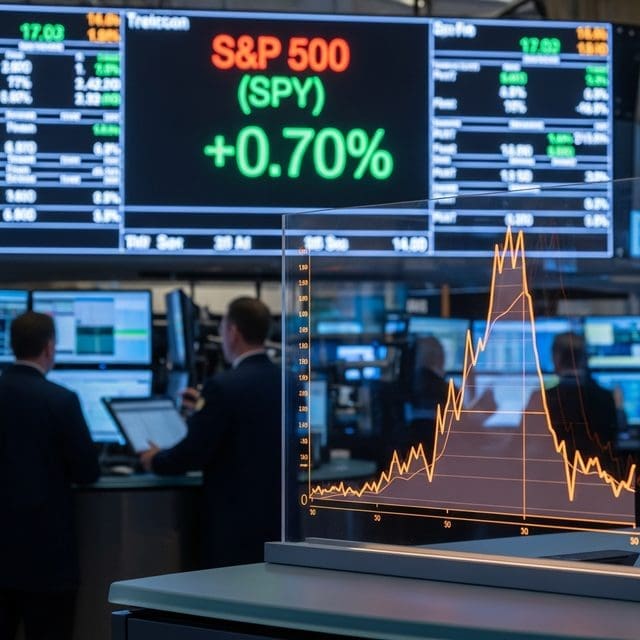
The S&P 500 gained 0.70% today as a historic U.S.-Japan currency intervention and a pause in Middle East hostilities offset concerns regarding 19-year highs in Treasury yields.
Global financial markets navigated a dense thicket of central bank intervention and shifting geopolitical alliances today, with the S&P 500 (SPY) maintaining a 0.70% gain. This upward movement in equities stands in stark contrast to a volatile bond market, where the 30-year Treasury yield held firm above 5.2%, hovering near 19-year highs. For the American taxpayer, this environment represents a “fragile bid”—a market buoyed by emergency policy backstops even as the underlying cost of long-term debt continues to climb, threatening the stability of the invisible economy.
The most significant development for global stability was the confirmation of a rare, coordinated intervention by the U.S. and Japan to arrest the yen’s slide toward 40-year lows. Reports indicate the operation reached between $40 billion and $53 billion, with the New York Fed acting on behalf of the U.S. Treasury to sell euros and buy yen. Satsuki Katayama, Japan’s Finance Minister, is expected to signal that these operations remain ongoing. This marks a return to late-1990s-style joint maneuvers, suggesting that centralized financial authorities are increasingly desperate to prevent a disorderly collapse in Asian currency markets that could spill over into domestic growth.
While currency markets stabilized, the Federal Reserve faced a public challenge to its inflation-fighting resolve. St. Louis Fed President Alberto Musalem warned that the recent sell-off in Treasuries is a direct signal that the central bank must “earn its credibility.” Musalem disclosed that he favored a 25-basis-point rate hike at this week’s meeting, where the Fed instead chose to hold rates at 3.5–3.75% for the fifth consecutive time. This policy hesitation has resulted in a “twist” in the yield curve, where long-dated yields rise sharply while shorter maturities remain steady. This dynamic reflects a growing market consensus that the Fed may be finished with hikes but will be forced to keep policy restrictive for much longer to combat persistent price pressures.
Geopolitics provided a temporary reprieve for energy-conscious households. The cancellation of planned military strikes against Iran on August 2, following reports of progress in ceasefire negotiations and diplomatic pressure from Saudi Crown Prince Mohammed bin Salman, effectively stripped the “war risk premium” from the commodities market. Brent crude, which had recently spiked toward $96, fell roughly 9% to trade below the $90 threshold. This cooling of tensions is a primary driver behind today’s 0.70% gain in the SPY, as lower energy costs reduce the immediate inflationary drag on corporate earnings and consumer spending.
Institutional activity further underscored the day’s mixed signals. While Amazon celebrated its best trading day in 11 years due to cloud growth inflection, and PureHealth reported a robust $337 million net profit for H1 2026, legal risks are mounting elsewhere. Pomerantz LLP has intensified investigations into investor claims against Metropolitan Bank Holding Corp. and Rollins, Inc., reminding market participants that corporate governance remains under scrutiny. Additionally, the U.S. is moving forward with aggressive industrial policy, implementing a 0% rate for companies relocating production to the U.S., which will escalate to 200% by 2030.
Ultimately, today’s market action reveals a tug-of-war between two forces: the relief provided by cooling geopolitical fires and the mounting pressure of a high-interest-rate environment. While the SPY remains in positive territory, the surge in long-term yields and the necessity of massive currency interventions suggest that the era of easy stability has been replaced by a period of managed volatility. For the principled defender of free markets, these developments serve as a reminder that government overreach in monetary systems often creates as many fires as it attempts to extinguish.

Jordan Lee serves as the Senior Correspondent for Wall Street, Finance, and Monetary Systems at Just Right News. Based in the heart of the world’s financial capital, New York City, Lee brings a sharp, principled eye to the complex mechanisms that drive the global economy. His reporting is defined by a commitment to fiscal responsibility, the defense of the free market, and a deep-seated belief that a transparent monetary system is the bedrock of a free society.
Raised in Portland, Oregon, Lee’s perspective was forged in a city that has undergone significant cultural and economic shifts. His upbringing in the Pacific Northwest instilled in him a profound appreciation for the industriousness of small business owners and the importance of local economic stability. Watching the evolution of his hometown’s landscape sparked an early interest in how federal fiscal policy and large-scale financial trends eventually trickle down to the average citizen. This background provides him with a unique vantage point; he understands the growing disconnect between the policy-making elite and the reality of Main Street, a theme that frequently resonates throughout his work.
Now operating from his base in New York City, Lee bridges the gap between the high-stakes trading floors of Manhattan and the households of everyday Americans. He views the financial sector not merely as a collection of numbers and tickers, but as a vital engine of American prosperity that requires constant vigilance and accountability. His reporting often highlights the dangers of centralized financial control and the necessity of maintaining a system that rewards merit, risk-taking, and innovation.
As the creator and lead of the featured series, “The Invisible Economy,” Lee pulls back the curtain on the often-opaque world of monetary systems. He specializes in translating the dense jargon of central banking and international finance into actionable insights for the Just Right News audience. His work explores the “invisible” forces—such as inflationary pressures, regulatory creep, and the expansion of the administrative state—that erode the purchasing power of American families. By focusing on these systemic issues, Lee empowers readers to understand the hidden forces shaping their financial independence.
Lee’s journalistic philosophy is rooted in a steadfast commitment to traditional American values. As an Asian American professional who has navigated the competitive corridors of the financial world, he is a vocal advocate for meritocracy and the preservation of the American Dream. He believes that a stable currency and a predictable regulatory environment are essential for national sovereignty and individual liberty. His reporting frequently warns against the risks of government overreach in the private sector, arguing that the most effective solutions to economic challenges arise from competition and individual enterprise rather than bureaucratic mandates.
At Just Right News, Jordan Lee remains dedicated to providing a clear-eyed defense of the taxpayer. Whether he is analyzing market volatility or investigating the long-term implications of national debt, his mission is to provide the truth about where the money is going and what it means for the future of the country. Through his rigorous analysis and principled stance, Lee has become a trusted voice for those who value a strong, sovereign, and fiscally sound America.