

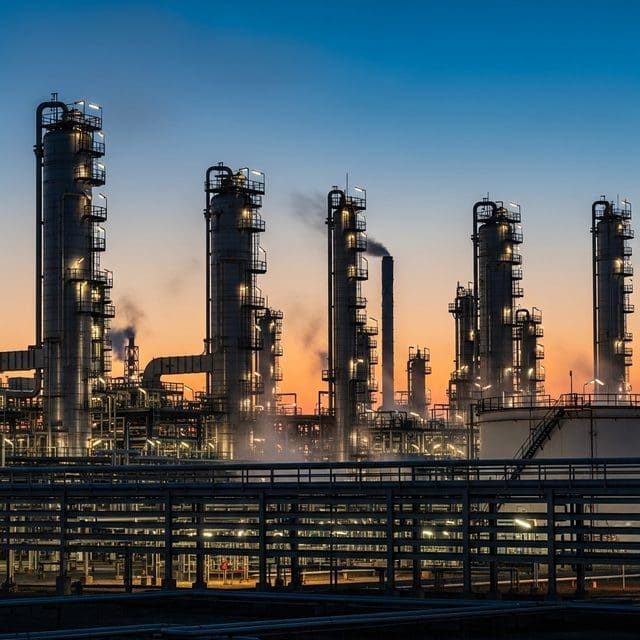
ExxonMobil and Chevron report surging profits as a historic global refining deficit decouples consumer fuel prices from crude benchmarks amid intensifying conflicts in the Middle East and Ukraine.
The global energy landscape is currently navigating a period of unprecedented structural strain, as a critical shortage of refining capacity threatens to keep consumer fuel prices elevated regardless of fluctuations in crude oil benchmarks. ExxonMobil CEO Darren Woods recently alerted markets that offline refining capacity has reached at least 5 million barrels per day. This represents the lowest available capacity relative to demand in modern history, a deficit driven by the Iran-related closure of the Strait of Hormuz and tightening export limits from China and Russia.
This refining crunch has created a lucrative, albeit volatile, environment for the world’s largest energy producers. Exxon and Chevron reported a combined $26.5 billion in second-quarter profits for 2026, a result largely attributed to soaring refining margins. Chevron CEO Mike Wirth noted that distillate demand—specifically for diesel and heating oil—remains exceptionally strong. Wirth warned investors that product prices face persistent upward pressure into the third quarter and beyond, even if headline crude prices soften, marking a significant decoupling of pump prices from the cost of raw oil.
The geopolitical risk premium remains the primary driver of market anxiety. Analysts in a recent Reuters poll revised their 2026 forecasts upward, placing Brent at an average of $85.22 per barrel and WTI at $80.14. These projections reflect the ongoing U.S.-Iran conflict and the persistent threat of Houthi attacks around the Bab el-Mandeb. Market observers, including Mirae Asset, suggest that the market may still be under-pricing the supply gap created by these dual shocks. The situation is further complicated by Ukrainian drone attacks on Russian refineries, which have idled 2.5 million barrels per day of refining capacity and pushed Russian crude output to a 2.5-year low of 8.3 million barrels per day.
In Europe, the impact of these disruptions is particularly acute. Russia’s suspension of diesel exports has removed approximately 10% of the global diesel supply, while CPC Black Sea loading suspensions following drone strikes have further tightened fuel markets. These factors have amplified global diesel crack spreads, placing a heavy burden on transport and logistics sectors that rely on distillate fuels. This energy volatility arrives as the U.S. economy shows accelerating growth, fueled by the insatiable demand for computer memory and infrastructure required for artificial intelligence development, which places additional stress on an already taxed electric grid and fuel supply chain.
Beyond the immediate conflict zones, the energy crossroads is becoming visible in Africa. Namibia is rapidly emerging as a prospective oil and gas hub, a development that stands in stark contrast to the contentious debates in South Africa regarding coal phase-outs and gas-to-power transitions. Namibia’s Electricity Control Board recently approved a modest 3.7% bulk power tariff increase, navigating the difficult balance between infrastructure funding and consumer affordability. These regional choices on hydrocarbons versus renewables are set to influence global investment flows for decades.
As the U.S. enters the latter half of 2026, the intersection of free-market principles and geopolitical reality remains clear. While technological innovation in the AI sector drives domestic growth, the tangible economic impact of energy policy is dictated by the physical realities of refining and transport. For the American taxpayer, the message from the energy majors is one of caution: until global refining capacity is restored and geopolitical routes are secured, the era of cheap, stable fuel prices remains out of reach.

Mark Davis serves as the Senior Correspondent for Energy, Climate, and Resource Economics at Just Right News. In an era where the conversation around the environment is often dominated by alarmism and top-down mandates, Mark provides a vital, market-oriented perspective on the complex forces shaping our world. As the lead voice behind the acclaimed feature series “Power and the Planet,” he explores the intersection of environmental policy, global energy markets, and the fundamental economic principles that sustain modern civilization.
Mark’s pragmatic approach to resource management was forged in the high desert of his hometown, Albuquerque, New Mexico. Growing up in a region defined by both its breathtaking natural beauty and its rugged, resource-dependent landscape, he developed an early appreciation for the delicate balance between conservation and utilization. New Mexico’s unique position as a hub for both traditional energy production and cutting-edge scientific research provided Mark with a front-row seat to the evolution of the American energy sector. This upbringing instilled in him a deep-seated belief that true environmental stewardship is inseparable from economic prosperity and technological innovation.
Now based in Boulder, Colorado, Mark operates from the heart of the nation’s climate research community. While Boulder is often seen as a bastion of environmental idealism, Mark utilizes his post to provide a necessary counterweight, grounded in the realities of resource economics. He understands that energy policy does not exist in a vacuum; it has tangible consequences for the American taxpayer, the stability of the national power grid, and the strength of the domestic manufacturing sector. By reporting from the front lines of the climate debate, he is able to challenge prevailing narratives with hard data and a commitment to the principles of the free market.
Throughout his tenure at Just Right News, Mark has distinguished himself by focusing on the “Resource Economics” aspect of his beat. He frequently highlights the hidden costs of rapid energy transitions and advocates for an “all-of-the-above” energy strategy that prioritizes American energy independence. His work often shines a light on the geopolitical implications of resource scarcity, arguing that a secure nation must first be an energy-secure nation. Whether he is analyzing the impact of federal land-use regulations or investigating the supply chains required for new technologies, Mark remains focused on how policy decisions affect the lives and livelihoods of everyday citizens.
In “Power and the Planet,” Mark continues to bridge the gap between complex scientific concepts and the economic realities facing the country. He rejects the false choice between a healthy environment and a thriving economy, instead seeking out solutions that leverage American ingenuity and private-sector competition. For Mark, reporting on the climate is not about following the latest trends, but about ensuring that the conversation remains tethered to the foundational values of liberty, property rights, and fiscal responsibility. His contributions ensure that Just Right News readers receive a comprehensive, clear-eyed view of the challenges and opportunities defining the future of our planet.