

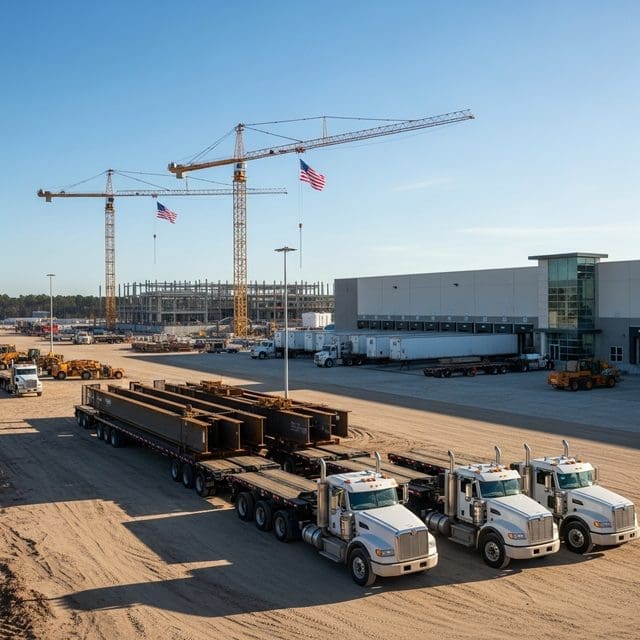
While shipping firm Saia Inc. saw a sharp 11.2% stock decline, builders like Sterling Infrastructure are expanding credit to secure American-made technology supply chains.
The physical journey of American goods is currently caught between a volatile global shipping landscape and a robust domestic push to build the facilities that house tomorrow’s technology. As international tensions rise, specifically with the expansion of conflict involving Iran in the Gulf region as of July 2026, the stability of traditional trade routes is under scrutiny. This geopolitical friction is reflected in the cooling sentiment for logistics providers moving goods from ports to the heartland.
Saia Inc., a major player in the less-than-truckload shipping sector, experienced a significant market retreat on Thursday, July 30, 2026. The company’s shares tumbled 11.2%, reaching lows of $359.06 and closing near $350.35. This selloff occurred on trading volume roughly 42% below the daily average, suggesting a sudden shift in investor confidence regarding freight volumes. Market observers are now looking toward Saia’s next earnings report on October 23, 2026, for clarity on whether this dip is a temporary hiccup or a symptom of broader supply chain fatigue as global trade costs fluctuate.
While the movement of finished goods faces these immediate headwinds, the construction of infrastructure required to produce them domestically is accelerating. Sterling Infrastructure Inc. has positioned itself at the center of this reshoring effort. The company recently finalized a July 8, 2026, amendment to its credit agreement, extending its facility to 2031 and expanding its revolving borrowing capacity to $1.5 billion. This represents a $1.05 billion increase over prior facilities, specifically designed to fuel the E-Infrastructure segment that specializes in large-scale data centers and semiconductor manufacturing plants.
Sterling’s growth highlights a fundamental shift in where capital is flowing. The company reported a 174% revenue surge in its infrastructure segment during the first quarter of 2026, driven by the urgent demand for domestic AI and tech manufacturing hubs. This surge led to a one-year return for shareholders of approximately 217%. Even as some institutional investors, such as Segall Bryant & Hamill LLC, have trimmed their stakes by 4.9%, the company’s year-to-date gain of 73% underscores a prevailing belief in the necessity of American-based production sites. Sterling is scheduled to release its Q2 2026 earnings on August 3, 2026.
The broader tech ecosystem is also seeing strategic shifts. Temasek Holdings recently reduced its stake in Alphabet Inc. by 2.8%, selling 137,184 shares, though it maintains a $1.35 billion position. As Alphabet-backed initiatives like Google’s Gemini Robotics 2.0 enter the market, the demand for sophisticated, domestically-built facilities to house these systems will continue to drive the industrial construction boom. These high-tech goods require a logistics chain that prioritizes security and proximity to the end-user over long-distance shipping.
For the American worker, this transition represents a pivot from reliance on fragile overseas shipping lanes to the tangible stability of local manufacturing. While companies like Flowco Holdings continue to provide steady returns, declaring a $0.09 per share quarterly dividend, the real story lies in the massive capital expenditures being made by firms like Sterling to ensure the journey of a product begins and ends on American soil. As the U.S. navigates expanding regional conflicts and technological competition, the focus remains on building the foundation for a resilient, self-contained national economy.

Sean Bradley serves as the Senior Correspondent for Trade, Supply Chains, and Global Labor at Just Right News, where he brings a principled, clear-eyed perspective to the complex systems that power the modern world. With a focus on the economic forces that impact the American household, Bradley has distinguished himself as a leading voice in explaining how global shifts in manufacturing and logistics translate to the kitchen table.
Growing up in Long Beach, California, Bradley’s interest in the movement of goods was forged against the backdrop of one of the nation’s most vital maritime gateways. Raised in a community where the towering cranes of the port were a constant fixture on the horizon, he developed an early appreciation for the blue-collar industries that form the backbone of the American economy. This upbringing instilled in him a profound respect for the dockworkers, truckers, and laborers who keep the country moving, a sentiment that remains a cornerstone of his reporting today. For Bradley, trade is not merely a series of abstract figures on a spreadsheet; it is a human endeavor that sustains families and defines the strength of a nation.
Now based in Seattle, Washington, Bradley occupies a strategic vantage point in another of the country’s most significant trade hubs. His location allows him to witness firsthand the intersection of traditional industry and the evolving technological landscape of global logistics. From the Pacific Northwest, he monitors the flow of goods across the ocean, providing Just Right News readers with timely insights into how international tensions, regulatory hurdles, and labor disputes affect the availability and cost of essential goods.
His signature feature series, “The Journey of Things,” has become a staple for readers seeking to understand the intricate path products take from raw materials to the retail shelf. Through this series, Bradley pulls back the curtain on the global marketplace, often highlighting the risks of over-reliance on foreign adversaries and the importance of domestic manufacturing resilience. His reporting consistently emphasizes the conservative values of national sovereignty, free-market competition, and the protection of the American worker from unfair global practices.
As a journalist of Irish heritage, Bradley maintains a deep-seated respect for the dignity of the individual worker and the importance of community stability. He approaches his beat with a commitment to transparency, often questioning the status quo of globalist policies that prioritize corporate efficiency over local prosperity. Whether he is reporting from a warehouse floor or analyzing a new international trade agreement, his goal remains the same: to provide the American public with the truth about where their products come from and what it costs to get them there.
Throughout his tenure at Just Right News, Bradley has remained a steadfast advocate for economic common sense. His work serves as a vital resource for those who believe that a strong nation is built on secure borders, robust trade, and a respected workforce. By combining his local roots in Long Beach with his professional experience in Seattle, Bradley continues to offer a unique and necessary perspective on the forces that shape the American way of life.