

The S&P 500 faces downward pressure as Middle East instability and skepticism over artificial intelligence capital expenditures create a volatile environment for American households and institutional investors.
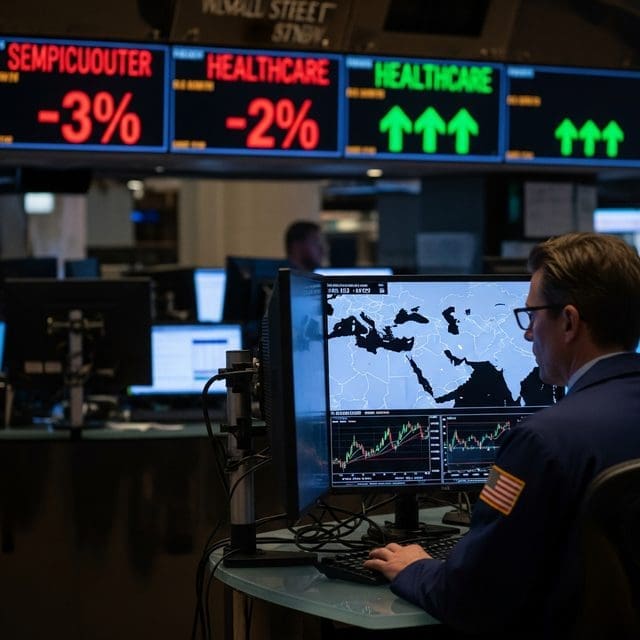
Wall Street is currently navigating a treacherous landscape where geopolitical volatility and skepticism over corporate capital allocation collide. The S&P 500 (SPY) is trading down 0.86% on the session, reflecting growing unease among investors questioning the long-term viability of the artificial intelligence spending boom. While the Dow Jones Industrial Average managed a 1.03% gain to close at 52,747.32, the tech-heavy Nasdaq slipped 0.22%, signaling a rotation out of growth-dependent sectors and into defensive value. This shift saw the S&P 500 healthcare index jump 2.4% and consumer staples add 2%, providing a buffer for diversified portfolios.
The most significant drag remains the semiconductor group. The Philadelphia Semiconductor Index plummeted 4.5% on Tuesday and has retreated roughly 25% from its June record. This correction highlights a sober realization: the billions poured into AI data centers by tech giants like Microsoft and Amazon are coming at the expense of free cash flow. While Apple briefly touched a historic $5 trillion market valuation intraday, hitting a session high of $342.89, the broader market demands more than promises. Investors are increasingly wary of this spending, even as Microsoft rose 1.1% ahead of its report and Amazon dipped 0.2%.
In the communication and healthcare sectors, there are pockets of resilience. Ractigen Therapeutics secured $31 million in new financing to advance its saRNA pipeline, while the Global Fraud Detection market is projected to nearly double to $15.06 billion by 2031. These developments underscore that merit-based innovation still attracts capital. For the working household, this suggests the economy is rewarding tangible results, evidenced by IQVIA Holdings jumping 14% after lifting its annual profit forecast and Coca-Cola rallying 5% on raised revenue projections.
However, the domestic economic picture is complicated by renewed instability in the Middle East. After oil prices declined below $87 per barrel, prices surged following a ballistic missile attack on a U.S. base in Jordan on July 29. This escalation prompted a vow of heavy retaliation from the White House. Simultaneously, the U.S. Senate moved with an 86-12 vote to advance a major sanctions bill against Russia and Iran. These geopolitical shocks threaten to reignite inflationary pressures just as S&P Global surveys indicate rising supply disruptions and accelerating costs for the American consumer.
The Federal Reserve now faces a difficult choice. While 71% of traders expect rates to remain unchanged, a 29% probability of a 25-basis-point hike is being priced in. Higher rates would further penalize the debt-heavy AI sector and companies like Corning, which recently tumbled 12% after missing sales estimates. As the market awaits pivotal earnings from Apple and Amazon, the focus remains on whether these corporate titans can justify their massive valuations through productivity gains or if current fatigue is the precursor to a more significant correction.
Ultimately, the day’s market action reveals a widening gap between speculative tech trades and the fundamental sectors supporting Main Street. While luxury apartment groundbreakings in Colorado and multifamily acquisitions in San Antonio suggest continued real estate activity, the volatility in the S&P 500 serves as a warning. The American household must contend with the reality that centralized financial control and geopolitical entanglements are increasingly dictating the rhythm of the domestic economy.

Jordan Lee serves as the Senior Correspondent for Wall Street, Finance, and Monetary Systems at Just Right News. Based in the heart of the world’s financial capital, New York City, Lee brings a sharp, principled eye to the complex mechanisms that drive the global economy. His reporting is defined by a commitment to fiscal responsibility, the defense of the free market, and a deep-seated belief that a transparent monetary system is the bedrock of a free society.
Raised in Portland, Oregon, Lee’s perspective was forged in a city that has undergone significant cultural and economic shifts. His upbringing in the Pacific Northwest instilled in him a profound appreciation for the industriousness of small business owners and the importance of local economic stability. Watching the evolution of his hometown’s landscape sparked an early interest in how federal fiscal policy and large-scale financial trends eventually trickle down to the average citizen. This background provides him with a unique vantage point; he understands the growing disconnect between the policy-making elite and the reality of Main Street, a theme that frequently resonates throughout his work.
Now operating from his base in New York City, Lee bridges the gap between the high-stakes trading floors of Manhattan and the households of everyday Americans. He views the financial sector not merely as a collection of numbers and tickers, but as a vital engine of American prosperity that requires constant vigilance and accountability. His reporting often highlights the dangers of centralized financial control and the necessity of maintaining a system that rewards merit, risk-taking, and innovation.
As the creator and lead of the featured series, “The Invisible Economy,” Lee pulls back the curtain on the often-opaque world of monetary systems. He specializes in translating the dense jargon of central banking and international finance into actionable insights for the Just Right News audience. His work explores the “invisible” forces—such as inflationary pressures, regulatory creep, and the expansion of the administrative state—that erode the purchasing power of American families. By focusing on these systemic issues, Lee empowers readers to understand the hidden forces shaping their financial independence.
Lee’s journalistic philosophy is rooted in a steadfast commitment to traditional American values. As an Asian American professional who has navigated the competitive corridors of the financial world, he is a vocal advocate for meritocracy and the preservation of the American Dream. He believes that a stable currency and a predictable regulatory environment are essential for national sovereignty and individual liberty. His reporting frequently warns against the risks of government overreach in the private sector, arguing that the most effective solutions to economic challenges arise from competition and individual enterprise rather than bureaucratic mandates.
At Just Right News, Jordan Lee remains dedicated to providing a clear-eyed defense of the taxpayer. Whether he is analyzing market volatility or investigating the long-term implications of national debt, his mission is to provide the truth about where the money is going and what it means for the future of the country. Through his rigorous analysis and principled stance, Lee has become a trusted voice for those who value a strong, sovereign, and fiscally sound America.