

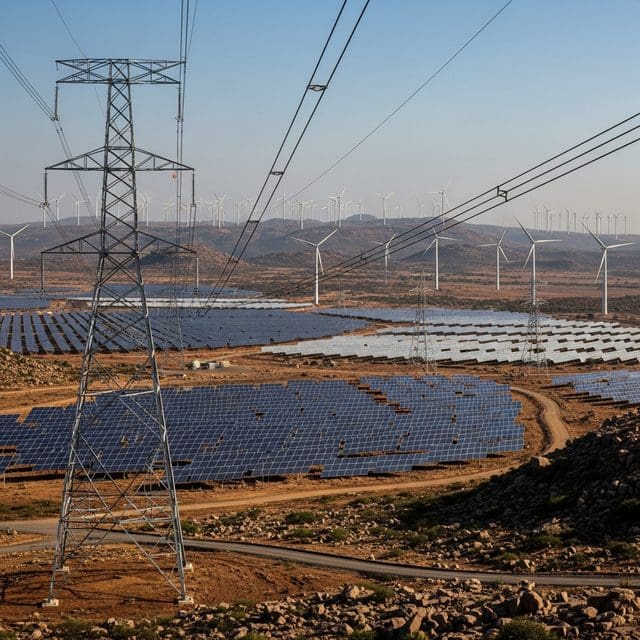
Tata Power Renewable Energy launches major solar and wind projects in Andhra Pradesh as U.S.-India clean-tech financial ties deepen to stabilize global supply chains.
The industrial transformation of India’s Rayalaseema region reached a new milestone this week as Tata Power Renewable Energy Limited prepared to break ground on two major clean energy projects. The developments in Kanekal, Anantapur district, and Pattikonda, Kurnool district, are valued at ₹5,750 crore. These projects represent a pragmatic expansion of the state’s Integrated Clean Energy Policy 2024, with HRD Minister Nara Lokesh scheduled to lead the foundation ceremonies on July 30. This build-out follows the successful commissioning of SAEL’s 600 MW solar project in Kurnool earlier this year, which utilized 2,400 acres to offset an estimated 1.1 million tonnes of carbon dioxide annually.
These projects are not isolated environmental initiatives but are integrated into a broader economic strategy for resource independence. Rayalaseema has already attracted ₹4.58 lakh crore in investment across 275 projects, with renewable energy serving as the primary engine for industrial growth. This includes Greenko’s massive ₹30,000-crore integrated solar-wind-pumped storage facility and JSW’s green steel plant in Kadapa, which utilizes 3,850 MW of captive renewable capacity to ensure price stability and operational reliability for heavy manufacturing. To support this, a ₹22,000-crore Green Energy Corridor is being developed, featuring 2,261 kilometers of transmission lines to export surplus power to other Indian states.
The timing of this build-out is critical as global energy markets face renewed volatility. While oil prices saw a brief decline on July 28 following reports of diplomatic talks between the Trump administration and Iran, the broader geopolitical landscape remains fragile. The collapse of the OPEC+ production agreement earlier this month, following hostilities in the Strait of Hormuz and a subsequent U.S. naval blockade effective July 14, has underscored the necessity for diversified energy portfolios. For emerging economies like India, scaling domestic solar and wind capacity provides a necessary hedge against the $95-per-barrel price spikes seen just last week.
Washington and New Delhi are increasingly aligned on the economic benefits of this transition. Beyond the existing $3.8 billion DFC pipeline, the two nations are currently working to mobilize $1 billion in new multilateral finance. This capital is specifically targeted at the clean-energy supply chain, including batteries and grid components, with an eye toward identifying pilot manufacturing projects that could eventually be deployed in third-country markets such as Africa. This cooperation is essential as global markets grapple with other pressures, such as the monthly drop in Micron stock amid China-related chip manufacturing concerns.
However, the transition remains grounded in market realities rather than pure ideology. At India Energy Week 2026, Indian firms expressed continued interest in U.S. LNG equity stakes and carbon capture technologies. This indicates that while Rayalaseema’s 325 GW technical solar potential is a massive asset, the long-term strategy involves a balanced mix of hydrocarbons and renewables to maintain grid reliability. The regional focus on high-capacity transmission ensures that clean energy can be treated as a tradable commodity rather than a localized subsidy.
As the U.S. navigates domestic economic headwinds—including a dip in the Conference Board Consumer Confidence Index to 90.8 in July and a modest 1.1 percent annual gain in the Case-Shiller Home Price Index—the partnership with India’s energy sector offers a strategic point of stability. By focusing on tangible infrastructure and manufacturing capacity, both nations are prioritizing the economic impacts of energy policy over political slogans. The Rayalaseema hub stands as a testament to how resource economics can drive regional development while insulating local industries from the whims of Middle Eastern oil diplomacy.

Mark Davis serves as the Senior Correspondent for Energy, Climate, and Resource Economics at Just Right News. In an era where the conversation around the environment is often dominated by alarmism and top-down mandates, Mark provides a vital, market-oriented perspective on the complex forces shaping our world. As the lead voice behind the acclaimed feature series “Power and the Planet,” he explores the intersection of environmental policy, global energy markets, and the fundamental economic principles that sustain modern civilization.
Mark’s pragmatic approach to resource management was forged in the high desert of his hometown, Albuquerque, New Mexico. Growing up in a region defined by both its breathtaking natural beauty and its rugged, resource-dependent landscape, he developed an early appreciation for the delicate balance between conservation and utilization. New Mexico’s unique position as a hub for both traditional energy production and cutting-edge scientific research provided Mark with a front-row seat to the evolution of the American energy sector. This upbringing instilled in him a deep-seated belief that true environmental stewardship is inseparable from economic prosperity and technological innovation.
Now based in Boulder, Colorado, Mark operates from the heart of the nation’s climate research community. While Boulder is often seen as a bastion of environmental idealism, Mark utilizes his post to provide a necessary counterweight, grounded in the realities of resource economics. He understands that energy policy does not exist in a vacuum; it has tangible consequences for the American taxpayer, the stability of the national power grid, and the strength of the domestic manufacturing sector. By reporting from the front lines of the climate debate, he is able to challenge prevailing narratives with hard data and a commitment to the principles of the free market.
Throughout his tenure at Just Right News, Mark has distinguished himself by focusing on the “Resource Economics” aspect of his beat. He frequently highlights the hidden costs of rapid energy transitions and advocates for an “all-of-the-above” energy strategy that prioritizes American energy independence. His work often shines a light on the geopolitical implications of resource scarcity, arguing that a secure nation must first be an energy-secure nation. Whether he is analyzing the impact of federal land-use regulations or investigating the supply chains required for new technologies, Mark remains focused on how policy decisions affect the lives and livelihoods of everyday citizens.
In “Power and the Planet,” Mark continues to bridge the gap between complex scientific concepts and the economic realities facing the country. He rejects the false choice between a healthy environment and a thriving economy, instead seeking out solutions that leverage American ingenuity and private-sector competition. For Mark, reporting on the climate is not about following the latest trends, but about ensuring that the conversation remains tethered to the foundational values of liberty, property rights, and fiscal responsibility. His contributions ensure that Just Right News readers receive a comprehensive, clear-eyed view of the challenges and opportunities defining the future of our planet.