

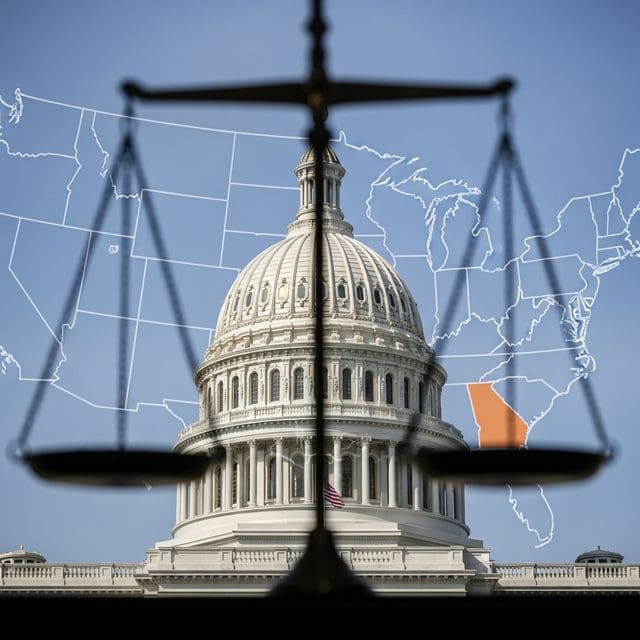
California leads a multi-state coalition to freeze a major media merger while Maine Democrats utilize a convention process to finalize their Senate challenger.
The principle of federalism is finding renewed strength as state capitals assert their authority over both global corporate consolidations and the mechanics of local representation. In a significant display of state-level power, California’s Attorney General has led a coalition of states to effectively freeze the planned merger between Paramount and Warner Bros. Discovery. The agreement, reached on July 24, 2026, mandates that the media giants postpone their consolidation until the conclusion of an antitrust trial or summer 2027, whichever comes first.
This move highlights the role of states as primary enforcers of competition when federal oversight is perceived as insufficient. By securing this delay, California and its partners have preserved their ability to demand structural or behavioral remedies, such as divestitures, before the merger can close. This proactive stance ensures that the interests of local consumers and regional economies are not sidelined by the rapid pace of industry consolidation. It serves as a reminder that the states remain the first line of defense against monopolies that threaten the economic landscape of the heartland.
On the opposite coast, Maine is demonstrating the resilience of state-managed political processes. Following the withdrawal of Graham Platner, the Maine Democratic Party utilized a traditional delegate convention rather than a costly and time-consuming special primary to select a new nominee for the U.S. Senate. Former State Senate President Troy Jackson secured the nomination with 566 votes at the state convention on July 26, 2026. This sets the stage for a high-stakes challenge against incumbent Senator Susan Collins. This reliance on a convention process underscores the constitutional prerogative of states to manage their own electoral vacancies and party nominations according to local rules and party bylaws.
In Sacramento, the limits of the ‘policy laboratory’ are being tested by fiscal reality and the practicalities of governance. State Senator Laura Richardson’s SB 1305, which proposes a study on reintroducing grizzly bears to California, faces a steep climb in the Assembly Appropriations Committee when lawmakers return on August 3. While the bill represents an ambitious attempt at environmental restoration, it currently authorizes only a roadmap study and is contingent on a future appropriation. Legislative analysts have warned that the Department of Fish and Wildlife is currently able to perform only 38% of its existing duties, making it impossible to absorb the work of a grizzly reintroduction program without significant new resources.
Furthermore, the substance of SB 1305 includes strict limitations on actual reintroduction. The bill bars any bears from being released until the roadmap is completed, science proves a self-sustaining population is viable, and extensive tribal and community engagement occurs. This cautious approach reflects the tension between legislative idealism and the ground-level concerns of local communities who would be most affected by such a policy. It demonstrates how the state legislative process acts as a filter, balancing broad environmental goals with the fiscal and social realities of the jurisdiction.
These developments across the country serve as a reminder that the most impactful governance often happens closest to home. Whether through the scrutiny of massive corporate mergers, the selection of political representatives, or the management of local wildlife, state institutions remain the essential guardians of the Tenth Amendment. By exercising their independent authority, these states are proving that decentralized governance is not merely a historical concept, but a vital tool for modern accountability. As these laboratories of power continue to experiment, they provide a blueprint for how local sovereignty can check both corporate and federal overreach, ensuring that the diverse needs of the American people are met through local solutions.

Dylan Brooks serves as the Senior Correspondent for Statehouses and Local Governance at Just Right News, where he brings a principled, constitutionalist lens to the often-overlooked machinery of state-level politics. As the lead voice behind the acclaimed feature series “Fifty Laboratories of Power,” Dylan has dedicated his career to the idea that the most impactful governance happens closest to home. His reporting consistently champions the Tenth Amendment, exploring how individual states can serve as testing grounds for innovative, conservative policy solutions that prioritize personal liberty and fiscal responsibility.
A native of Des Moines, Iowa, Dylan’s journalistic philosophy was forged in the heart of the American Midwest. Growing up in a community where local school board meetings and town halls were the bedrock of civic life, he developed a deep appreciation for the “retail politics” of the heartland. This upbringing instilled in him a fundamental belief that the American experiment is best preserved when power is decentralized. He carries the values of his Iowa roots into every assignment, maintaining a healthy skepticism of federal overreach and a steadfast commitment to the concerns of everyday citizens over the interests of the administrative state.
Now based in Madison, Wisconsin, Dylan operates from one of the nation’s most pivotal political battlegrounds. His location in a state capital known for its rigorous policy debates allows him to provide Just Right News readers with a front-row seat to the legislative process. From Madison, he tracks the ripple effects of statehouse decisions on local municipalities, ensuring that the connection between high-level policy and community impact is never lost. His work often highlights the success of conservative governors and legislatures in fostering economic growth, protecting parental rights, and securing the integrity of local institutions.
As an African American man in the conservative media landscape, Dylan offers a vital perspective on how limited government and free-market principles empower individuals and families. He frequently reports on how deregulation and school choice initiatives provide new avenues for success in underserved communities, challenging the monolithic narratives often presented by legacy media outlets. Dylan’s work is characterized by a commitment to the facts and a refusal to shy away from the complex realities of modern governance.
Throughout his tenure at Just Right News, Dylan has become a trusted authority for readers who value a rigorous, principled approach to the news. Whether he is dissecting a complex state budget or profiling a local grassroots movement, his goal remains the same: to provide the American public with the information they need to hold their local leaders accountable. By focusing on the “Fifty Laboratories of Power,” Dylan Brooks ensures that the vital work being done in statehouses across the country receives the national attention it deserves, always through a lens that respects the traditions and sovereignty of the American people.