

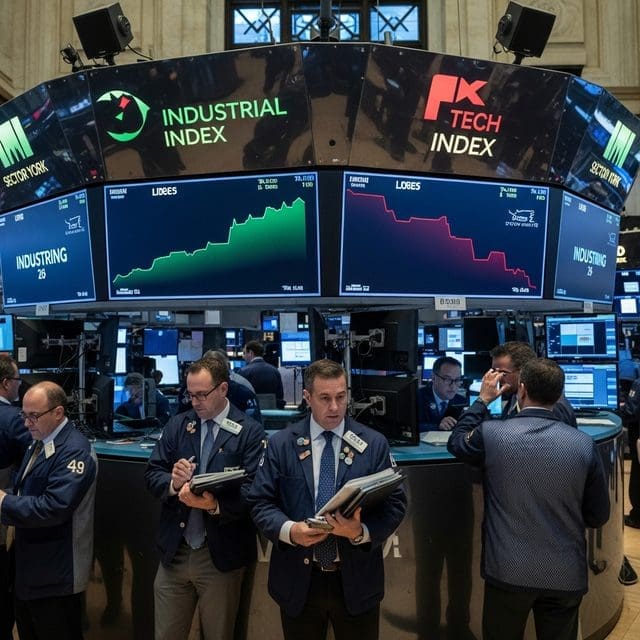
The S&P 500 staged a modest recovery Friday as robust industrial and defense performance balanced a massive $800 billion wipeout in megacap tech following disappointing AI expenditure guidance.
Global equity markets are attempting to find their footing today as the S&P 500 (SPY) rose 0.46% in a partial retracement of Thursday’s tech-heavy selloff. The recovery comes after a brutal session that saw the ‘Magnificent Seven’ shed approximately $800 billion in market value, driven by investor skepticism over the massive capital expenditures required to sustain the artificial intelligence boom. The Nasdaq Composite, which fell 2.15% to approximately 25,138 yesterday, remains under pressure as the market re-evaluates the premium placed on high-growth tech multiples.
Alphabet sparked the tech retreat, with shares sliding roughly 6.5% after the company raised its 2026 capital expenditure guidance to a range of $195 billion to $205 billion. This move crystallized fears on Wall Street that hyperscale AI spending may not yield immediate returns, leading to a broader selloff in communication services. Tesla added to the downward pressure, slumping 14.5% after missing operating profit consensus and reporting negative free cash flow for the first time in two years. These developments have forced a reckoning for the American taxpayer and retail investor, as the ‘AI growth story’ shifts toward a demand for earnings and cash-flow discipline.
In contrast to the tech volatility, the industrial sector has emerged as a primary beneficiary of a defensive rotation. Industrials gained 1.77% during the recent downturn, led by defense giants like Lockheed Martin, which rallied over 7% after raising its 2026 profit forecasts. This sector strength is being bolstered by significant real estate activity and institutional investment in the American heartland. MAG Capital Partners recently completed the sale of a 1.37 million square foot Midwest industrial portfolio to a Starwood Property Trust subsidiary for $89 million, while Merritt Properties nearly doubled its Jacksonville footprint with the acquisition of the Center Point Business Park.
Energy markets remain a significant headwind for working households and corporate margins alike. Global oil prices topped $100 per barrel on July 23 following Houthi militant attacks on tankers in the Red Sea and ongoing military escalations in the Middle East. This follows a volatile period where prices surged to $95 after a U.S. naval blockade on Iran was announced. The surge in crude, combined with the Trump administration’s new 12.5% tariffs on 60 trading partners effective today, has reignited inflation fears. These tariffs, enacted as earlier authorities expire, represent a shift in trade policy that impacts nearly every sector of the domestic economy.
Healthcare has provided a relative haven for capital, trading flat-to-higher as investors seek shelter from high-multiple tech names. Thermo Fisher Scientific provided a bright spot in the sector, rallying 8.7% after beating quarterly estimates and raising its annual profit outlook. This divergence suggests a market in transition, moving away from pure growth speculation toward companies demonstrating tangible cash flow. However, the sector is not without risk, as evidenced by recent securities class action lawsuits against entities like Genius Group Limited and Peabody Energy Corporation, reminding investors of the importance of meritocracy and transparency.
As the market closes out the week, the focus shifts to upcoming earnings from Microsoft, Amazon, and Meta. These reports will serve as a litmus test for whether the current tech pullback is a healthy correction or the beginning of a deeper skepticism regarding the AI-driven economy. For now, the resilience of industrials and healthcare is preventing a broader contagion, even as geopolitical tensions, drone-driven energy insecurity, and new trade barriers add layers of complexity to the national economic sovereignty. The S&P 500 remains up about 8% year-to-date, but the path forward requires a return to fiscal responsibility and a stable monetary outlook.

Jordan Lee serves as the Senior Correspondent for Wall Street, Finance, and Monetary Systems at Just Right News. Based in the heart of the world’s financial capital, New York City, Lee brings a sharp, principled eye to the complex mechanisms that drive the global economy. His reporting is defined by a commitment to fiscal responsibility, the defense of the free market, and a deep-seated belief that a transparent monetary system is the bedrock of a free society.
Raised in Portland, Oregon, Lee’s perspective was forged in a city that has undergone significant cultural and economic shifts. His upbringing in the Pacific Northwest instilled in him a profound appreciation for the industriousness of small business owners and the importance of local economic stability. Watching the evolution of his hometown’s landscape sparked an early interest in how federal fiscal policy and large-scale financial trends eventually trickle down to the average citizen. This background provides him with a unique vantage point; he understands the growing disconnect between the policy-making elite and the reality of Main Street, a theme that frequently resonates throughout his work.
Now operating from his base in New York City, Lee bridges the gap between the high-stakes trading floors of Manhattan and the households of everyday Americans. He views the financial sector not merely as a collection of numbers and tickers, but as a vital engine of American prosperity that requires constant vigilance and accountability. His reporting often highlights the dangers of centralized financial control and the necessity of maintaining a system that rewards merit, risk-taking, and innovation.
As the creator and lead of the featured series, “The Invisible Economy,” Lee pulls back the curtain on the often-opaque world of monetary systems. He specializes in translating the dense jargon of central banking and international finance into actionable insights for the Just Right News audience. His work explores the “invisible” forces—such as inflationary pressures, regulatory creep, and the expansion of the administrative state—that erode the purchasing power of American families. By focusing on these systemic issues, Lee empowers readers to understand the hidden forces shaping their financial independence.
Lee’s journalistic philosophy is rooted in a steadfast commitment to traditional American values. As an Asian American professional who has navigated the competitive corridors of the financial world, he is a vocal advocate for meritocracy and the preservation of the American Dream. He believes that a stable currency and a predictable regulatory environment are essential for national sovereignty and individual liberty. His reporting frequently warns against the risks of government overreach in the private sector, arguing that the most effective solutions to economic challenges arise from competition and individual enterprise rather than bureaucratic mandates.
At Just Right News, Jordan Lee remains dedicated to providing a clear-eyed defense of the taxpayer. Whether he is analyzing market volatility or investigating the long-term implications of national debt, his mission is to provide the truth about where the money is going and what it means for the future of the country. Through his rigorous analysis and principled stance, Lee has become a trusted voice for those who value a strong, sovereign, and fiscally sound America.