

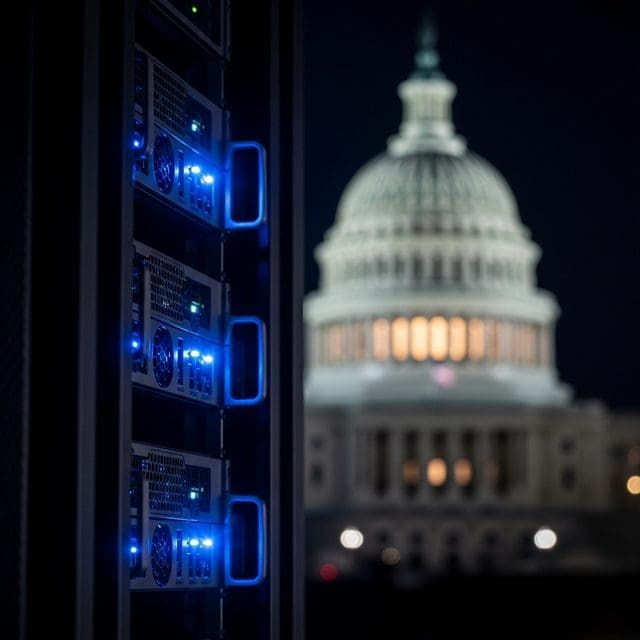
Legislative delays for the CLARITY Act and fluctuating institutional capital flows create a complex landscape for American digital asset leadership and protocol development.
The drive for American digital leadership and the protection of decentralized infrastructure faces a critical juncture as legislative windows narrow and institutional capital flows exhibit renewed volatility. While early July suggested a stabilization of the Bitcoin ecosystem, recent data and congressional gridlock highlight persistent hurdles facing the integration of decentralized engineering into the American financial fabric. The intersection of protocol development and national policy is currently defined by a struggle for clarity against global authoritarian competition and domestic political friction.
On the legislative front, the CLARITY Act remains stalled in the Senate despite its successful passage through the House. A fresh draft released this week by Senator Cynthia Lummis introduced a significant ethics provision barring sitting federal officials, including the President and members of Congress, from issuing or sponsoring digital assets during their terms. This move aims to prevent the weaponization of digital assets for political gain, yet the bill’s momentum is hindered by the calendar. With the Senate likely to recess by August 7, the window for establishing a clear regulatory framework is rapidly closing. This stalemate leaves the industry in a state of jurisdictional uncertainty, potentially ceding leadership in cryptography to offshore jurisdictions.
Institutional engagement via U.S. spot Bitcoin ETFs continues to serve as a volatile barometer for market sentiment. On July 23, spot Bitcoin ETFs recorded net outflows of approximately $225.18 million. This sharp reversal stands in contrast to the performance of Ethereum spot ETFs, which recorded net inflows of $26.32 million during the same period. Despite this single-day contraction, the month-to-date picture for July 2026 remains marginally positive, with net inflows totaling roughly $67.9 million. This equates to a modest daily average net flow of approximately $6.2 million per trading day, suggesting the market is attempting to find a floor after a period of intense selling pressure.
This fragile stabilization follows a grueling period of capital flight. Data indicates that more than $8.2 billion was withdrawn from American spot Bitcoin ETFs since May during an eight-week streak of continuous outflows. While discrete bursts of institutional interest—such as the $2.73 billion inflow recorded between July 2 and July 8—have provided temporary relief, the broader trend remains precarious. Real-time trackers still report 30-day net outflows of about $1.104 billion, highlighting that the early-July rebound has not yet been sufficient to erase the broader capital bleed characterizing the year-to-date performance.
From a technical perspective, Bitcoin appears to be consolidating within a range of $62,000 to $68,000. This consolidation occurs against a confluence of forces, including geopolitical escalation in the Middle East and the domestic regulatory vacuum. For proponents of decentralized engineering, the lack of legislative progress on the CLARITY Act represents a missed opportunity to cement the United States as the primary hub for secure digital infrastructure. Without a clear signal from Washington, the ‘New Cold War’ for digital supremacy remains a battleground defined by cautious institutional re-entry and persistent political friction.
Ultimately, the current landscape for Bitcoin is one of transition. The shift from persistent outflows to mild net inflows in July suggests a turnaround in sentiment, yet the $225 million outflow on July 23 serves as a reminder that institutional appetite is not yet a one-way street. As the Senate approaches its August recess, the fate of the CLARITY Act will determine whether the United States can provide the legal certainty required for long-term protocol development or if the nation will remain reactive to global shifts.

Ryan Mitchell serves as a Staff Writer for Just Right News, where he anchors the desk for Cyber, Technology Policy, and Digital Sovereignty. In an era where the digital landscape has become as much a battlefield as any physical territory, Ryan provides a critical conservative lens on the forces shaping the future of American innovation and national security. His work is defined by a commitment to the idea that American leadership in the digital age is not just a matter of economic success, but a necessity for the preservation of global liberty.
Born and raised in Austin, Texas, Ryan’s perspective is deeply rooted in the Lone Star State’s tradition of independence and skepticism of centralized authority. Growing up in a city that transformed from a quiet state capital into a global technology hub, he witnessed firsthand the disruptive power of the tech industry. This upbringing instilled in him a firm belief in free-market principles and the necessity of protecting individual liberties from both government overreach and corporate overstep. His Texan background serves as a foundational compass, guiding his reporting toward stories that emphasize national resilience and the preservation of constitutional values in an increasingly virtual world.
Now based in San Francisco, California, Ryan operates from the epicenter of the very industry he scrutinizes. Living and working in the heart of Silicon Valley allows him to provide “boots on the ground” reporting that few conservative journalists can match. He navigates the cultural and political complexities of the Bay Area to bring Just Right News readers an inside look at the boardrooms and coding labs where the next generation of digital policy is forged. For Ryan, being stationed in San Francisco is a strategic choice; it allows him to challenge the prevailing ideological monoculture of the tech elite from within their own backyard, ensuring that the concerns of middle America are represented in the conversation about our digital future.
His beat—Cyber, Technology Policy, and Digital Sovereignty—covers the high-stakes world of data privacy, artificial intelligence, and the infrastructure of the modern web. Ryan is particularly focused on the concept of digital sovereignty, arguing that for a nation to remain truly free, it must maintain control over its own technological destiny and critical infrastructure. He frequently explores how international regulations and domestic policies impact the ability of American firms to compete without sacrificing the privacy or security of their citizens.
Central to his current body of work is his featured series, “The New Cold War.” Through this project, Ryan examines the escalating technological rivalry between the United States and its global adversaries. He delves into the complexities of state-sponsored hacking, the global race for semiconductor dominance, and the ideological struggle to define the rules of the internet. Ryan views this competition not merely as a commercial race, but as a fundamental defense of Western values against authoritarian digital models. Through his rigorous reporting and principled analysis, Ryan Mitchell ensures that the readers of Just Right News stay informed about the invisible forces defining the 21st century, always advocating for a future where technology serves the cause of freedom.