

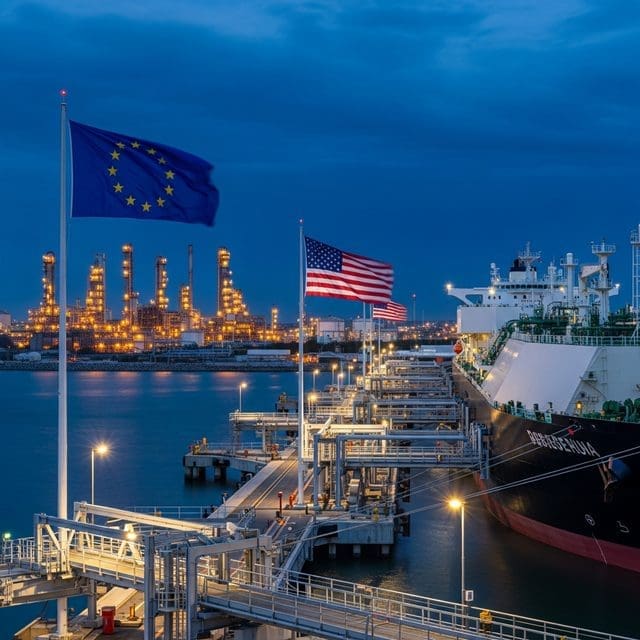
The European Union will terminate all Russian LNG contracts by January 1, intensifying global supply competition as Middle East tensions drive crude oil prices above $100 per barrel.
Global energy markets are confronting a dual-front supply shock as the European Union prepares to finalize its decoupling from Russian energy while military conflict in the Middle East chokes off vital transit routes. On July 23, global oil prices surpassed the $100 per barrel threshold following Houthi militant attacks on Saudi Arabian tankers, compounding the volatility caused by the ongoing U.S. naval blockade of Iran. This price surge follows a steady climb from the $95 level reached just 24 hours prior, as market participants price in the risk of a prolonged disruption in the Strait of Hormuz.
The European Commission has clarified that all long-term Russian liquefied natural gas (LNG) contracts will be terminated by January 1, 2027, with pipeline gas following a year later. This aggressive timeline comes despite a paradoxical 17% increase in Russian LNG imports to Europe between March and May of this year, as member states stock reserves ahead of the looming winter deadline. The new sanctions packages, specifically the 19th and 20th rounds, also prohibit maintenance and terminal services for Russian LNG tankers and icebreakers as of April 23, 2026. Furthermore, EU operators are now barred from trading or marketing Russian LNG to third countries, effectively closing the loophole that previously allowed for the redirection of cargoes to Asian markets.
This regulatory shift places American energy producers at the center of European security. U.S. LNG now accounts for roughly two-thirds of Europe’s supply, a figure projected to reach 80% by 2030. However, this growing dependence on Washington is creating friction. U.S. Energy Secretary Chris Wright recently warned that stringent new EU methane-leak regulations could divert U.S. cargoes to other markets. In response, the European Commission proposed a three-year waiver of penalties for reporting failures, attempting to balance environmental standards with the urgent need for supply reliability. The Commission is also rolling out a strategy to “electrify the continent,” accelerating renewables to blunt both Russian and U.S. leverage over the grid.
The supply crunch is further exacerbated by the collapse of the OPEC+ production agreement following renewed hostilities. Iranian strikes on Qatar, the world’s second-largest LNG exporter, have brought tanker movements through the Strait to a near standstill. The U.S. military has responded with force, deploying B-1 long-range bombers on July 22 to strike Iranian Revolutionary Guard Corps targets, marking the first such mission since fighting resumed 12 days prior. With traditional supply chains fractured, market analysts suggest that if oil prices sustain levels above $100, S&P 500 energy giants like Occidental Petroleum could see significant returns, even as the broader market remains cautious.
In Washington, the House of Representatives passed a resolution on July 23 to rein in the Trump administration’s military campaign in Iran, marking the second such rebuke this month. Lawmakers are increasingly concerned about the economic impact of a prolonged blockade on domestic fuel prices and global trade stability. As the administration weighs a ten-day ceasefire against a massive joint military campaign with Israel, the energy sector faces a period of unprecedented structural realignment where geopolitical strategy and market fundamentals are inextricably linked. The tangible economic impacts are already surfacing, from record-high home insurance claims severity reported by LexisNexis to shifting labor dynamics within the Teamsters, as the American taxpayer bears the cost of this global resource recalibration.
Beyond the immediate fuel crisis, the broader technological and economic landscape is shifting under the weight of these geopolitical tensions. While the EU moves to fine American tech giants like Google for market manipulation, domestic leaders like Nvidia CEO Jensen Huang are calling for the continued use of Chinese open-source AI models, highlighting a divergence between energy protectionism and technological globalism. As the Transpacific Future Center establishes its new headquarters in D.C., the intersection of energy independence and international trade policy remains the defining challenge for the current administration. The coming weeks will determine whether the Strait of Hormuz reopens or if the world enters a new era of permanent energy scarcity and localized grid fortification.

Mark Davis serves as the Senior Correspondent for Energy, Climate, and Resource Economics at Just Right News. In an era where the conversation around the environment is often dominated by alarmism and top-down mandates, Mark provides a vital, market-oriented perspective on the complex forces shaping our world. As the lead voice behind the acclaimed feature series “Power and the Planet,” he explores the intersection of environmental policy, global energy markets, and the fundamental economic principles that sustain modern civilization.
Mark’s pragmatic approach to resource management was forged in the high desert of his hometown, Albuquerque, New Mexico. Growing up in a region defined by both its breathtaking natural beauty and its rugged, resource-dependent landscape, he developed an early appreciation for the delicate balance between conservation and utilization. New Mexico’s unique position as a hub for both traditional energy production and cutting-edge scientific research provided Mark with a front-row seat to the evolution of the American energy sector. This upbringing instilled in him a deep-seated belief that true environmental stewardship is inseparable from economic prosperity and technological innovation.
Now based in Boulder, Colorado, Mark operates from the heart of the nation’s climate research community. While Boulder is often seen as a bastion of environmental idealism, Mark utilizes his post to provide a necessary counterweight, grounded in the realities of resource economics. He understands that energy policy does not exist in a vacuum; it has tangible consequences for the American taxpayer, the stability of the national power grid, and the strength of the domestic manufacturing sector. By reporting from the front lines of the climate debate, he is able to challenge prevailing narratives with hard data and a commitment to the principles of the free market.
Throughout his tenure at Just Right News, Mark has distinguished himself by focusing on the “Resource Economics” aspect of his beat. He frequently highlights the hidden costs of rapid energy transitions and advocates for an “all-of-the-above” energy strategy that prioritizes American energy independence. His work often shines a light on the geopolitical implications of resource scarcity, arguing that a secure nation must first be an energy-secure nation. Whether he is analyzing the impact of federal land-use regulations or investigating the supply chains required for new technologies, Mark remains focused on how policy decisions affect the lives and livelihoods of everyday citizens.
In “Power and the Planet,” Mark continues to bridge the gap between complex scientific concepts and the economic realities facing the country. He rejects the false choice between a healthy environment and a thriving economy, instead seeking out solutions that leverage American ingenuity and private-sector competition. For Mark, reporting on the climate is not about following the latest trends, but about ensuring that the conversation remains tethered to the foundational values of liberty, property rights, and fiscal responsibility. His contributions ensure that Just Right News readers receive a comprehensive, clear-eyed view of the challenges and opportunities defining the future of our planet.