

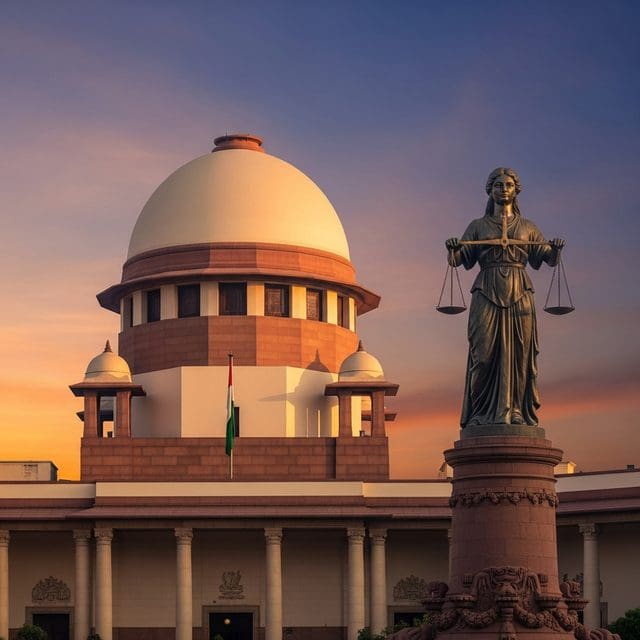
The Supreme Court of India has tightened the standards for bail in serious criminal matters and intensified judicial oversight of the Rajasthan government’s failure to mitigate toxic river pollution.
The Supreme Court of India has issued a series of significant directives that reinforce the primacy of trial integrity and the constitutional right to a clean environment, signaling a rigorous approach to both criminal procedure and executive accountability. In a notable reversal of lower court orders, a bench of Justices M.M. Sundresh and P.B. Varale cancelled the bail of Sonam Raghuvanshi, the primary accused in the high-profile murder of her husband, Raja Raghuvanshi, during their honeymoon in Meghalaya.
The decision provides essential doctrinal clarity on the application of Article 22(1) of the Constitution, which governs the communication of grounds for arrest. While the Meghalaya High Court had previously favored Raghuvanshi based on alleged defects in how those grounds were communicated, the Supreme Court distinguished between a total failure to provide reasons and mere technical inadequacy. The bench held that because there was no complete failure to serve grounds, the arrest remained valid. Furthermore, the Court emphasized that procedural objections must be raised at the earliest possible opportunity rather than being used as a late-stage maneuver to secure release. The justices clarified that while Article 22(1) is a vital protection, it does not serve as a loophole for defendants when the core requirements of the law have been substantially met.
In its reasoning, the Court noted that earlier orders rejecting Raghuvanshi’s bail on the merits of the case had already attained finality. The justices observed that continued enlargement at this stage might hinder the ongoing trial, signaling a willingness to prioritize the stability of the judicial process over the general rule that bail is the default. Raghuvanshi has been granted three weeks to surrender to authorities, though the Court allowed for a fresh bail plea if the trial is not completed within the next six months. This shift marks a successful appeal by the Meghalaya government, which had sought to overturn the High Court’s more lenient stance, and follows a July 3rd hearing where the Supreme Court had initially declined to stay the release.
Simultaneously, the Court turned its attention to the persistent failure of state regulators to address industrial pollution in Rajasthan. In a sharp rebuke of the state government, the Court described the ongoing discharge of highly acidic water into the Jojari River as a violation of the right to life under Article 21. The bench dismissed the state’s Special Investigation Team probe as a mere eyewash, emphasizing that executive inaction has effectively poisoned the local ecosystem despite prior judicial mandates. Expert reports recently reviewed by the Court confirmed that despite previous orders, the water remains dangerously acidic and unfit for any use, reflecting a total breakdown in regulatory enforcement.
To address these systemic failures, the Court has mandated the creation of Special Courts for the speedy trial of environmental violations and ordered the immediate completion of effluent treatment infrastructure. The interim directions include the closure and prosecution of non-compliant industrial units and the implementation of zero-liquid-discharge norms. These measures are designed to restore the Jojari-Bandi-Luni river systems through technology-driven monitoring and strict compliance reporting, with the most recent reports due as of July 21, 2026. The Court warned that it would not tolerate further delays in protecting the health of citizens from industrial runoff.
The Jojari matter remains under the administrative control of Chief Justice of India Surya Kant. By placing the case before the Chief Justice for appropriate bench formation and monitoring, the Court ensures that the judiciary maintains a centralized, ongoing role in overseeing environmental restoration rather than relying on one-off orders. This centralized oversight is particularly relevant as Chief Justice Kant has also been managing administrative orders to ensure that lawyers are not penalized for non-appearance due to local infrastructure disruptions, such as metro station closures. These rulings collectively underscore a judicial philosophy that prioritizes the substantive rule of law and the protection of citizens over administrative delays and procedural loopholes.

Lila Hayes serves as a Staff Writer for Just Right News, where she anchors the “Courts, Law, and Constitutional Order” beat. Her work is defined by a steadfast commitment to the foundational principles of the American republic and a rigorous defense of the legal frameworks that ensure national stability. As a primary voice for the outlet, she provides readers with a clear-eyed analysis of the judiciary, focusing on the importance of originalism and the preservation of the separation of powers.
Lila’s perspective was forged in the American heartland. Raised in St. Louis, Missouri, she grew up in a Hispanic household where the values of hard work, faith, and respect for the law were paramount. Her upbringing instilled in her a deep appreciation for the American Dream and the legal protections that make it possible. This Missouri background remains a cornerstone of her reporting, providing a grounded, common-sense counter-narrative to the often-insular legal circles of the coastal elite. She understands that the decisions made in high-court chambers have real-world consequences for families and small business owners across the country.
At Just Right News, Lila has become widely recognized for her signature feature series, “The Rulebook of Power.” In this ongoing project, she delves into the mechanics of the federal government, examining how administrative overreach and judicial activism can threaten the delicate balance of the Constitution. She approaches her beat with the tenacity of a veteran journalist and the precision of a legal scholar, consistently advocating for a judiciary that interprets the law as written rather than legislating from the bench. For Lila, the Constitution is not a “living” document subject to the whims of modern social trends; it is a fixed standard that ensures the government remains the servant of the people, not their master.
Now based in Philadelphia, Pennsylvania, Lila finds herself at the very epicenter of American constitutional history. Living and working in the city where the Founders drafted the documents she defends daily provides a constant source of inspiration. The historic halls and landmarks of Philadelphia serve as a daily reminder of the high stakes involved in her reporting. Her presence in the city allows her to bridge the gap between the historical intent of the law and its contemporary application, ensuring that the legacy of the Founding Fathers remains central to the national conversation.
Throughout her career, Lila has remained dedicated to the idea that a free society requires an informed citizenry and a transparent legal system. Her reporting is more than just a collection of headlines; it is a defense of the constitutional order that has sustained the nation for over two centuries. By focusing on the “Rulebook of Power,” she ensures that her readers understand not just what is happening in the courtrooms, but why those decisions matter for the future of American liberty. Lila Hayes continues to be a vital voice for those who believe that the law should be a shield for the citizen and a constraint on the state.