

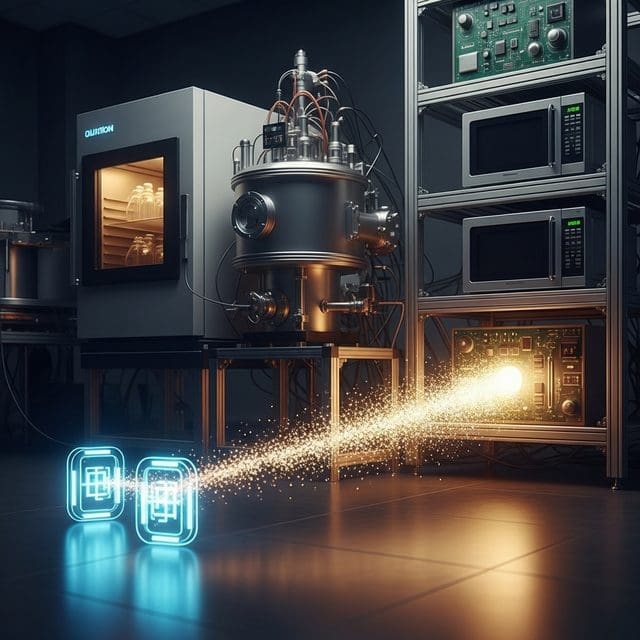
Researchers at the Institute of Science and Technology Austria have successfully used a ‘quantum bath’ of photons to autonomously link distant qubits, a breakthrough for decentralized quantum computing.
In the high-stakes race to build a functional quantum computer, the primary hurdle has long been the extreme fragility of ‘qubits,’ the subatomic building blocks that store information. These particles are notoriously difficult to link across distances, often requiring constant, heavy-handed intervention from centralized control systems to maintain their connection. This week, however, researchers at the Institute of Science and Technology Austria (ISTA) announced a breakthrough that could shift the physics paradigm toward a more stable and decentralized future for the technology.
Published in the journal Physical Review X, the study led by Ph.D. student Alejandro Andrés-Juanes and Professor Johannes Fink details the experimental realization of what scientists call a ‘quantum bath.’ By using a continuous stream of correlated microwave photons, the team managed to autonomously entangle two distant stationary qubits. This confirms a theoretical prediction made more than 20 years ago, proving that quantum states can be stabilized through environmental interaction rather than despite it. The researchers utilized quantum tomography over measurement windows ranging from 20 to 80 nanoseconds to probe these states, demonstrating a level of precision that bridges the gap between theoretical physics and practical engineering.
Traditional methods of entangling distant processors require precise, active measurements and repeated corrections—a process that becomes increasingly difficult to manage as a network grows. The ISTA team’s approach is fundamentally different. By creating a ‘nonlocal squeezed reservoir,’ they have essentially built a system where the entangled state is the natural ground state. Professor Fink noted that this method creates a new ground state through the continuous stream of photons, ensuring the entangled qubit state is stabilized even beyond the qubits’ own natural ‘lifetime.’ This means the connection remains available as a resource for processing without the need for the constant ‘babysitting’ required by current quantum architectures.
While the current prototype captures about 10% of the bath’s available entanglement, the implications for American technological independence are significant. A decentralized quantum architecture—one that does not rely on a massive, centralized cooling and control apparatus managed by a few bureaucratic entities—aligns with the vision of a resilient, distributed infrastructure. If quantum processing can be networked reliably across distances with minimal control overhead, it moves the technology out of the hands of a few Silicon Valley gatekeepers and into a more modular, accessible format that respects the sovereignty of individual innovators.
Beyond the quantum lab, the broader field of physics is seeing similar leaps in material science. At Kyoto University, researcher Kazuyuki Takeda has demonstrated how ordinary graphite can be transformed into a ‘flying carpet’ through diamagnetic levitation. By chemically coating graphite particles with a thin glass layer to suppress conductivity and aligning them within a superconducting magnet, Takeda’s team created a stiff plate that floats stably above permanent magnets. This platform is so sensitive it recently detected a real-world earthquake impulse during a recording session, showcasing how decentralized, mechanical sensors could eventually rival complex electronic monitoring systems.
As the U.S. military continues to invest in global asset tracking and the Senate navigates leadership transitions following the passing of Senator Lindsey Graham, the underlying hardware of the future must remain a priority. The ISTA discovery suggests that the path to a ‘quantum internet’ may not require more centralized bureaucracy, but rather a more sophisticated understanding of the natural laws governing these particles. The next step for the scientific community will be refining the efficiency of these photon baths to ensure that ‘on-demand’ entanglement becomes a standard feature of a secure, sovereign technological landscape.

Mason Reed serves as a Staff Writer for Just Right News, where he spearheads the Future Frontiers & Special Projects desk. In an era defined by rapid technological shifts and evolving social landscapes, Mason provides a steady, principled voice, examining the innovations of tomorrow through the lens of traditional American values. His work is most prominently featured in his signature series, “The Next Horizon,” where he explores the intersection of emerging technology, national sovereignty, and the preservation of individual liberty.
A native of San Diego, California, Mason’s worldview was shaped by the unique culture of his hometown. Growing up in a region defined by its strong military presence and its history of maritime industry, he developed a deep-seated respect for the institutions that provide national stability and the entrepreneurial spirit that drives the American economy. This upbringing instilled in him a belief that true progress is not found in discarding the past, but in building upon a foundation of proven principles. His reporting often reflects this San Diego influence, emphasizing the importance of a robust national defense and the necessity of maintaining a competitive edge in the global marketplace.
Now based in San Francisco, Mason operates from the heart of the world’s technological engine. Living and working in the Bay Area provides him with a front-row seat to the advancements—and the ideological challenges—emanating from Silicon Valley. While many in the region embrace a “move fast and break things” mentality, Mason’s reporting serves as a vital counterweight. He offers Just Right News readers a “boots on the ground” perspective, documenting how radical local policies and the concentration of tech power impact the everyday lives of citizens. His proximity to the industry allows him to cut through the marketing jargon of big tech to uncover the real-world implications for privacy, free speech, and the nuclear family.
In his “Future Frontiers” beat, Mason tackles complex subjects ranging from the ethics of artificial intelligence to the burgeoning private space race. He approaches these topics with a healthy skepticism toward centralized bureaucracy, championing instead the decentralized innovations that empower individuals. Through “The Next Horizon,” he highlights the pioneers and thinkers who are working to ensure that the future remains a place where human dignity and constitutional rights are protected. He believes that the rapid pace of change requires more than just technical expertise; it requires a moral compass rooted in the Western tradition.
Throughout his tenure at Just Right News, Mason has remained committed to the idea that the future is something to be shaped, not merely accepted. His writing is characterized by a rigorous defense of American exceptionalism and a belief that the country’s best days lie ahead, provided it remains true to its founding ideals. Whether he is investigating the impact of automation on the American workforce or profiling the next generation of aerospace engineers, Mason Reed ensures that his readers are equipped with the insights they need to navigate a changing world with confidence and clarity.