

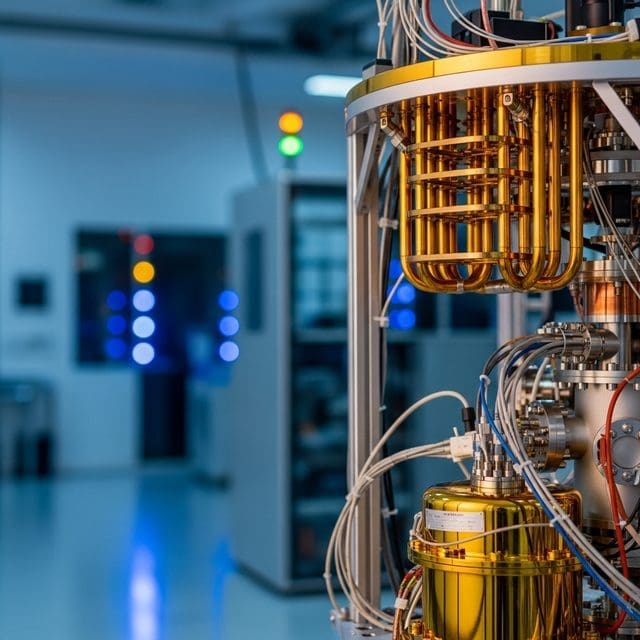
Recent findings from Caltech and Google suggest quantum computers could compromise modern encryption with far fewer qubits than previously estimated, accelerating the urgency for post-quantum security migration.
The timeline for the so-called Q-day—the moment quantum computers become capable of shattering modern digital security—has moved significantly closer this week. New data from Caltech and Google researchers indicates that hardware requirements for breaking standard encryption are plummeting, challenging the belief that such threats were decades away. These findings suggest that the cryptographic foundations of the global financial system and private communications are more fragile than previously understood. For the principled observer, this represents a shift from theoretical physics to a pressing matter of national sovereignty and the protection of individual digital liberty.
At the heart of the discovery is a radical optimization of Shor’s algorithm, the mathematical tool used by quantum systems to factor large numbers. A Google research team recently demonstrated a new implementation that is ten times more efficient than any prior method. According to their white paper, most cryptocurrencies secured by elliptic-curve cryptography (ECC) could be compromised in mere minutes by a machine utilizing fewer than 500,000 physical qubits. This is a staggering 20-fold reduction from previous industry estimates, signaling that the window for transitioning to quantum-resistant standards is closing faster than anticipated. Specifically, the Google team detailed two compiled Shor circuits for the secp256k1 curve used in many digital assets, requiring as few as 70 million Toffoli gates to execute an attack.
Simultaneously, Caltech researchers have proposed a neutral-atom architecture that further lowers the barrier for entry. Their simulations show that a system using approximately 10,000 to 26,000 reconfigurable atomic qubits could potentially break RSA-2048 encryption—the gold standard for securing web traffic and sensitive documents. While such a process might currently take a century on that specific hardware, the fact that tens of thousands of qubits can perform the task at all is a major shift from earlier models that required millions of qubits. Related commentary on the Caltech work highlights that 256-bit ECC could potentially be broken in approximately ten days using a 26,000-qubit array, further compressing the risk window for modern financial infrastructure.
These developments are not merely academic; they are driving a new consensus among security experts. At least four independent studies now converge on a credible attack window spanning 10,000 to 1,000,000 qubits for meaningful RSA and ECC compromise. This replaces earlier narratives that suggested billions of qubits would be necessary. Consequently, legal and industry frameworks, such as those discussed by CMS, are framing Shor’s algorithm as a tool that makes the derivation of private keys theoretically possible in hours or minutes. This makes post-quantum transition planning an immediate compliance and risk-management issue for enterprises and governments alike.
Beyond the realm of cryptography, the physics community is seeing parallel leaps in quantum verification and control. Researchers at the University of Innsbruck and Lund University have developed techniques to certify that quantum measurements are genuine and cannot be mimicked by simpler classical means. Meanwhile, the University of Basel has demonstrated all-electrical control of single-molecule quantum states without the need for magnetic field confinement. These advances ensure that as we build these powerful machines, we have the tools to verify their integrity and operate them with greater precision. Furthermore, quantum computers have recently demonstrated the capability to learn from their own errors without interrupting calculations, a critical step toward the fault-tolerant systems required for large-scale cryptanalysis.
The primary takeaway remains the compression of the security timeline. Current U.S. executive orders have already set hard deadlines for federal agencies to migrate to post-quantum cryptography by 2030 and 2031, but these new physics benchmarks suggest that private industry and the nuclear family’s digital footprint must also be shielded sooner. As quantum hardware scales and the qubit requirements for RSA-2048 fall toward the 42 million physical qubit range for a 2032-2035 window, the era of theoretical quantum threats has ended, and the era of practical risk management has begun. Protecting the constitutional right to privacy now requires a proactive defense against the looming quantum horizon.

Mason Reed serves as a Staff Writer for Just Right News, where he spearheads the Future Frontiers & Special Projects desk. In an era defined by rapid technological shifts and evolving social landscapes, Mason provides a steady, principled voice, examining the innovations of tomorrow through the lens of traditional American values. His work is most prominently featured in his signature series, “The Next Horizon,” where he explores the intersection of emerging technology, national sovereignty, and the preservation of individual liberty.
A native of San Diego, California, Mason’s worldview was shaped by the unique culture of his hometown. Growing up in a region defined by its strong military presence and its history of maritime industry, he developed a deep-seated respect for the institutions that provide national stability and the entrepreneurial spirit that drives the American economy. This upbringing instilled in him a belief that true progress is not found in discarding the past, but in building upon a foundation of proven principles. His reporting often reflects this San Diego influence, emphasizing the importance of a robust national defense and the necessity of maintaining a competitive edge in the global marketplace.
Now based in San Francisco, Mason operates from the heart of the world’s technological engine. Living and working in the Bay Area provides him with a front-row seat to the advancements—and the ideological challenges—emanating from Silicon Valley. While many in the region embrace a “move fast and break things” mentality, Mason’s reporting serves as a vital counterweight. He offers Just Right News readers a “boots on the ground” perspective, documenting how radical local policies and the concentration of tech power impact the everyday lives of citizens. His proximity to the industry allows him to cut through the marketing jargon of big tech to uncover the real-world implications for privacy, free speech, and the nuclear family.
In his “Future Frontiers” beat, Mason tackles complex subjects ranging from the ethics of artificial intelligence to the burgeoning private space race. He approaches these topics with a healthy skepticism toward centralized bureaucracy, championing instead the decentralized innovations that empower individuals. Through “The Next Horizon,” he highlights the pioneers and thinkers who are working to ensure that the future remains a place where human dignity and constitutional rights are protected. He believes that the rapid pace of change requires more than just technical expertise; it requires a moral compass rooted in the Western tradition.
Throughout his tenure at Just Right News, Mason has remained committed to the idea that the future is something to be shaped, not merely accepted. His writing is characterized by a rigorous defense of American exceptionalism and a belief that the country’s best days lie ahead, provided it remains true to its founding ideals. Whether he is investigating the impact of automation on the American workforce or profiling the next generation of aerospace engineers, Mason Reed ensures that his readers are equipped with the insights they need to navigate a changing world with confidence and clarity.